Chen Weipeng, Zhang Chuqing, Li Zhe, Xu Zhimin, Ding Cong, Wu Jiawei, Wei Hanmiao, Deng Zhenji, He Tingxiang, Long Liufen, Mao Yanping, Ma Jun, Liang Xiaoyu
State Key Laboratory of Oncology in South China, Collaborative Innovation Center of Cancer Medicine, Guangdong Key Laboratory of Nasopharyngeal Carcinoma Diagnosis and Therapy, Guangdong Provincial Clinical Research Center for Cancer, Sun Yat-sen University Cancer Center, Guangzhou, PR China.
Department of Nuclear Medicine, Sun Yat-Sen University Cancer Center, Guangzhou, PR China.
Nat Commun. 2025 Aug 4;16(1):7145. doi: 10.1038/s41467-025-62558-4.
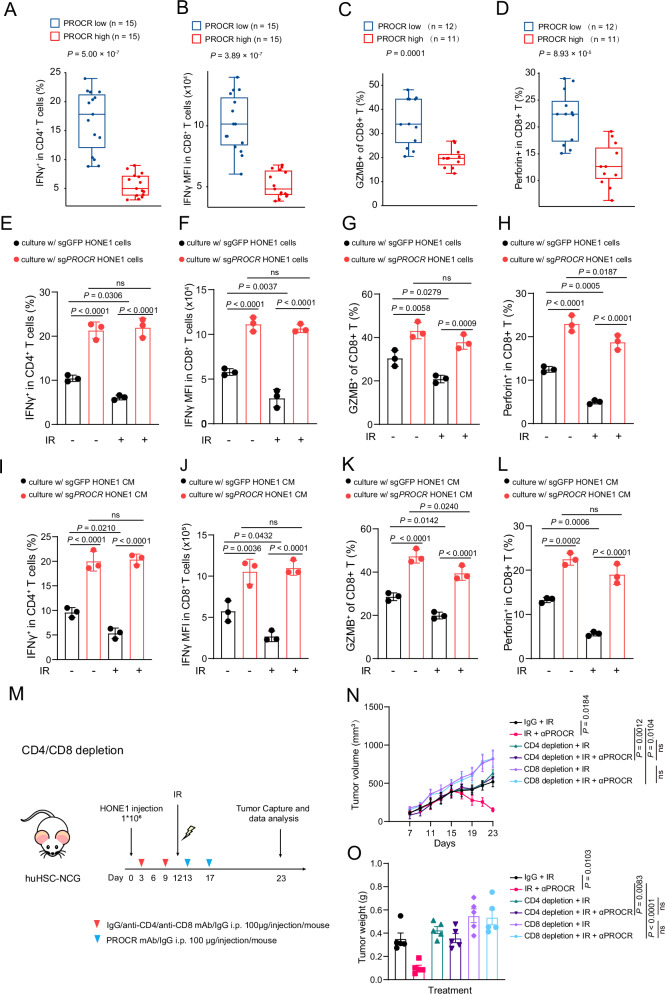
T cell dependent anti-tumour immunity reprogrammed by radiotherapy is critical for its efficacy. However, the mechanisms by which tumour cells hinder this process remain poorly understood. Here, we show that tumour cells expressing protein C receptor (PROCR) dampen antitumour immunity by promoting the production of interleukin-6 (IL-6), which inhibits the differentiation of T helper 1 (Th1) cells and suppresses the function of CD8 T cells. We also demonstrate that radiation therapy enhances PROCR expression by reducing its selective autophagic degradation through the modulation of p62 phosphorylation, a process governed by mTORC1 signalling. This suggests that PROCR upregulation is an intrinsic cellular response to radiation. Targeting PROCR or IL-6 improves the efficacy of radiotherapy in preclinical models, including humanized mice and immunocompetent mice. In patients with nasopharyngeal carcinoma, higher PROCR expression correlates with reduced Th1 cell infiltration and worse functional state of CD8 T cells. Meanwhile, elevated levels of PROCR or IL-6 are associated with reduced responsiveness to radiotherapy. These findings identify PROCR as a key immunosuppressive factor linked to radiotherapy resistance and highlight its potential as a therapeutic target to enhance treatment outcomes.
放疗重编程的T细胞依赖性抗肿瘤免疫对其疗效至关重要。然而,肿瘤细胞阻碍这一过程的机制仍知之甚少。在这里,我们表明,表达蛋白C受体(PROCR)的肿瘤细胞通过促进白细胞介素-6(IL-6)的产生来抑制抗肿瘤免疫,IL-6会抑制辅助性T细胞1(Th1)的分化并抑制CD8 T细胞的功能。我们还证明,放射治疗通过调节p62磷酸化来减少PROCR的选择性自噬降解,从而增强PROCR表达,这一过程由mTORC1信号传导控制。这表明PROCR上调是细胞对辐射的一种内在反应。在临床前模型(包括人源化小鼠和免疫活性小鼠)中,靶向PROCR或IL-6可提高放疗疗效。在鼻咽癌患者中,较高的PROCR表达与Th1细胞浸润减少和CD8 T细胞功能状态较差相关。同时,PROCR或IL-6水平升高与放疗反应性降低有关。这些发现确定PROCR是与放疗抗性相关的关键免疫抑制因子,并突出了其作为增强治疗效果的治疗靶点的潜力。