Yan Tiancai, Liu Ling, Li Yuxin, Qin Chunhui, Guan Haonan, Zhang Tong
Department of Radiology, The Fourth Hospital of Harbin Medical University, Harbin, China.
GE Healthcare, MR Research China, Beijing, China.
Front Oncol. 2025 Jul 21;15:1563073. doi: 10.3389/fonc.2025.1563073. eCollection 2025.
Lung-RADS ≥4A nodules require urgent intervention. Low-dose CT (LDCT), the primary screening tool, involves cumulative radiation exposure-critical for patients with serial scans. Oxygen-enhanced zero-echo time MRI (OE-ZTE-MRI) shows potential for lung nodule evaluation. However, its additive value when combined with CT radiomics and clinical factors for Lung-RADS ≥4A nodules remains unproven. This study aimed to develop a preoperative prediction model integrating OE-ZTE-MRI/CT radiomics and clinical factors for benign-malignant discrimination of Lung-RADS ≥4A nodules and compare its performance against single-modality models.
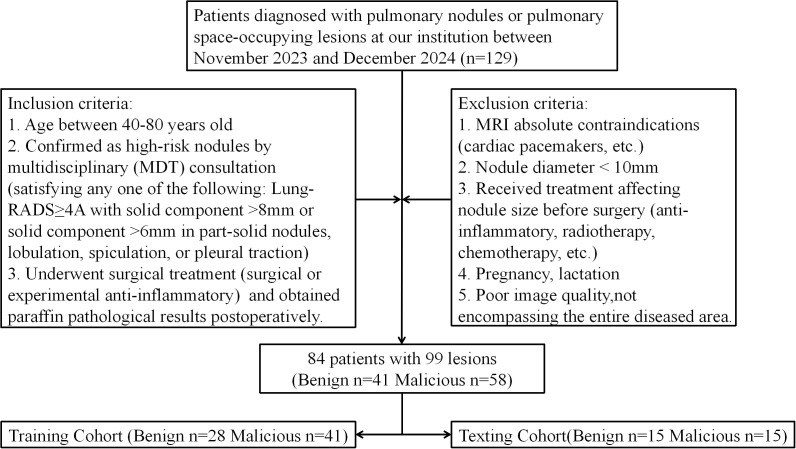
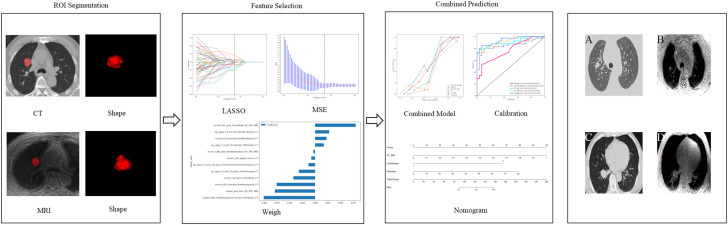
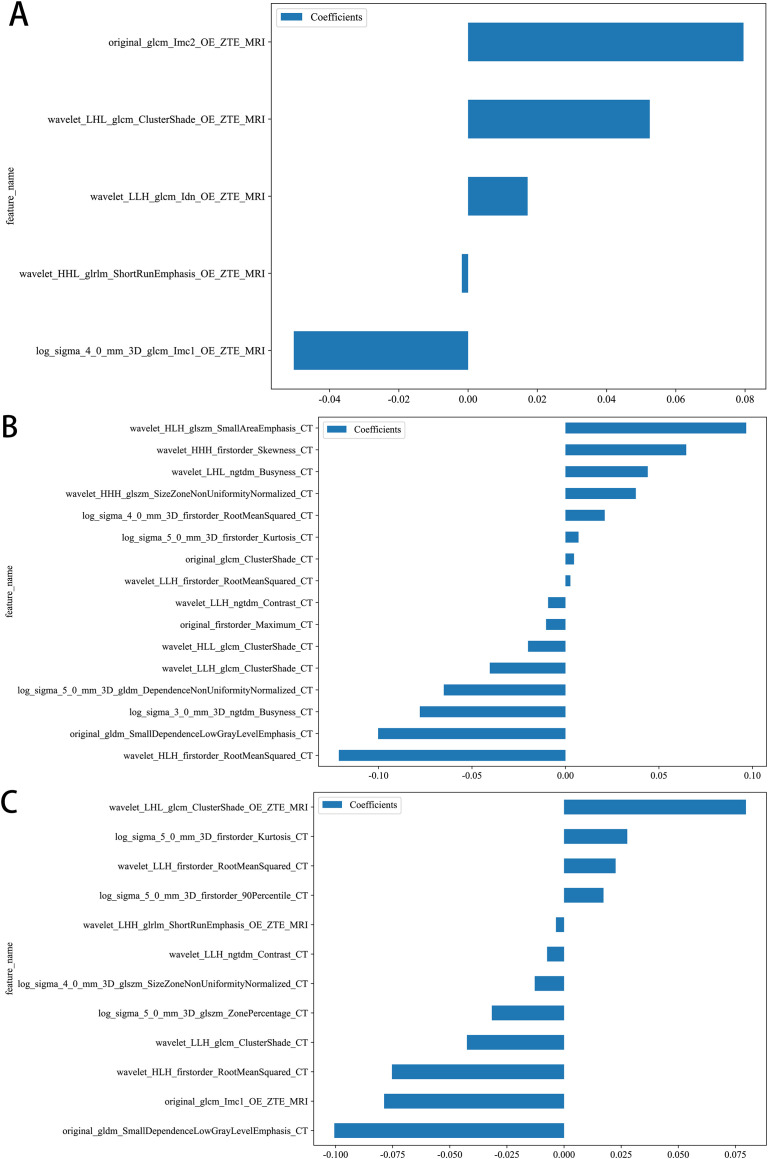
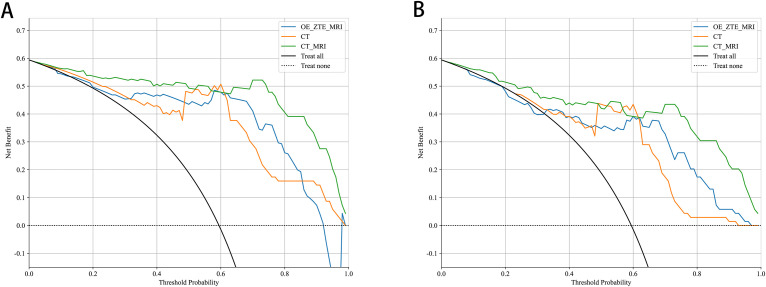
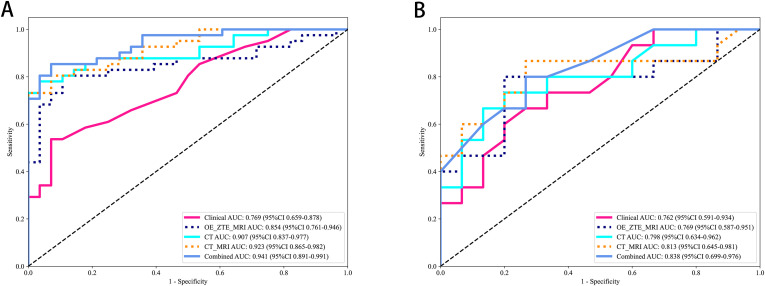
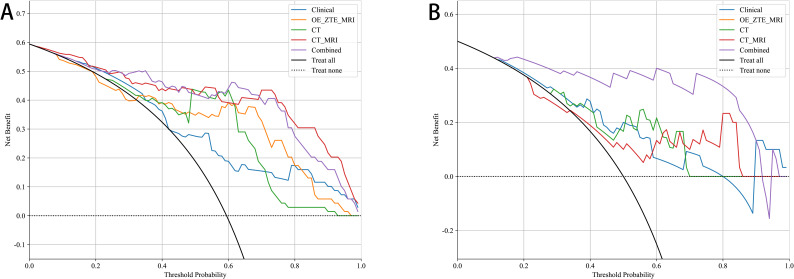
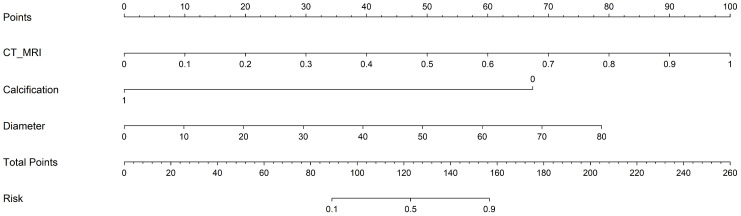
99 nodules from 84 prospectively enrolled patients undergoing both LDCT and OE-ZTE-MRI were included. Nodule boundaries were manually contoured as regions of interest (ROIs) on both modalities. Six machine learning classifiers were applied to radiomic features (extracted from LDCT and OE-ZTE-MRI) and clinical parameters (age, smoking history, nodule diameter, calcification, etc.). Model performance was evaluated using receiver operating characteristic (ROC) curves with area under the curve (AUC), complemented by decision curve analysis (DCA). Univariate and multivariate logistic regression identified independent predictors, which were incorporated into a final nomogram to visualize clinical-radiomic prediction.
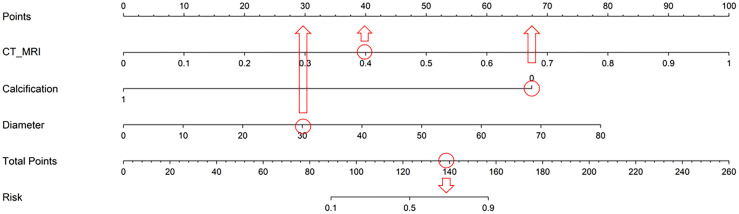
MRI model had a similar diagnostic performance to CT model (MRI . CT: training cohort AUC: 0.854 0.907; testing cohort AUC: 0.769 0.798). Multi-radiomics model achieved the highest diagnostic efficiency (train cohort AUC:0.923; testing cohort AUC: 0.813). Multivariate Logistic regression showed that nodule diameter (=0.005) and calcification (=0.029) were important factors affecting the benign and malignant nodules. The nomogram constructed by 3 models(CT/OE-ZTE-MRI/Clinical factors) achieved the best preoperative prediction performance for benign and malignant nodules (training cohort: AUC 0.941; testing cohort AUC:0.838).
The nomogram combining OE-ZTE-MRI/CT radiomics and clinical factors (nodule diameter, calcification) improves preoperative discrimination of Lung-RADS ≥4A nodules (AUC=0.838), outperforming single-modality models. This tool enables evidence-based triage, potentially reducing unnecessary invasive procedures.
Lung-RADS≥4A类结节需要紧急干预。低剂量CT(LDCT)作为主要的筛查工具,会使患者因多次扫描而累积接受辐射,这一点至关重要。氧增强零回波时间磁共振成像(OE-ZTE-MRI)显示出评估肺结节的潜力。然而,其与CT影像组学及临床因素相结合用于Lung-RADS≥4A类结节时的附加价值仍未得到证实。本研究旨在开发一种术前预测模型,该模型整合OE-ZTE-MRI/CT影像组学和临床因素,用于鉴别Lung-RADS≥4A类结节的良恶性,并将其性能与单模态模型进行比较。
纳入了84例前瞻性招募的同时接受LDCT和OE-ZTE-MRI检查患者的99个结节。在两种检查方式下均手动勾勒出结节边界作为感兴趣区域(ROI)。将六种机器学习分类器应用于影像组学特征(从LDCT和OE-ZTE-MRI中提取)以及临床参数(年龄、吸烟史、结节直径、钙化等)。使用带有曲线下面积(AUC)的受试者工作特征(ROC)曲线评估模型性能,并辅以决策曲线分析(DCA)。单因素和多因素逻辑回归确定独立预测因素,并将其纳入最终的列线图以可视化临床影像组学预测。
MRI模型的诊断性能与CT模型相似(MRI. CT:训练队列AUC:0.854 0.907;测试队列AUC:0.769 0.798)。多影像组学模型实现了最高的诊断效率(训练队列AUC:0.923;测试队列AUC:0.813)。多因素逻辑回归显示结节直径(=0.005)和钙化(=0.029)是影响结节良恶性的重要因素。由三种模型(CT/OE-ZTE-MRI/临床因素)构建的列线图对结节良恶性的术前预测性能最佳(训练队列:AUC 0.941;测试队列AUC:0.838)。
结合OE-ZTE-MRI/CT影像组学和临床因素(结节直径、钙化)的列线图可改善对Lung-RADS≥4A类结节的术前鉴别(AUC = 0.838),优于单模态模型。该工具可实现基于证据的分诊,可能减少不必要的侵入性操作。