Dosey Annie, Dadonaite Bernadeta, Gillespie Rebecca A, Leaf Elizabeth M, Vukovich Matthew J, McGowan Jackson, Grey Emily, Muramatsu Hiromi, Jun Rachel H J, Pardi Norbert, Kanekiyo Masaru, Bloom Jesse D, King Neil P
Department of Biochemistry, University of Washington; Seattle, WA 98195, USA.
Institute for Protein Design, University of Washington; Seattle, WA 98195, USA.
bioRxiv. 2025 Aug 2:2025.07.30.667762. doi: 10.1101/2025.07.30.667762.
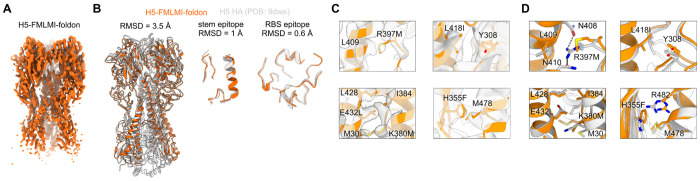
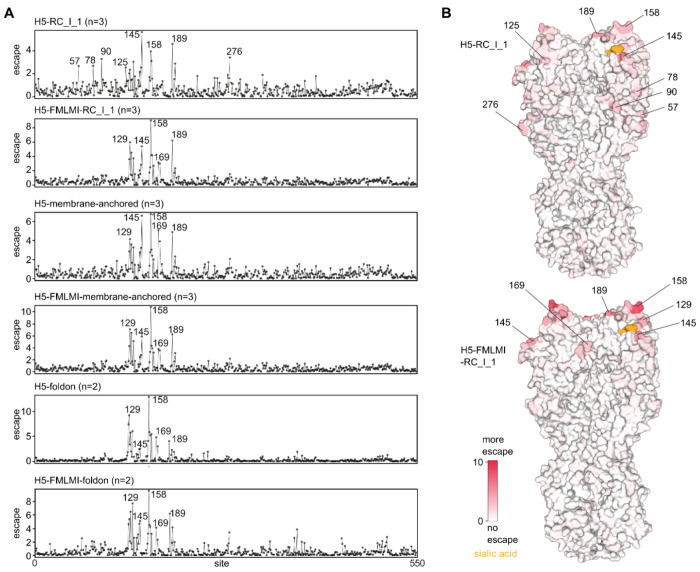
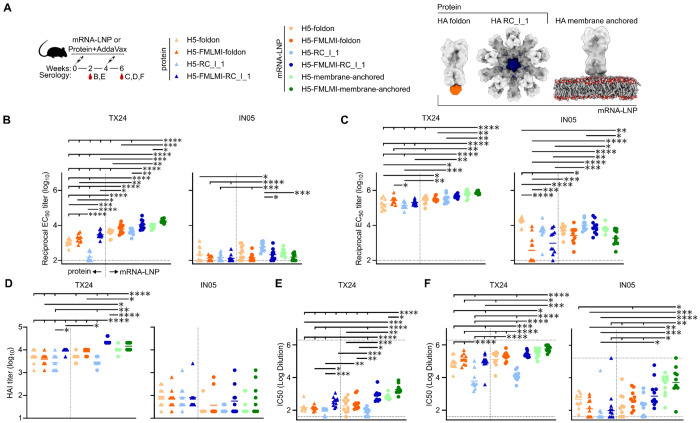
Transmission of highly pathogenic avian influenza from H5 clade 2.3.4.4b has expanded in recent years to infect large populations of birds and mammals, heightening the risk of a human pandemic. Influenza viruses adapted to transmission in birds and some other animals tend to have a less stable hemagglutinin (HA) than seasonal influenza viruses, enabling membrane fusion at comparatively high pH levels. Here, we combine five mutations within H5 HA that dramatically increase its melting temperature and promote stable closure of the HA trimer. Structural analysis by cryo-electron microscopy revealed that the stabilizing mutations create several new hydrophobic interactions, while maintaining local HA structure. We found that vaccinating mice with stabilized H5 HA immunogens resulted in higher hemagglutination inhibition and neutralization titers than non-stabilized comparators. Epitope mapping of vaccine-elicited polyclonal antibody responses using negative stain electron microscopy and deep mutational scanning showed that site E on the side of the HA receptor binding domain was immunodominant across all groups; however, the stabilized immunogens shifted responses toward the receptor binding site (RBS), eliciting a higher proportion of neutralizing antibodies. These findings highlight that H5 HA-stabilizing mutations enhance the quality of antibody responses across different vaccine formats, underscoring their potential to improve pandemic preparedness vaccines targeting viruses from this widely circulating clade.
近年来,源自H5进化分支2.3.4.4b的高致病性禽流感传播范围不断扩大,感染了大量鸟类和哺乳动物,增加了人类大流行的风险。与季节性流感病毒相比,适应在鸟类和其他一些动物中传播的流感病毒的血凝素(HA)往往不太稳定,能在相对较高的pH值水平下实现膜融合。在此,我们在H5 HA中组合了五个突变,这些突变显著提高了其解链温度,并促进了HA三聚体的稳定闭合。冷冻电子显微镜结构分析表明,这些稳定突变产生了几个新的疏水相互作用,同时保持了局部HA结构。我们发现,用稳定化的H5 HA免疫原给小鼠接种疫苗,其血凝抑制和中和效价比未稳定化的对照物更高。使用负染电子显微镜和深度突变扫描对疫苗引发的多克隆抗体反应进行表位作图表明,HA受体结合域一侧的E位点在所有组中都是免疫显性的;然而,稳定化免疫原使反应向受体结合位点(RBS)转移,引发了更高比例的中和抗体。这些发现突出表明,H5 HA稳定突变提高了不同疫苗形式下抗体反应的质量,强调了它们在改进针对这一广泛传播进化分支病毒的大流行防范疫苗方面的潜力。