Department of Biochemistry and Molecular Biology, Johns Hopkins Bloomberg School of Public Health, Baltimore, Maryland, USA.
W. Harry Feinstone Department of Molecular Microbiology and Immunology, Johns Hopkins Bloomberg School of Public Health, Baltimore, Maryland, USA.
mBio. 2022 Aug 30;13(4):e0183922. doi: 10.1128/mbio.01839-22. Epub 2022 Jul 20.
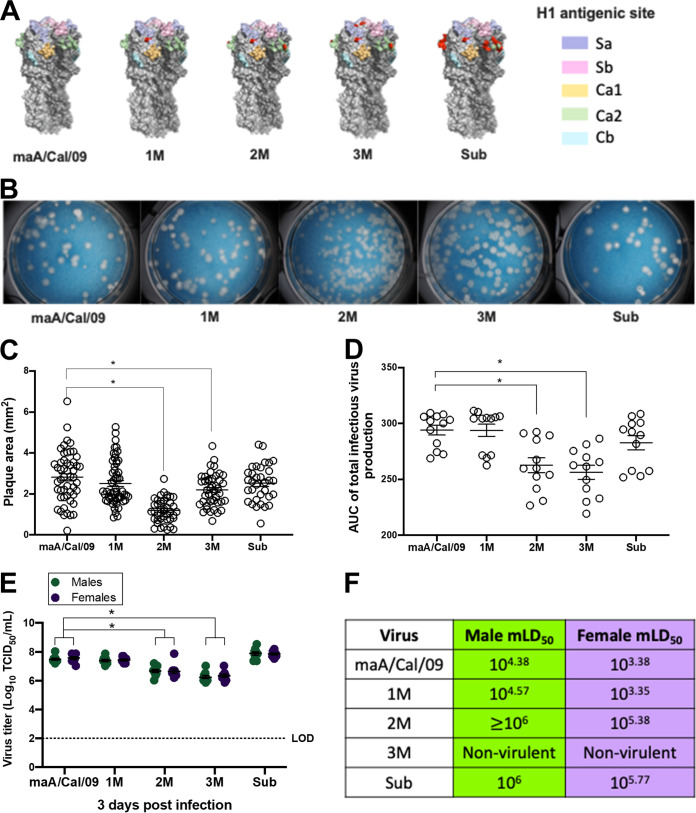
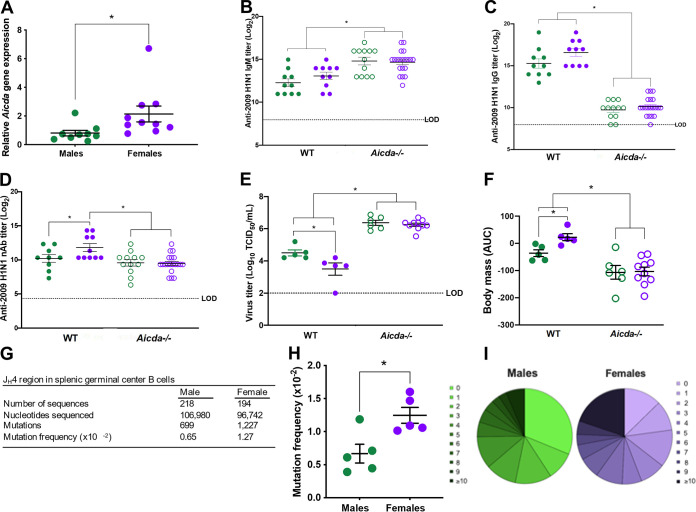
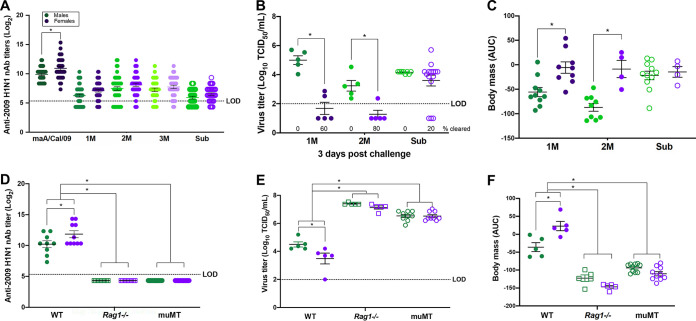
Inactivated influenza vaccines induce greater antibody responses in females than males among both humans and mice. To test the breadth of protection, we used recombinant mouse-adapted A/California/2009 (maA/Cal/09) H1N1 viruses containing mutations at one (1M), two (2M), or three (3M) antigenic sites, in addition to a virus containing the 1M mutation and a substitution of the Ca2 antigenic site (Sub) with one derived from an H5 hemagglutinin (HA) to challenge mice of both sexes. Following maA/Cal/09 vaccination, females produced greater virus-specific, class-switched total IgG and IgG2c antibodies against the vaccine and all mutant viruses, and antibodies from females recognized a greater number of unique, linear HA epitopes than did antibodies from males. While females had greater neutralizing antibody titers against the vaccine virus, both sexes showed a lower neutralization capacity against mutant viruses. After virus challenge, vaccinated females had lower pulmonary virus titers and reduced morbidity than males for the 1M and 2M viruses, but not the Sub virus. Females generated greater numbers of germinal center (GC) B cells containing superior somatic hypermutation (SHM) frequencies than vaccinated males. Deletion of activation-induced cytidine deaminase () eliminated female-biased immunity and protection against the 2M virus. Harnessing methods to improve GC B cell responses and frequencies of SHM, especially in males, should be considered in the development of universal influenza vaccines. Adult females develop greater antibody responses to influenza vaccines than males. We hypothesized that female-biased immunity and protection would be dependent on the extent of virus diversity as well as molecular mechanisms in B cells which constrain the breadth of epitope recognition. We developed a panel of mouse-adapted (ma) A/Cal/09 viruses that had mutations in the immunodominant hemagglutinin. Following vaccination against maA/Cal/09, females were better able to neutralize maA/Cal/09 than males, but neutralization of mutant maA/Cal/09 viruses was equally poor in both sexes, despite vaccinated females being better protected against these viruses. Vaccinated females benefited from the greater production of class-switched, somatically hypermutated antibodies generated in germinal center B cells, which increased recognition of more diverse maA/Cal/09 hemagglutinin antigen epitopes. Female-biased protection against influenza infection and disease after vaccination is driven by differential mechanisms in males versus females and should be considered in the design of novel vaccine platforms.
灭活流感疫苗在人类和小鼠中均能诱导女性产生比男性更强的抗体反应。为了测试保护范围,我们使用了含有一个(1M)、两个(2M)或三个(3M)抗原位点突变的重组小鼠适应 A/加利福尼亚/2009(maA/Cal/09)H1N1 病毒,此外还有一种病毒含有 1M 突变和 Ca2 抗原位点的替代物(Sub),该替代物来自 H5 血凝素(HA),以挑战雌雄小鼠。接种 maA/Cal/09 疫苗后,雌性产生了针对疫苗和所有突变病毒的更多病毒特异性、类别转换总 IgG 和 IgG2c 抗体,并且来自雌性的抗体识别了更多独特的线性 HA 表位,而来自雄性的抗体识别了更少的独特的线性 HA 表位。虽然女性对疫苗病毒的中和抗体滴度更高,但两性对突变病毒的中和能力都较低。接种疫苗后,雌性在肺部病毒滴度和发病率方面均低于雄性,对于 1M 和 2M 病毒,但对于 Sub 病毒则不然。雌性产生的含有更高体细胞超突变(SHM)频率的生发中心(GC)B 细胞数量多于接种疫苗的雄性。删除激活诱导的胞嘧啶脱氨酶()消除了雌性偏向性免疫和对 2M 病毒的保护。在开发通用流感疫苗时,应考虑改善 GC B 细胞反应和 SHM 频率的方法,特别是在男性中。