Liberati Francesca Romana, Spizzichino Sharon, Di Russo Sara, Borsatti Giulia Elizabeth, Riva Agnese, Magnifico Maria Chiara, Bouzidi Amani, Giardina Giorgio, Arese Marzia, Scribani Rossi Chiara, Boi Dalila, Boumis Giovanna, Di Fonzo Federica, Guarguaglini Giulia, Contestabile Roberto, Tramonti Angela, Macone Alberto, Paiardini Alessandro, Rinaldo Serena, Paone Alessio, Cutruzzolà Francesca
Department of Biochemical Sciences A. Rossi Fanelli, Sapienza University of Rome, Rome, Italy.
Translational Oncology Research Unit IRCCS Regina Elena National Cancer Institute, Rome, Italy.
Cell Death Discov. 2025 Aug 6;11(1):369. doi: 10.1038/s41420-025-02646-y.
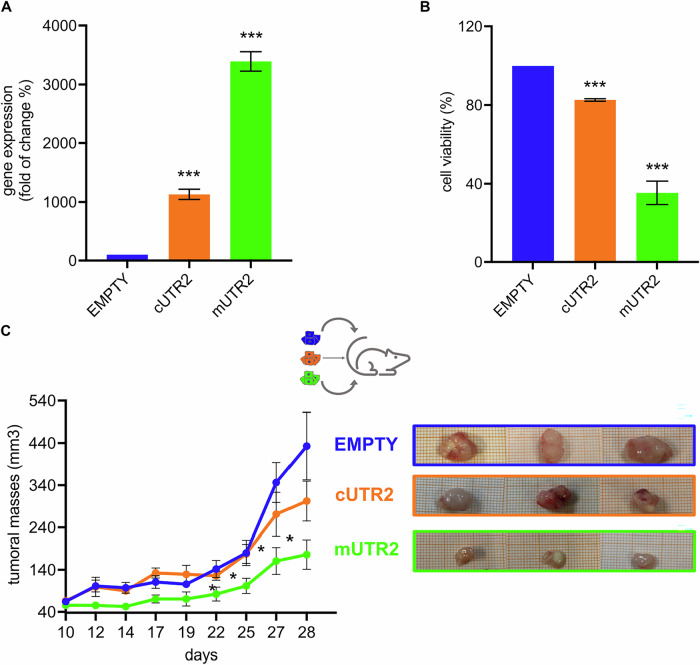
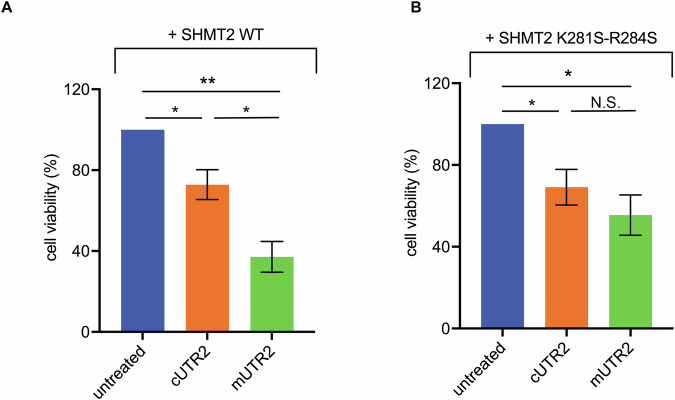
Targeting metabolic reprogramming is crucial for cancer treatment. Recent advances highlight RNA's ability to directly regulate enzyme activity through riboregulation. In this study, we used an RNA-based approach to inhibit the mitochondrial enzyme Serine hydroxymethyltransferase 2 (SHMT2), which lacks a selective in vivo inhibitor. SHMT2, often overexpressed in various cancers, is pivotal in one-carbon metabolism, a pathway vital for cell proliferation. Our results show that RNA effectively inhibits SHMT2's serine-to-glycine conversion in vitro (IC = 4.4 ± 0.2 nM). By using a mitochondrial import signal, we successfully delivered the inhibitory RNA into the mitochondria of lung cancer cells, reducing cell viability in vitro and tumor growth in vivo in a xenograft mouse model. These findings suggest that RNA-based strategies could be extended to selectively target other RNA-binding metabolic enzymes, offering potential solutions where small molecule inhibitors fall short or to counteract drug resistance.
靶向代谢重编程对癌症治疗至关重要。最近的进展凸显了RNA通过核糖调控直接调节酶活性的能力。在本研究中,我们采用基于RNA的方法抑制线粒体酶丝氨酸羟甲基转移酶2(SHMT2),该酶缺乏体内选择性抑制剂。SHMT2在多种癌症中常过度表达,在一碳代谢中起关键作用,一碳代谢是细胞增殖所必需的途径。我们的结果表明,RNA在体外能有效抑制SHMT2的丝氨酸向甘氨酸转化(IC = 4.4 ± 0.2 nM)。通过使用线粒体导入信号,我们成功地将抑制性RNA递送至肺癌细胞的线粒体中,在体外降低了细胞活力,并在异种移植小鼠模型中抑制了体内肿瘤生长。这些发现表明,基于RNA的策略可扩展至选择性靶向其他RNA结合代谢酶,为小分子抑制剂不足或对抗耐药性提供潜在解决方案。