Son Yejun, Lee Hyeri, Yu Seungyeong, Kim Hyeon Jin, Park Jaeyu, Woo Selin, Lee Hayeon, Fond Guillaume, Boyer Laurent, Rahmati Masoud, Smith Lee, López Sánchez Guillermo F, Dragioti Elena, Kang Jiseung, Kim Tae, Yon Dong Keon
Center for Digital Health, Medical Science Research Institute, Kyung Hee University College of Medicine, Seoul, South Korea.
Department of Precision Medicine, Kyung Hee University College of Medicine, Seoul, South Korea.
Syst Rev. 2025 Aug 6;14(1):160. doi: 10.1186/s13643-025-02902-3.
Photobiomodulation (PBM) is a non-invasive therapy increasingly used for pain, inflammation, and tissue repair, yet a comprehensive synthesis of its effectiveness across multiple health outcomes remains lacking. Herein, we aimed to systematically assess the clinical effects and strength of evidence for PBM across a wide range of health outcomes using data from existing meta-analyses of randomized controlled trials (RCTs).
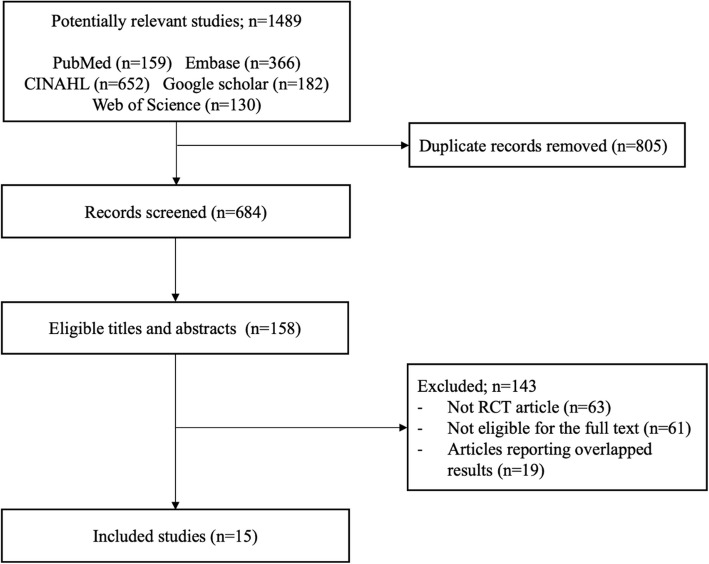
We conducted an umbrella review of meta-analyses of RCTs, searching five databases up to December 8, 2023. Two reviewers independently assessed methodological quality using AMSTAR 2 and evaluated certainty of evidence using a modified GRADE framework. Pooled effect sizes were recalculated as equivalent standardized mean differences (eSMD) with 95% confidence intervals (CI). The study was registered with PROSPERO (CRD42023495502).
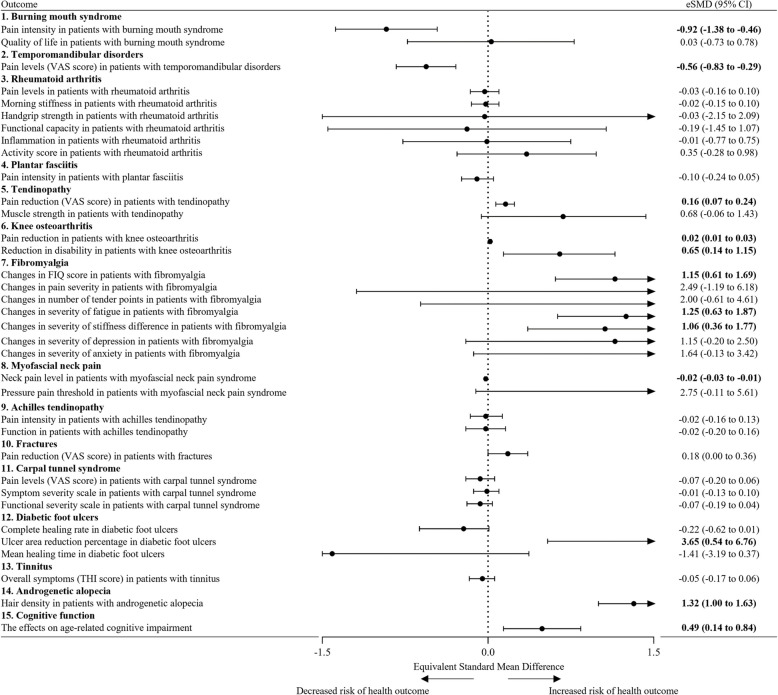
A total of 15 meta-analyses encompassing 204 RCTs and over 9000 participants were included, covering 35 health endpoints across 15 disease conditions. PBM showed significant effects for 12 outcomes, with moderate certainty of evidence supporting improvements in burning mouth syndrome (pain reduction, eSMD - 0.92 [95% CI - 1.38 to - 0.46]), knee osteoarthritis (disability, 0.65 [0.14 to 1.15]), fibromyalgia (fatigue, 1.25 [0.63 to 1.87]), androgenetic alopecia (hair density, 1.32 [1.00 to 1.63]), and cognitive function (0.49 [0.14 to 0.84]). Most other outcomes exhibited low or very low certainty due to heterogeneity or small-study effects. P-curve and funnel plot analyses indicated evidential value for several outcomes, though potential publication bias was identified in some.
PBM appeared beneficial for some health conditions, such as the strongest support for fibromyalgia, osteoarthritis-related disability, and cognitive impairment. However, given the overall low-to-moderate certainty of evidence for most endpoints, further high-quality trials and standardization of PBM protocols are warranted before widespread clinical adoption.
光生物调节(PBM)是一种越来越多地用于治疗疼痛、炎症和组织修复的非侵入性疗法,但目前仍缺乏对其在多种健康结局方面有效性的全面综合分析。在此,我们旨在利用现有随机对照试验(RCT)的荟萃分析数据,系统评估PBM在广泛健康结局方面的临床效果和证据强度。
我们对RCT的荟萃分析进行了一项汇总分析,检索了截至2023年12月8日的五个数据库。两名评审员使用AMSTAR 2独立评估方法学质量,并使用改良的GRADE框架评估证据的确定性。合并效应量重新计算为等效标准化均数差(eSMD),并给出95%置信区间(CI)。该研究已在PROSPERO(CRD42023495502)注册。
共纳入15项荟萃分析,涉及204项RCT和9000多名参与者,涵盖15种疾病状况下的35个健康终点。PBM对12项结局显示出显著效果,证据的确定性为中等,支持灼口综合征(疼痛减轻,eSMD -0.92 [95%CI -1.38至-0.46])、膝关节骨关节炎(功能障碍,0.65 [0.14至1.15])、纤维肌痛(疲劳,1.25 [0.63至1.87])、雄激素性脱发(毛发密度,1.32 [1.00至1.63])和认知功能(0.49 [0.14至0.84])的改善。由于异质性或小样本研究效应,大多数其他结局的证据确定性较低或非常低。P曲线和漏斗图分析表明了若干结局的证据价值,不过在一些分析中发现了潜在的发表偏倚。
PBM似乎对某些健康状况有益,例如对纤维肌痛、骨关节炎相关功能障碍和认知障碍的支持力度最强。然而,鉴于大多数终点的证据确定性总体较低至中等,在广泛临床应用之前,有必要进行进一步的高质量试验并规范PBM方案。