Yamaguchi Satoshi, Foo Jerome Clifford, Sasaki Tsukasa
Department of Physical and Health Education, Graduate School of Education The University of Tokyo Tokyo Japan.
Unit for Mental Health Promotion Research Center for Social Science & Medicine, Tokyo Metropolitan Institute of Medical Science Tokyo Japan.
PCN Rep. 2025 Aug 5;4(3):e70168. doi: 10.1002/pcn5.70168. eCollection 2025 Sep.
School teachers are expected to support students with mental health problems. However, few studies have examined actual helping behaviors of teachers for the students. This study aimed to investigate the behaviors of Japanese teachers for students experiencing internalizing problems (e.g., depression/anxiety).
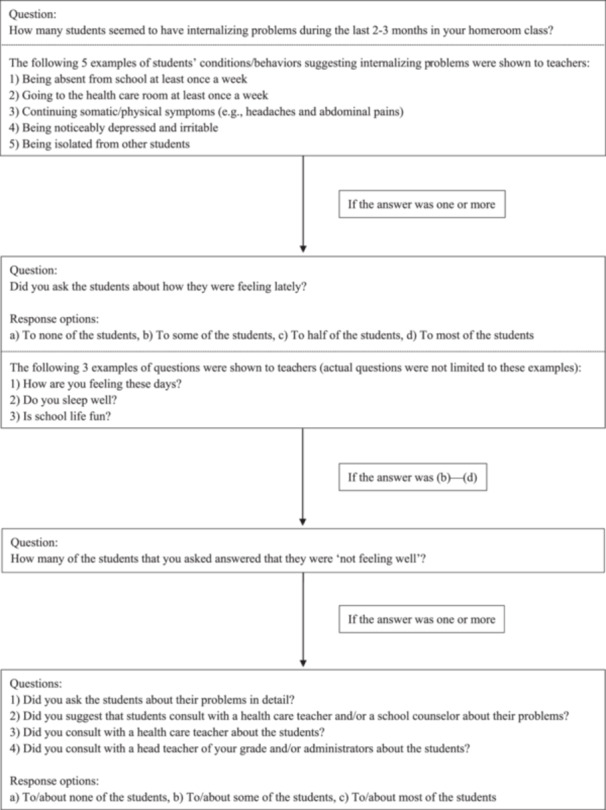
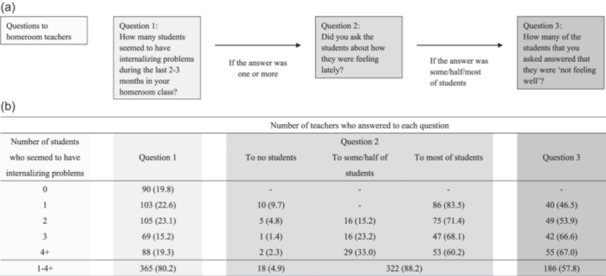
In 2020, teachers ( = 465) from 48 Japanese schools (primary/junior high/senior high) answered a self-administered questionnaire asking about: (a) the number of students in their homeroom class who seemed to have internalizing problems during the last 2-3 months, (b) whether they asked these students how they had been feeling lately, and (c) the number of students who answered "not feeling well." Mental health literacy (MHL) in teachers was also assessed.
Most of the teachers (80.2%) reported that they dealt with one or more students who seemed to have internalizing problems during the last 2-3 months. Among these teachers, 94.7% had asked at least some of the students how they had been feeling, and over half of the teachers (57.8%) reported that at least one of the students answered "not feeling well." Teachers who had confidence in helping students with depressive symptoms were more likely to recognize students who were "not feeling well" ( = 0.04).
Teachers appear to be willing to help students with mental health problems when they recognize symptoms of the problems. Future studies will benefit from more closely examining whether improving confidence in teachers through MHL training increases students' willingness to disclose mental health problems to teachers, an important step in the prevention/treatment of these problems.
学校教师应支持有心理健康问题的学生。然而,很少有研究考察教师对学生的实际帮助行为。本研究旨在调查日本教师对有内化问题(如抑郁/焦虑)学生的行为。
2020年,来自48所日本学校(小学/初中/高中)的465名教师回答了一份自填式问卷,问卷内容包括:(a)在过去2至3个月里,他们所教班级中似乎有内化问题的学生人数;(b)他们是否询问过这些学生最近的感受;(c)回答“感觉不舒服”的学生人数。还评估了教师的心理健康素养(MHL)。
大多数教师(80.2%)报告说,在过去2至3个月里,他们应对过一名或多名似乎有内化问题的学生。在这些教师中,94.7%至少询问过一些学生的感受,超过一半的教师(57.8%)报告说至少有一名学生回答“感觉不舒服”。对帮助有抑郁症状学生有信心的教师更有可能识别出“感觉不舒服”的学生(P = 0.04)。
当教师识别出心理健康问题的症状时,他们似乎愿意帮助有这些问题的学生。未来的研究将受益于更密切地考察通过心理健康素养培训提高教师的信心是否会增加学生向教师披露心理健康问题的意愿,这是预防/治疗这些问题的重要一步。