Tsung Irene, Yentz Sarah E, Reichert Zachery R
Division of Hematology/Oncology, Department of Internal Medicine, University of Michigan, Ann Arbor, Michigan, USA.
Cancer. 2025 Aug 15;131(16):e70030. doi: 10.1002/cncr.70030.
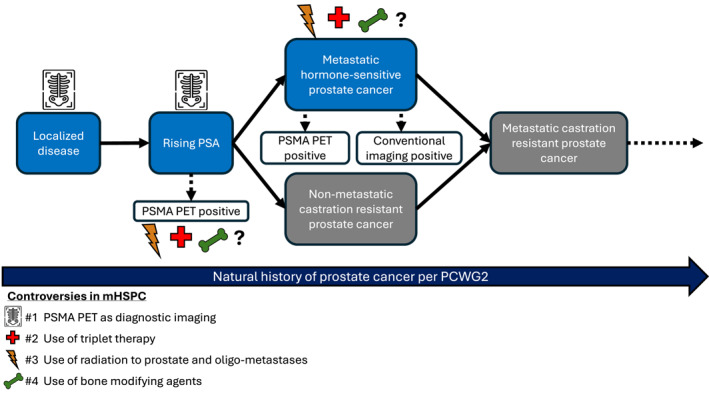
Metastatic hormone-sensitive prostate cancer (mHSPC) is an incurable phase of prostate cancer. Diagnostic tools and management strategies for this complex disease are expanding. Despite these advances, more therapies may not be the optimal approach for all patients. This review explores four major controversies surrounding mHSPC management-the role of prostate-specific membrane antigen positron emission tomography scans as diagnostic imaging, triplet therapy (androgen deprivation therapy, androgen receptor pathway inhibitor, and docetaxel chemotherapy), radiation to the prostate and/or oligo-metastases, and bone modifying agents. Critical evaluation of the data emphasizes the need for further work to determine which subgroups of patients with mHSPC benefit from each treatment. With a deeper understanding of these current issues, this review seeks to guide clinicians to refine their clinical practice to help patients achieve their best quantity and quality of life.
转移性激素敏感性前列腺癌(mHSPC)是前列腺癌的一个无法治愈的阶段。针对这种复杂疾病的诊断工具和管理策略正在不断扩展。尽管取得了这些进展,但更多的治疗方法可能并非对所有患者都是最佳选择。本综述探讨了围绕mHSPC管理的四个主要争议——前列腺特异性膜抗原正电子发射断层扫描作为诊断成像的作用、三联疗法(雄激素剥夺疗法、雄激素受体途径抑制剂和多西他赛化疗)、对前列腺和/或寡转移灶的放疗以及骨改良剂。对数据的批判性评估强调,需要进一步开展工作以确定mHSPC患者的哪些亚组能从每种治疗中获益。通过对这些当前问题的更深入理解,本综述旨在指导临床医生优化其临床实践,以帮助患者实现最佳的生活质量和数量。