Zhu Ziliang, Yang Yue, Samuel Tinu M, Li Tengfei, Yin Weiyan, Howell Brittany R, Cho Seoyoon, Hazlett Heather C, Elison Jed T, Zhu Hongtu, Sprenger Norbert, Lin Weili
Department of Biostatistics, University of North Carolina at Chapel Hill, Chapel Hill, NC, USA.
Nestlé Product Technology Center-Nutrition, Société Des Produits Nestlé S.A. Vevey, Vevey, Switzerland.
Sci Rep. 2025 Aug 7;15(1):28944. doi: 10.1038/s41598-025-13530-1.
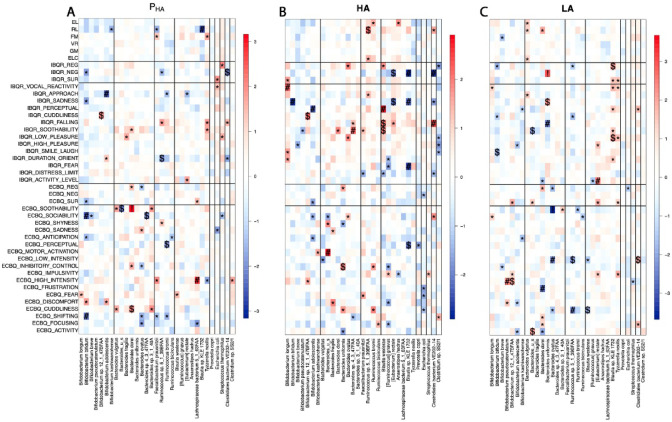
The presence of gut microbiota-brain-axis has been widely reported. However, few studies have focused on uncovering the potential associations during a time-period that our brain and gut microbiota undergo rapid maturation. We evaluated the potential associations between characteristics of gut microbiota and cognition and temperament using an accelerated longitudinal design in typically developing children over 0-3 years of age. Specifically, we extracted gut microbiota characteristics at three scale levels: diversity measures, microbial networks, and subject-wise longitudinal trajectory features, shedding light on how associations between cognition/temperament and gut microbiota may differ at global (diversity), ecological (microbial networks) and subject-wise levels. Our findings illustrated that associations between gut microbiota and temperament/cognition varied with the analytical approaches and highlighted differential gut microbial features in association with cognition and temperament traits-diversity measures and microbial networks largely with cognition while subject-wise trajectories with temperament. In addition, Ruminococcus bromii exhibited significant associations with cognitions spanning over multiple subdomains. Finally, the associations of gut microbiota with temperament and cognition converge on the potential interplay of language ability and social behaviors and highlight the importance of age-appropriate gut microbiota on early cognition/temperament development.
肠道微生物群-脑轴的存在已被广泛报道。然而,很少有研究关注在我们的大脑和肠道微生物群经历快速成熟的时间段内揭示潜在关联。我们采用加速纵向设计,对0至3岁的正常发育儿童评估肠道微生物群特征与认知和气质之间的潜在关联。具体而言,我们在三个尺度水平上提取肠道微生物群特征:多样性指标、微生物网络和个体纵向轨迹特征,从而揭示认知/气质与肠道微生物群之间的关联在全局(多样性)、生态(微生物网络)和个体水平上可能存在的差异。我们的研究结果表明,肠道微生物群与气质/认知之间的关联因分析方法而异,并突出了与认知和气质特征相关的不同肠道微生物特征——多样性指标和微生物网络主要与认知相关,而个体轨迹与气质相关。此外,布氏瘤胃球菌与多个子领域的认知表现出显著关联。最后,肠道微生物群与气质和认知的关联集中在语言能力和社会行为的潜在相互作用上,并突出了适合年龄的肠道微生物群对早期认知/气质发展的重要性。