Armon Natalie, Thompson Nora, DaJusta Daniel, Fuchs Molly, Ching Christina B
Department of Pediatric Urology, Nationwide Children's Hospital, Columbus, OH, United States.
Kidney and Urinary Tract Center, Nationwide Children's Hospital, Columbus, OH, United States.
Front Urol. 2023 Jan 27;3:1104597. doi: 10.3389/fruro.2023.1104597. eCollection 2023.
Gender inequities in medicine exist. Urology is a male dominated surgical specialty, with recent census data showing females represent only 10.9% of the workforce. We aimed to characterize the composition of female pediatric urologists across the Societies for Pediatric Urology (SPU) pediatric urology fellowship accredited programs, with particular attention to academic promotion and leadership positions.
In January 2023, we reviewed the official websites of the 27 pediatric urology programs listed on the SPU website as fellowship accredited programs. We identified pediatric urology surgery attendings, their gender, academic title, and if they were named a director of an internal program or had a hospital leadership position. We identified the program chief and fellow/resident program director. This data was associated with years in practice.
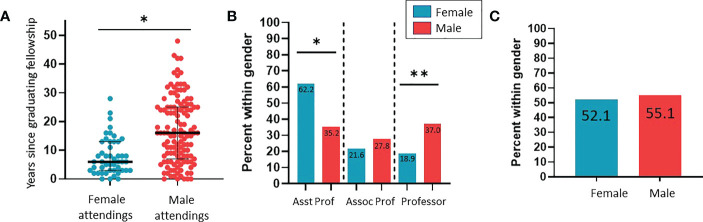
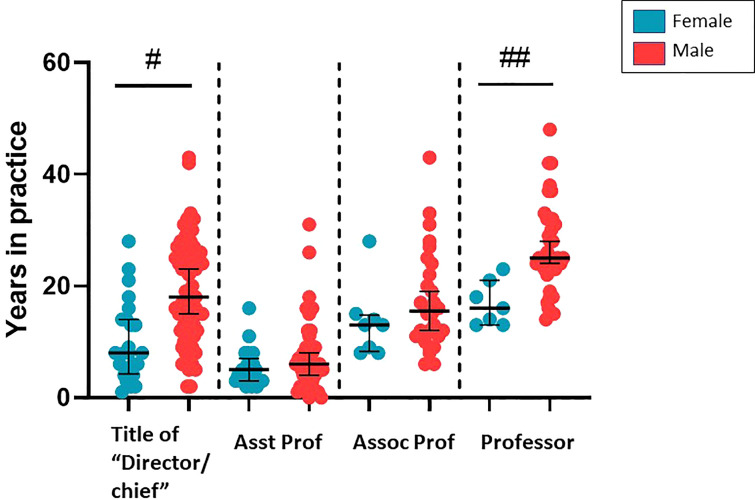
Females represented 27.4% of pediatric urology surgical attendings. Four programs (14.8%) had no female attendings. Female staff were in practice a median shorter time than that of males (6 vs. 16 years, p<0.0001). A significantly higher proportion of females were assistant professors (62.2 vs. 35.2%; p=0.0041) while a significantly higher proportion of men were professors (37.0 vs. 18.9%; p=0.0421). Only one program (3.7%) had a female department/division chief. There was no difference between genders regarding being named a director of a program and/or having an identified hospital position of leadership. Female professors had been in practice a significantly shorter time than male professors (p=0.0003); women with an internal or hospital leadership position had also been in practice a significantly shorter time than males (p<0.001).
Females are represented more in SPU pediatric urology fellowship accredited programs than the overall urology workforce. Fewer female attendings are professors compared to male attendings; however, differences in promotion could be impacted by female attendings being earlier in their career. Hopefully with time, we will see more equal representation amongst genders in pediatric urology programs overall, but especially where we are training the next generation.
医学领域存在性别不平等现象。泌尿外科是一个男性主导的外科专业,最近的人口普查数据显示,女性仅占该领域劳动力的10.9%。我们旨在描述小儿泌尿外科女性医生在小儿泌尿外科协会(SPU)认可的小儿泌尿外科 fellowship 项目中的构成情况,尤其关注学术晋升和领导职位。
2023年1月,我们查阅了SPU网站上列为fellowship认可项目的27个小儿泌尿外科项目的官方网站。我们确定了小儿泌尿外科手术主治医师、他们的性别、学术职称,以及他们是否被任命为内部项目主任或担任医院领导职位。我们确定了项目负责人以及研究员/住院医师项目主任。这些数据与从业年限相关。
女性占小儿泌尿外科手术主治医师的27.4%。四个项目(14.8%)没有女性主治医师。女性员工的从业时间中位数比男性短(6年对16年,p<0.0001)。女性担任助理教授的比例显著更高(62.2%对35.2%;p=0.0041),而男性担任教授的比例显著更高(37.0%对18.9%;p=0.0421)。只有一个项目(3.7%)有女性科室主任。在被任命为项目主任和/或拥有确定的医院领导职位方面,性别之间没有差异。女性教授的从业时间明显短于男性教授(p=0.0003);担任内部或医院领导职位的女性的从业时间也明显短于男性(p<0.001)。
在SPU认可的小儿泌尿外科fellowship项目中,女性的占比高于泌尿外科劳动力的总体水平。与男性主治医师相比,女性担任教授的人数较少;然而,晋升方面的差异可能受到女性主治医师处于职业生涯早期的影响。希望随着时间的推移,我们能在小儿泌尿外科项目中看到性别之间更平等的代表比例,尤其是在我们培养下一代的地方。