Cruz-Cano Raul, Payne-Sturges Devon C
Department of Epidemiology & Biostatistics, School of Public Health, Indiana University, Bloomington, Indiana, United States of America.
Department of Global, Environmental, and Occupational Health, University of Maryland School of Public Health, College Park, Maryland, United States of America.
PLoS One. 2025 Aug 8;20(8):e0329130. doi: 10.1371/journal.pone.0329130. eCollection 2025.
During the COVID-19 pandemic, migrant and seasonal farmworkers were deemed essential due to their central roles in US agricultural operations. However, employer-provided housing and transportation conditions increased their risks of SARS-CoV-2 exposure, and some states implemented emergency temporary standards (ETSs) at the insistence of farmworker advocates. Despite numerous studies examining the effectiveness of policy interventions (e.g., workplace closures) for mitigating SARS-CoV-2 transmission, limited research has specifically examined the effectiveness of interventions aimed at protecting farmworkers from COVID-19.
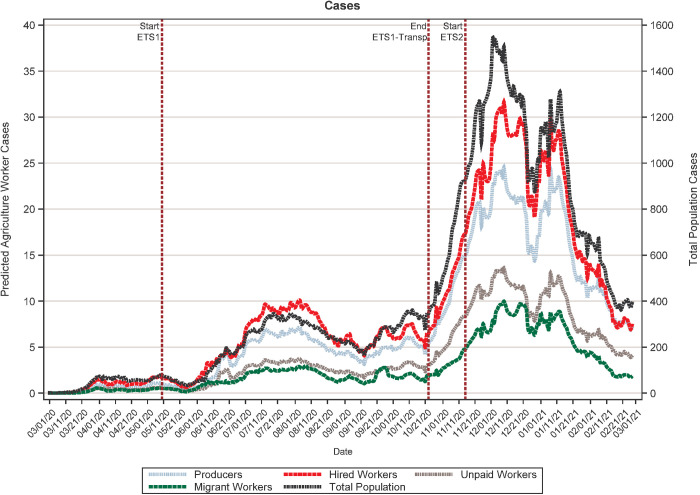
We used an interrupted time series analysis to estimate how two ETSs and one executive order issued in Oregon impacted COVID-19 trends from March 1, 2020, to February 27, 2021, for the overall population and among agricultural labor groups in Oregon.
Our models show that the ETS and executive order, which specifically targeted farmworker housing, transportation, and worksites, did not demonstrate any significant effects on the numbers of COVID-19 cases or associated deaths. However, the other ETS, which targeted all workplaces, was associated with statistically significant decreases in COVID-19 cases among the general population (-142.36214, p-value<0.0001), producers (-1.67128, p-value = 0.0009), hired workers (-2.39413, p-value = 0.0014), unpaid workers (-1.01572, p-value = 0.0003), and migrant workers (-0.60017, p-value = 0.0166). None of the three policy changes were found to have any statistically significant impacts on the numbers of COVID-19-associated deaths.
The ETS targeting all workplaces was more effective for reducing COVID-19 transmission than the ETS or executive order specifically targeting farmworkers, indicating that the design, communication, and implementation of ETSs targeting farmworkers should be re-evaluated.
在新冠疫情期间,移民和季节性农场工人因其在美国农业运营中的核心作用而被视为必不可少的劳动力。然而,雇主提供的住房和交通条件增加了他们感染新冠病毒的风险,一些州在农场工人倡导者的坚持下实施了紧急临时标准(ETS)。尽管有许多研究考察了政策干预措施(如工作场所关闭)对减轻新冠病毒传播的有效性,但专门研究旨在保护农场工人免受新冠疫情影响的干预措施有效性的研究却很有限。
我们采用中断时间序列分析来估计俄勒冈州发布的两项紧急临时标准和一项行政命令对2020年3月1日至2021年2月27日期间俄勒冈州总人口以及农业劳工群体中新冠疫情趋势的影响。
我们的模型显示,专门针对农场工人住房、交通和工作场所的紧急临时标准和行政命令,对新冠病例数或相关死亡人数没有显示出任何显著影响。然而,另一项针对所有工作场所的紧急临时标准与普通人群(-142.36214,p值<0.0001)、生产者(-1.67128,p值 = 0.0009)、雇佣工人(-2.39413,p值 = 0.0014)、无薪工人(-1.01572,p值 = 0.0003)和移民工人(-0.60017,p值 = 0.0166)中新冠病例数的统计学显著下降相关。未发现这三项政策变化对新冠相关死亡人数有任何统计学显著影响。
针对所有工作场所的紧急临时标准在减少新冠病毒传播方面比专门针对农场工人的紧急临时标准或行政命令更有效,这表明应重新评估针对农场工人的紧急临时标准的设计、宣传和实施。