Yamamoto Hitoshi, Okada Isamu, Suzuki Takahisa
Department of Business Administration, Rissho University, Tokyo, Japan.
Department of Business Administration, Soka University, Tokyo, Japan.
PLoS One. 2025 Aug 8;20(8):e0329742. doi: 10.1371/journal.pone.0329742. eCollection 2025.
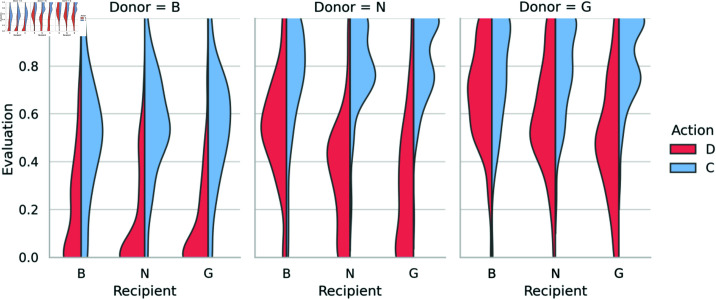
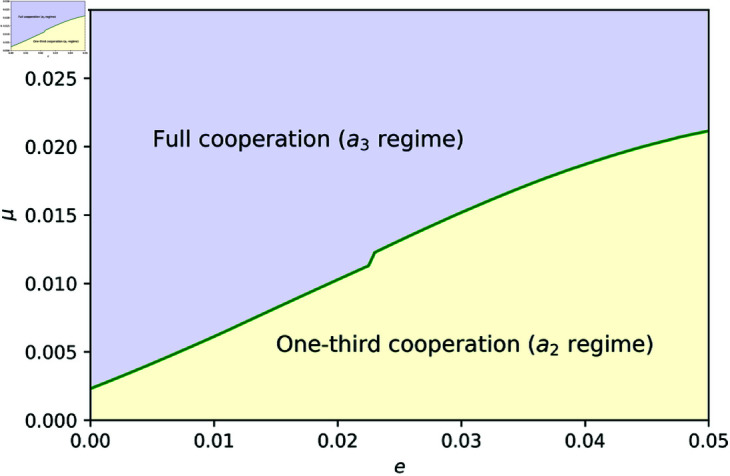
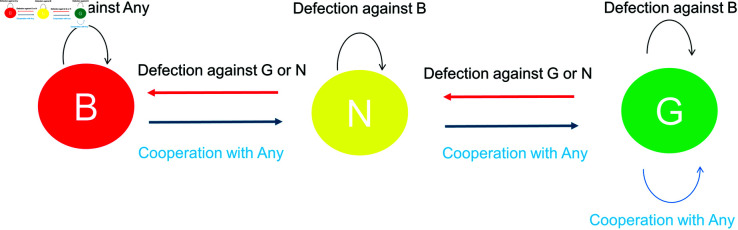
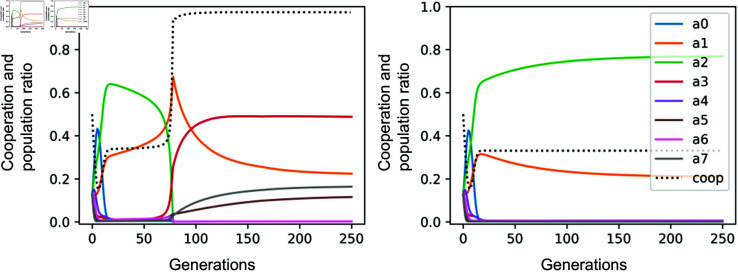
Humans have achieved widespread cooperation, largely sustained by mechanisms such as indirect reciprocity, which relies on reputation and social norms. People are highly motivated to maintain a good reputation, and social norms play a critical role in reputation systems by defining acceptable behavior, helping prevent exploitation by free-riders. However, there is a gap between theory and experiment in handling reputation information, with experiments often failing to capture the complexity that theoretical models propose. Here, we address two key issues: what kind of information is needed to define reputation as a social norm and the appropriate level of granularity required for reputation information to function effectively. This paper combines scenario-based experiments and evolutionary game theory to investigate the social norms individuals adopt in real-world settings, aiming to uncover the stability of these norms. Our results show that reputations should be categorized into three levels good, neutral, and bad. Results suggest gradual reputation dynamics that increase and decrease gradually due to cooperation or defection. However, a person's reputation remains unchanged only when they defect against a bad reputation. Our experimental and theoretical results support critical insights into the dynamics of reputation and social norms within indirect reciprocity, challenging traditional binary reputational evaluations. The gradual nature of reputation updating and the use of nuanced evaluations provide a more realistic model of reputation dynamics.
人类已经实现了广泛的合作,很大程度上是由间接互惠等机制维持的,间接互惠依赖于声誉和社会规范。人们有很强的动力去维护良好的声誉,而社会规范在声誉系统中起着关键作用,它通过定义可接受的行为,帮助防止搭便车者的剥削。然而,在处理声誉信息方面,理论与实验之间存在差距,实验往往无法捕捉理论模型所提出的复杂性。在这里,我们解决两个关键问题:将声誉定义为一种社会规范需要什么样的信息,以及声誉信息有效发挥作用所需的适当粒度水平。本文结合基于场景的实验和进化博弈论,研究个体在现实世界环境中采用的社会规范,旨在揭示这些规范的稳定性。我们的结果表明,声誉应分为三个等级:好、中、差。结果表明,由于合作或背叛,声誉动态会逐渐增加或减少。然而,只有当一个人背叛一个坏名声的人时,他的声誉才会保持不变。我们的实验和理论结果支持了对间接互惠中声誉和社会规范动态的关键见解,挑战了传统的二元声誉评估。声誉更新的渐进性和细微差别评估的使用提供了一个更现实的声誉动态模型。