Ariyadamrongkwan Jutharat, Satitsri Saravut, Khumjiang Rungtiwa, Muanprasat Chatchai
Chakri Naruebodindra Medical Institute, Faculty of Medicine Ramathibodi Hospital, Mahidol University, Bang Phli, Samut Prakarn, Thailand.
Program in Translational Medicine, Faculty of Medicine Ramathibodi Hospital, Mahidol University, Bangkok, Thailand.
Sci Rep. 2025 Aug 10;15(1):29265. doi: 10.1038/s41598-025-14516-9.
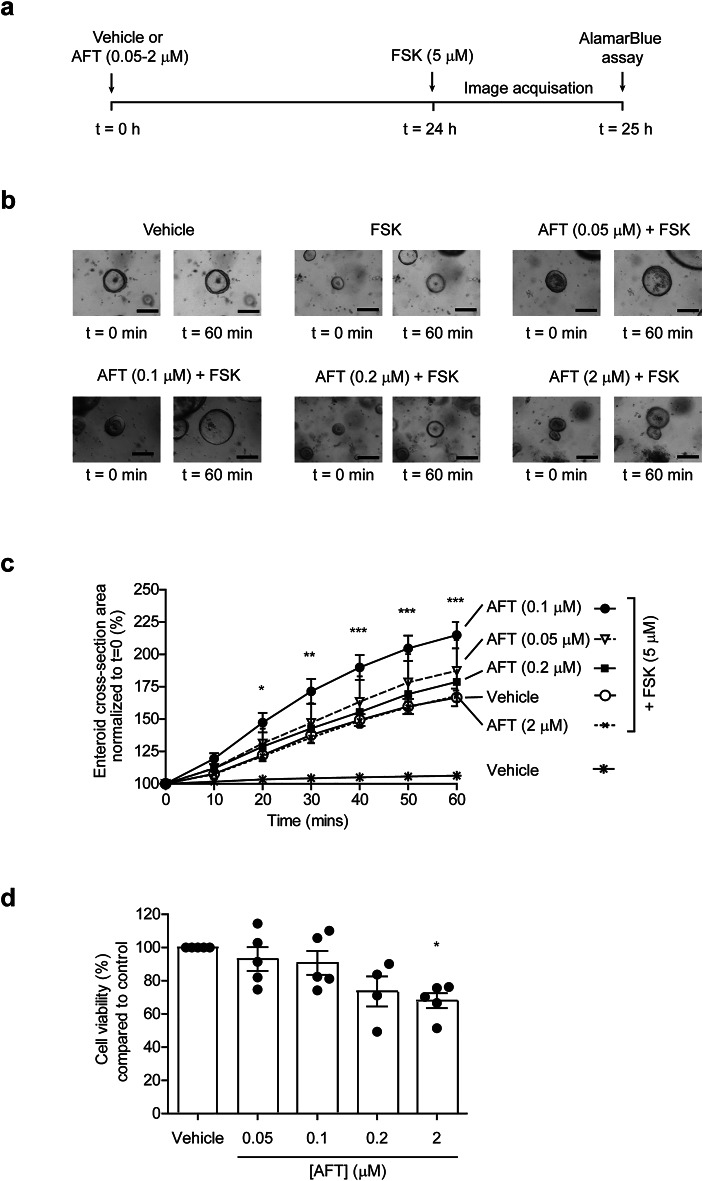
Afatinib is an effective treatment of metastatic non-small cell lung cancer, despite the occurrence of its common gastrointestinal toxicities especially diarrheas, which lead to dose adjustments or treatment cessation in severe cases. Underlying mechanisms of afatinib-induced diarrheas under prolonged treatment remain elusive. This study aimed to investigate mechanisms involved in the afatinib-induced fluid secretion in three-dimensional (3D) mouse mini-gut models under prolonged treatment (24 h). The swelling assay, qRT-PCR, and immunoblotting experiments were performed. Our results showed that afatinib amplified the cAMP-induced fluid secretion by 2 folds by mechanisms requiring TMEM16A and K7 channels via EPAC-calcium-dependent pathways. Additionally, afatinib treatment increased K7.1 and NKCC1 expression. Interestingly, afatinib induced secretory cell differentiation and upregulation of Paneth cell markers. Treatment with a PI3K inhibitor mimicked the effect of afatinib on increasing expression of membrane transporters and secretory lineage cell markers with no additive effect being observed after combination with afatinib, suggesting that the observed effect of afatinib was via PI3K inhibition. Collectively, our results indicate that prolonged afatinib treatment enhances cAMP-induced fluid secretion by mechanisms involving EPAC-TMEM16A-K7.1-mediated fluid secretion and secretory cell differentiation in 3D mouse mini-gut models. The EPAC-TMEM16A-K7.1-mediated fluid secretion represents a promising therapeutic target for treating afatinib-induced diarrheas.
阿法替尼是转移性非小细胞肺癌的一种有效治疗方法,尽管会出现常见的胃肠道毒性,尤其是腹泻,严重时会导致剂量调整或治疗中断。长期治疗下阿法替尼诱导腹泻的潜在机制仍不清楚。本研究旨在探讨长期治疗(24小时)下三维(3D)小鼠微型肠道模型中阿法替尼诱导液体分泌的机制。进行了肿胀试验qRT-PCR和免疫印迹实验。我们的结果表明,阿法替尼通过需要TMEM16A和K7通道的机制,经由EPAC-钙依赖性途径使cAMP诱导的液体分泌增加了2倍。此外,阿法替尼治疗增加了K7.1和NKCC1的表达。有趣的是,阿法替尼诱导分泌细胞分化并上调潘氏细胞标志物。用PI3K抑制剂治疗模拟了阿法替尼对增加膜转运蛋白和分泌谱系细胞标志物表达的作用,与阿法替尼联合使用后未观察到相加效应,这表明阿法替尼的观察到的效应是通过PI3K抑制作用。总体而言,我们的结果表明,在3D小鼠微型肠道模型中,长期阿法替尼治疗通过涉及EPAC-TMEM16A-K7.1介导的液体分泌和分泌细胞分化的机制增强了cAMP诱导的液体分泌。EPAC-TMEM16A-K7.1介导的液体分泌是治疗阿法替尼诱导腹泻的一个有前景的治疗靶点。