Hu Ningning, Deng Yucheng, Ding Lujia, Men Lijun, Zhang Wenjun, Yin Ruixue
School of Mechatronic Engineering and Automation, Shanghai University, Shanghai, 200444, China.
Division of Biomedical Engineering, University of Saskatchewan, Saskatoon, SK, S7N 0W8, Canada.
Microsyst Nanoeng. 2025 Aug 12;11(1):149. doi: 10.1038/s41378-025-00975-7.
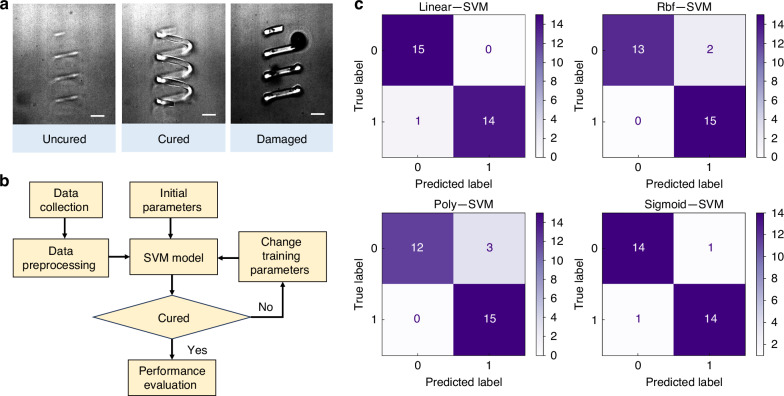
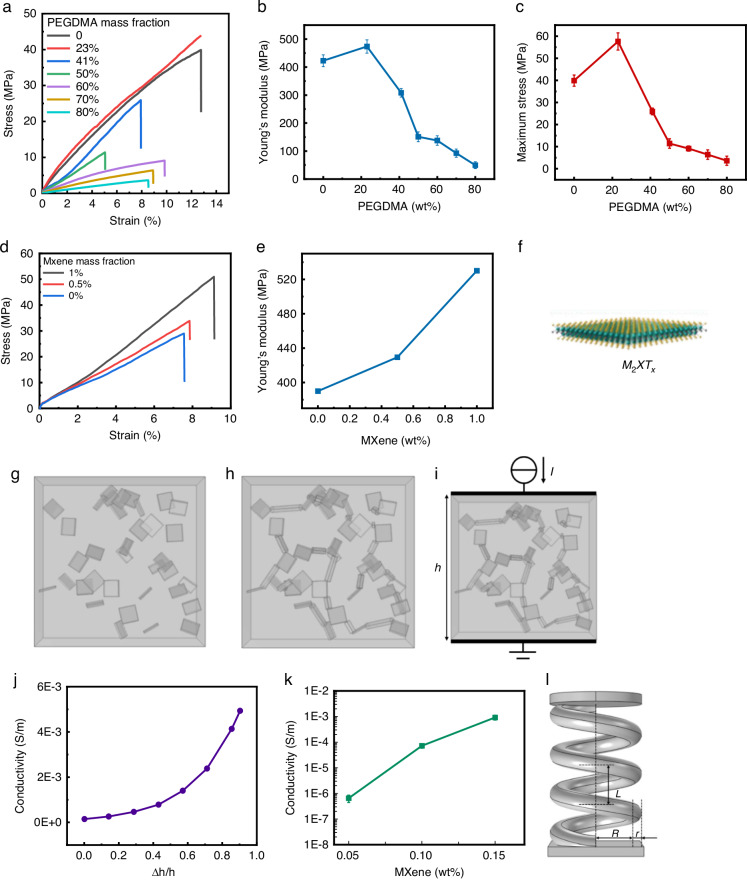
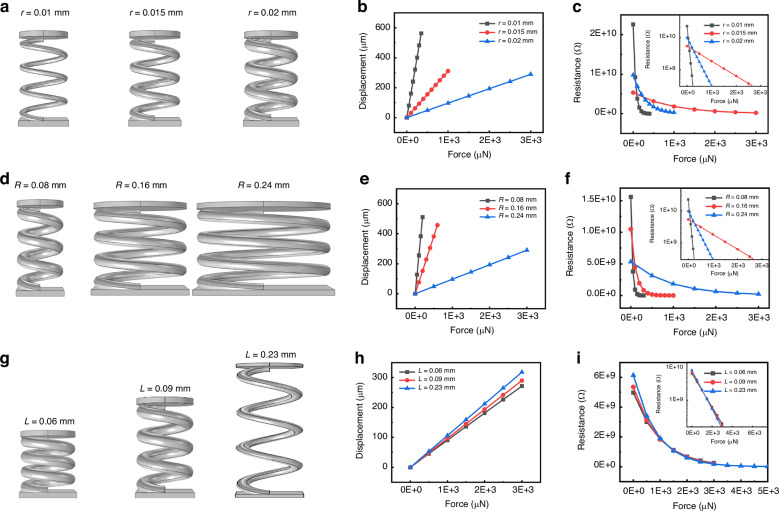
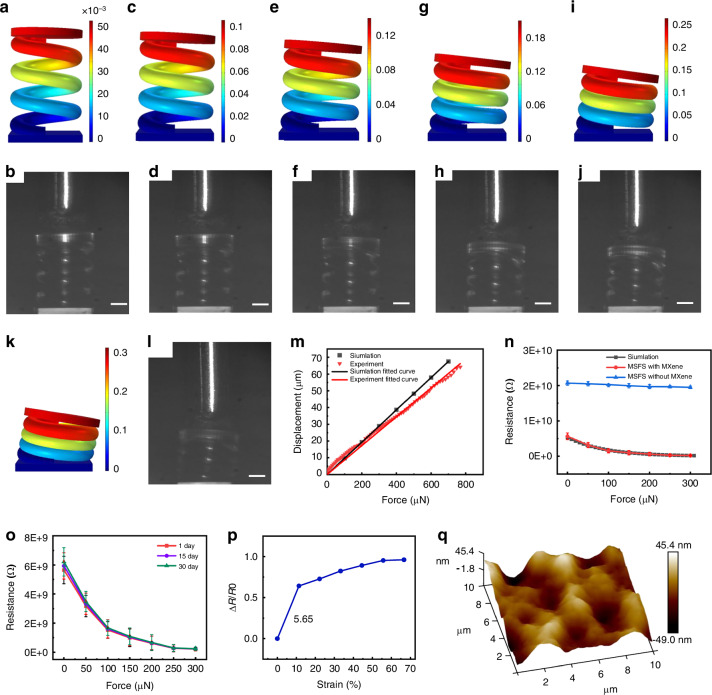
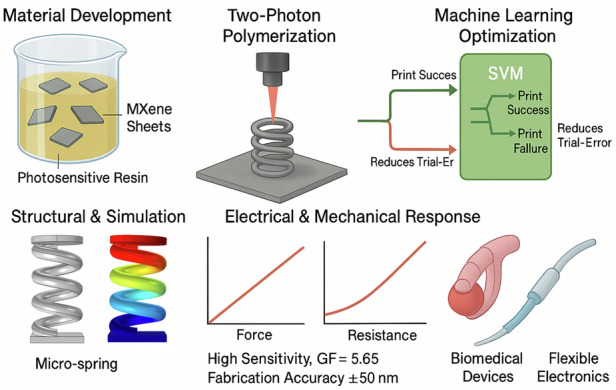
The rapid miniaturization of electronic devices has fueled unprecedented demand for flexible, high-performance sensors across fields ranging from medical devices to robotics. Despite advances in fabrication techniques, the development of micro- and nano-scale flexible force sensors with superior sensitivity, stability, and biocompatibility remains a formidable challenge. In this study, we developed a novel conductive photosensitive resin specifically designed for two-photon polymerization, systematically optimized its printing parameters, and improved its structural design, thereby enabling the fabrication of high-precision micro-spring force sensors (MSFS). The proposed photosensitive resin, doped with MXene nanomaterials, combines exceptional mechanical strength and conductivity, overcoming limitations of traditional materials. Using a support vector machine model in machine learning techniques, we optimized the polymerizability of the resin under varied laser parameters, achieving a predictive accuracy of 92.66%. This model significantly reduced trial-and-error in the TPP process, accelerating the discovery of ideal fabrication conditions. Finite element analysis was employed to design and simulate the performance of the MSFS, guiding structural optimization to achieve high sensitivity and mechanical stability. The fabricated MSFS demonstrated outstanding electromechanical performance, with a sensitivity coefficient of 5.65 and a fabrication accuracy within ±50 nm, setting a new standard for MSFS precision. This work not only pushes the boundaries of sensor miniaturization but also introduces a scalable, efficient pathway for the rapid design and fabrication of high-performance flexible sensors. The development of flexible, high-performance microscale force sensors remains a critical challenge for next-generation biomedical and wearable electronics. Here, we report a novel micro-spring force sensor fabricated via two-photon polymerization using a custom-designed conductive photosensitive resin doped with MXene nanosheets. The resin formulation was optimized to balance mechanical strength and electrical conductivity while ensuring high-resolution printability. To accelerate parameter optimization, a support vector machine model was trained to predict polymerization outcomes based on laser conditions and material compositions, achieving a prediction accuracy of 92.66%. Finite element analysis guided the design of the MSFS structure, enabling tunable electromechanical performance. The fabricated MSFS exhibited excellent sensitivity high fabrication precision and long-term stability. These results demonstrate the potential of integrating machine learning, functional nanomaterials, and TPP microfabrication to enable scalable, high-precision production of intelligent microsensors for biomedical and soft robotic applications.
电子设备的迅速小型化推动了从医疗设备到机器人技术等各个领域对柔性、高性能传感器前所未有的需求。尽管制造技术取得了进展,但开发具有卓越灵敏度、稳定性和生物相容性的微米和纳米级柔性力传感器仍然是一项艰巨的挑战。在本研究中,我们开发了一种专门为双光子聚合设计的新型导电光敏树脂,系统地优化了其打印参数,并改进了其结构设计,从而能够制造高精度微弹簧力传感器(MSFS)。所提出的掺杂MXene纳米材料的光敏树脂结合了出色的机械强度和导电性,克服了传统材料的局限性。使用机器学习技术中的支持向量机模型,我们在不同激光参数下优化了树脂的可聚合性,预测准确率达到92.66%。该模型显著减少了双光子聚合过程中的试错,加速了理想制造条件的发现。采用有限元分析来设计和模拟MSFS的性能,指导结构优化以实现高灵敏度和机械稳定性。所制造的MSFS展示出出色的机电性能,灵敏度系数为5.65,制造精度在±50 nm以内,为MSFS精度设定了新标准。这项工作不仅推动了传感器小型化的边界,还为高性能柔性传感器的快速设计和制造引入了一种可扩展、高效的途径。柔性、高性能微尺度力传感器的开发仍然是下一代生物医学和可穿戴电子设备面临的关键挑战。在此,我们报告一种通过双光子聚合使用定制设计的掺杂MXene纳米片的导电光敏树脂制造的新型微弹簧力传感器。优化了树脂配方以平衡机械强度和导电性,同时确保高分辨率可打印性。为了加速参数优化,训练了一个支持向量机模型以根据激光条件和材料成分预测聚合结果,预测准确率达到92.66%。有限元分析指导了MSFS结构的设计,实现了可调的机电性能。所制造的MSFS表现出优异的灵敏度、高制造精度和长期稳定性。这些结果证明了整合机器学习、功能纳米材料和双光子聚合微加工以实现用于生物医学和软机器人应用的智能微传感器的可扩展、高精度生产的潜力。