Syu Yu-Ci, Long Zixi, Musier-Forsyth Karin
Molecular, Cellular, and Developmental Biology Graduate Program, Department of Chemistry and Biochemistry, Center for RNA Biology, and Center for Retrovirus Research, The Ohio State University, Columbus, OH.
bioRxiv. 2025 Jul 15:2025.07.15.664966. doi: 10.1101/2025.07.15.664966.
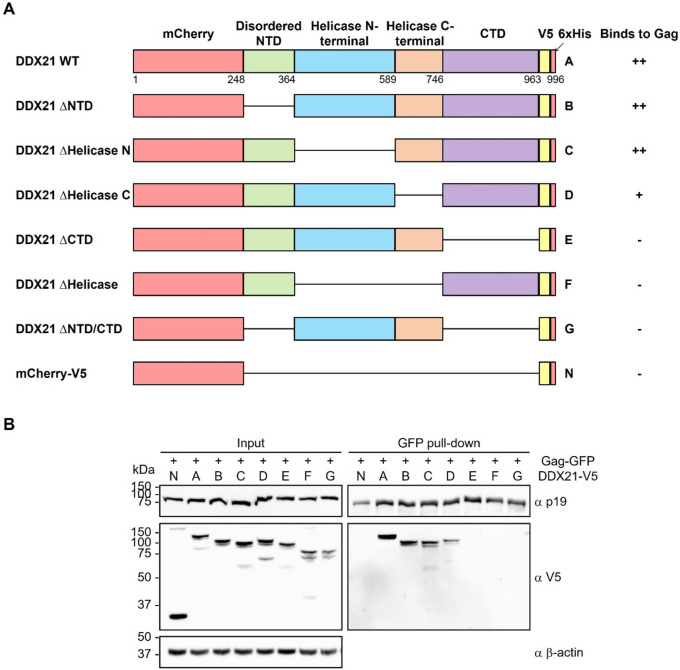
Human T-cell leukemia virus type 1 (HTLV-1), an oncogenic retrovirus, uses human tRNA to prime reverse transcription (RT). However, how tRNA is annealed to the primer binding site (PBS), which is embedded in a highly structured hairpin in the genomic RNA (gRNA), remains unclear. We hypothesize that HTLV-1 Gag may have more robust chaperone activity than mature HTLV-1 nucleocapsid (NC), which in contrast to HIV-1 NC, displays relatively weak chaperone function, and that a cellular co-factor may be required to facilitate primer tRNA annealing. Recombinant HTLV-1 Gag was successfully purified for the first time and used to perform primer-annealing assays. Relative to mature NC and matrix (MA) domains, HTLV-1 Gag is only slightly more effective at chaperoning the annealing of tRNA to the PBS. To identify potential HTLV-1 Gag interacting co-chaperones of tRNA annealing in cells, we performed affinity tagging/purification-mass spectrometry (AP-MS). Two significant AP-MS hits, RPL7 and DDX21, were further validated by reciprocal co-IP studies in both HEK293T and chronically HTLV-1-infected MT-2 cells. Domain mapping studies revealed that HTLV-1 Gag interacts with RPL7 and DDX21 through the zinc fingers in the NC domain independent of the presence of RNA. In addition, we showed that both RPL7 and DDX21 are packaged into virions. RPL7 or DDX21 alone was more effective than HTLV-1 Gag at annealing tRNA to the PBS. Synergistic effects of the Gag/RPL7/DDX21 combination in facilitating tRNA annealing to the PBS were found. Taken together, the mechanistic insights gained from these studies could be exploited for the development of new therapeutic strategies aimed at targeting HTLV-1 RT.
人类T细胞白血病病毒1型(HTLV-1)是一种致癌逆转录病毒,它利用人类tRNA起始逆转录(RT)。然而,tRNA如何退火至引物结合位点(PBS)仍不清楚,该位点位于基因组RNA(gRNA)的高度结构化发夹结构中。我们推测,与成熟的HTLV-1核衣壳(NC)相比,HTLV-1 Gag可能具有更强的伴侣活性,与HIV-1 NC相反,HTLV-1 NC的伴侣功能相对较弱,并且可能需要一种细胞辅助因子来促进引物tRNA退火。首次成功纯化了重组HTLV-1 Gag,并用于进行引物退火试验。相对于成熟的NC和基质(MA)结构域,HTLV-1 Gag在陪伴tRNA退火至PBS方面仅略有效。为了鉴定细胞中tRNA退火的潜在HTLV-1 Gag相互作用共伴侣,我们进行了亲和标签/纯化-质谱(AP-MS)分析。通过在HEK293T和慢性HTLV-1感染的MT-2细胞中的相互免疫共沉淀研究,进一步验证了两个重要的AP-MS结果,即RPL7和DDX21。结构域定位研究表明,HTLV-1 Gag通过NC结构域中的锌指与RPL7和DDX21相互作用,与RNA的存在无关。此外,我们表明RPL7和DDX21都被包装进病毒颗粒。单独的RPL7或DDX21在使tRNA退火至PBS方面比HTLV-1 Gag更有效。发现Gag/RPL7/DDX21组合在促进tRNA退火至PBS方面具有协同作用。综上所述,这些研究获得的机制见解可用于开发针对HTLV-1 RT的新治疗策略。