Sanchez Laura L Huerta, Siao Natasha M, Chaudhari Sanil R, Barrios Julie E, Na Audrey Y, Tadros Mirette G, McConnell Megan L, Kaplan Rachel M, Lane Caden R, Doan Hoa H T, Liger Ashley B, Chou Tessa C, Marcon Serena, Cano Fernando J, Kippin Tod E, Szumlinski Karen K
Department of Psychological and Brain Sciences, University of California Santa Barbara, Santa Barbara, CA, 93106-9660.
Department of Molecular, Cellular and Developmental Biology and the Neuroscience Research Institute, University of California Santa Barbara, Santa Barbara, CA, 93106.
bioRxiv. 2025 Jul 15:2025.07.10.664193. doi: 10.1101/2025.07.10.664193.
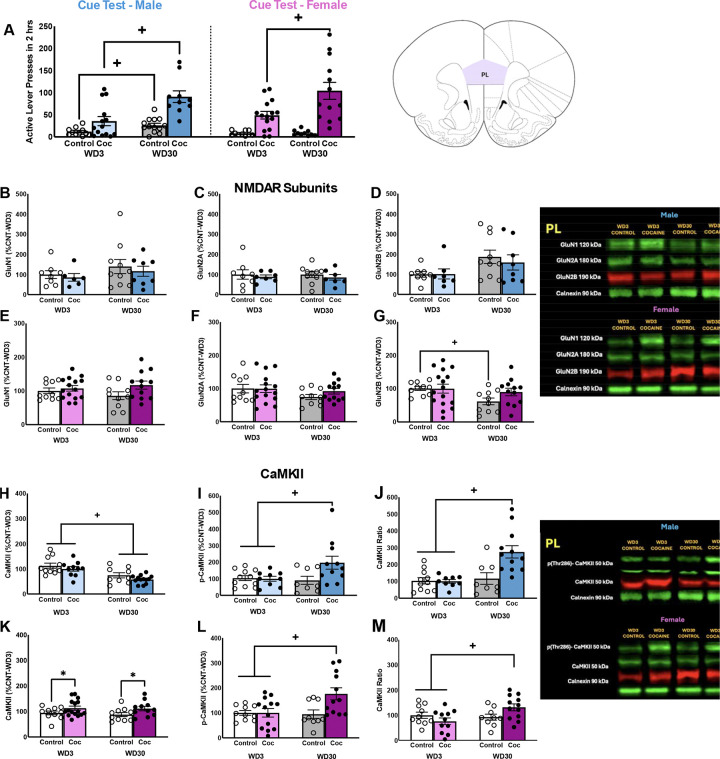
The incubation of craving is a term coined to characterize the behavioral phenomenon wherein cue-elicited craving strengthens over a period of abstinence. Incubated cocaine-craving is mediated, at least in part, by increased glutamate release within the prelimbic cortex (PL). We hypothesized that this glutamate release stimulates NMDA-type glutamate receptors (NMDARs) leading to calcium-dependent activation of CaMKII signaling that drives incubated craving. To test this hypothesis, adult male and female Sprague-Dawley rats were trained to self-administer either IV cocaine or sucrose pellets (6h/day x10 days) and tested for cue-elicited cocaine- or sucrose-craving in early versus later (i.e. after incubation) withdrawal. Incubated cocaine-seeking was associated with increased CaMKII activity in the PL, but no change in NMDAR subunits. In contrast, incubated sucrose-craving was associated with many sex-dependent changes in both NMDAR subunit expression and CaMKII activation that were subregion-selective. An intra-PL infusion of the NMDA antagonist D-AP5 (2.5 or 7.5 μg/side) or the CaMKII inhibitor myr-AIP (10 pg/side) blocked both incubated cocaine- and sucrose-craving, with no effects detected in early withdrawal. Co-infusion of both D-AP5 and myr-AIP exerted an additive effect on incubated cocaine-craving that was larger than either antagonist alone. These data corroborate earlier evidence for distinct biochemical correlates within mPFC between incubated cocaine- and sucrose-craving and, for the first time, demonstrate that NMDARs and CaMKII activation within the PL are common drivers of incubated craving that operate via independent signaling pathways suggesting combined pharmacological treatments may have greater efficacy in managing addiction.
渴求的潜伏期是一个新造术语,用于描述一种行为现象,即线索引发的渴求在禁欲一段时间后会增强。潜伏期的可卡因渴求至少部分是由前边缘皮质(PL)内谷氨酸释放增加介导的。我们假设这种谷氨酸释放会刺激NMDA型谷氨酸受体(NMDARs),导致CaMKII信号通路的钙依赖性激活,从而驱动潜伏期的渴求。为了验证这一假设,成年雄性和雌性Sprague-Dawley大鼠接受训练,以静脉注射可卡因或蔗糖颗粒的方式进行自我给药(每天6小时×10天),并在早期与后期(即潜伏期后)戒断时测试线索引发的可卡因或蔗糖渴求。潜伏期的可卡因寻求行为与PL中CaMKII活性增加有关,但NMDAR亚基没有变化。相比之下,潜伏期的蔗糖渴求与NMDAR亚基表达和CaMKII激活方面许多性别依赖性变化有关,这些变化具有区域选择性。向PL内注射NMDA拮抗剂D-AP5(2.5或7.5μg/侧)或CaMKII抑制剂myr-AIP(10pg/侧)可阻断潜伏期的可卡因和蔗糖渴求,在早期戒断时未检测到影响。同时注射D-AP5和myr-AIP对潜伏期的可卡因渴求产生相加效应,其作用大于单独使用任何一种拮抗剂。这些数据证实了早期证据,即潜伏期的可卡因渴求与蔗糖渴求在内侧前额叶皮质(mPFC)内具有不同的生化相关性,并且首次证明PL内的NMDARs和CaMKII激活是潜伏期渴求的共同驱动因素,它们通过独立的信号通路发挥作用,这表明联合药物治疗在管理成瘾方面可能具有更高的疗效。