Offer Konstantin, Oglanova Natalia, Oswald Lisa, Hertwig Ralph
Center for Adaptive Rationality (ARC), Max Planck Institute for Human Development, 14195 Berlin, Germany.
Max Planck School of Cognition, 04103 Leipzig, Germany.
Ann Behav Med. 2025 Jan 4;59(1). doi: 10.1093/abm/kaaf058.
Medical information avoidance-the prevention or delay of acquiring health-related information-is a growing concern for physicians, healthcare professionals, and policymakers. Yet, its prevalence and predictors have remained poorly understood.
We conducted a systematic review and meta-analysis to clarify the prevalence and predictors of medical information avoidance, offering key insights into the worldwide empirical evidence.
We performed a systematic search, preregistered on the OSF and in accordance with PRISMA and MOOSE reporting guidelines. Additional individual participant datasets were obtained from the National Institutes of Health (NIH). Data analysis was performed using random--effects and mixed-effects models.
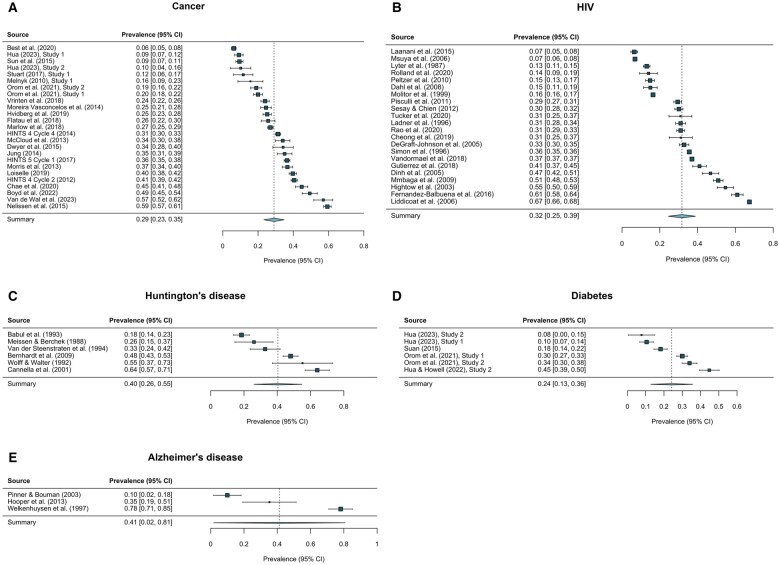
A total of 92 studies and 6 individual participant datasets (564 497 unique participants, 25 countries) were analyzed. We found that almost 1 in 3 participants avoided or were likely to avoid information. Specifically, we estimated prevalence rates of 24% for diabetes, 29% for cancer, 32% for HIV, 40% for Huntington's disease, and 41% for Alzheimer's disease. We did not find any reliable association with gender or with race and ethnicity. Instead, we identified 16 significant predictors across cognitive, health-related, and sociodemographic domains. The strongest predictors were all cognitive: information overload (r = 0.26), perceived stigma (r = 0.36), self-efficacy (r = -0.28), and trust in the medical system (r = -0.25).
Nearly 1 in 3 participants avoided or were likely to avoid medical information. The highest prevalence rates were found for Huntington's disease and Alzheimer's disease, 2 incurable neurodegenerative diseases. Key cognitive predictors suggest entry points for policy interventions and future research.
Medical information is more accessible than ever, but many people choose to avoid it. How common is this behavior, and what predicts it? To find out, we analyzed data from over 90 studies involving more than half a million people across 25 countries. We found that nearly 1 in 3 people avoided or were likely to avoid medical information. Avoidance was highest for incurable neurodegenerative diseases (Alzheimer's disease: 41%, Huntington's disease: 40%), moderate for severe but treatable conditions (HIV: 32%, cancer: 29%), and lowest for a chronic, manageable illness (diabetes: 24%). We identified 16 key predictors of medical information avoidance. Surprisingly, gender, race, and ethnicity were not among them. Instead, the strongest predictors were cognitive and emotional: mistrust in the medical system, feeling overwhelmed, low confidence in managing one's health, and fear of being judged. Patterns of avoidance varied across world regions, suggesting that differences in healthcare systems may influence behavior. In this study, we do not judge whether medical information avoidance is good or bad. Instead, we offer the first comprehensive review of how common it is and what predicts it. More research is needed to understand the psychological and medical consequences of avoiding medical information.

医学信息回避——即预防或延迟获取健康相关信息——日益引起医生、医疗保健专业人员和政策制定者的关注。然而,其普遍性和预测因素仍未得到充分了解。
我们进行了一项系统综述和荟萃分析,以阐明医学信息回避的普遍性和预测因素,为全球实证证据提供关键见解。
我们进行了系统检索,在开放科学框架(OSF)上预先注册,并符合PRISMA和MOOSE报告指南。另外从美国国立卫生研究院(NIH)获取了个体参与者数据集。使用随机效应和混合效应模型进行数据分析。
共分析了92项研究和6个个体参与者数据集(564497名独特参与者,25个国家)。我们发现,近三分之一的参与者回避或可能回避信息。具体而言,我们估计糖尿病的回避率为24%,癌症为29%,艾滋病毒为32%,亨廷顿舞蹈症为40%,阿尔茨海默病为41%。我们未发现与性别、种族和民族有任何可靠关联。相反,我们在认知、健康相关和社会人口学领域确定了16个显著的预测因素。最强的预测因素均为认知方面的:信息过载(r = 0.26)、感知到的污名(r = 0.36)、自我效能感(r = -0.28)以及对医疗系统的信任(r = -0.25)。
近三分之一的参与者回避或可能回避医学信息。亨廷顿舞蹈症和阿尔茨海默病这两种无法治愈的神经退行性疾病的回避率最高。关键的认知预测因素为政策干预和未来研究提供了切入点。
医学信息比以往任何时候都更容易获取,但许多人选择回避它。这种行为有多普遍,又是什么因素导致的呢?为了找到答案,我们分析了来自90多项研究的数据,这些研究涉及25个国家的50多万人。我们发现,近三分之一的人回避或可能回避医学信息。对于无法治愈的神经退行性疾病(阿尔茨海默病:41%,亨廷顿舞蹈症:40%),回避率最高;对于严重但可治疗的疾病(艾滋病毒:32%,癌症:29%),回避率适中;对于慢性、可控疾病(糖尿病:24%),回避率最低。我们确定了医学信息回避的16个关键预测因素。令人惊讶的是,性别、种族和民族并不在其中。相反,最强的预测因素是认知和情感方面的:对医疗系统的不信任、感到不堪重负、对管理自身健康缺乏信心以及害怕被评判。回避模式在世界各地区有所不同,这表明医疗保健系统的差异可能会影响行为。在本研究中,我们不评判医学信息回避是好是坏。相反,我们首次全面综述了其普遍性以及导致这种行为的因素。需要更多研究来了解回避医学信息的心理和医学后果。