Al-Khateeb Lateefa A, Abbas Ahmed Emad F, Elghobashy Mohamed R, Abo Talib Nisreen F, Naguib Ibrahim A, Alqarni Mohammed, Halim Michael K
Department of Chemistry, Faculty of Science, King Abdulaziz University, P.O. Box 80203, Jeddah, 21589, Saudi Arabia.
Analytical Chemistry Department, Faculty of Pharmacy, October 6 University, 6 October City, Giza, 12585, Egypt.
BMC Chem. 2025 Aug 12;19(1):237. doi: 10.1186/s13065-025-01598-9.
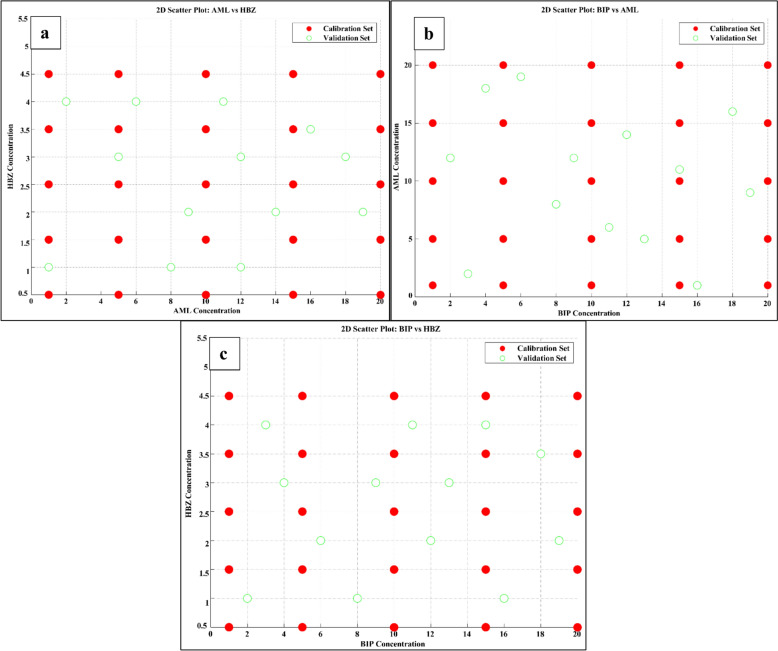
The simultaneous quantification of active pharmaceutical ingredients alongside their mutagenic impurities represents a critical challenge in pharmaceutical quality control. This study presents the first multicolor analytical platform for concurrent determination of bisoprolol fumarate (BIP), amlodipine besylate (AML), and 4-hydroxybenzaldehyde (HBZ), a Class 3 mutagenic impurity in BIP requiring strict regulatory monitoring. Two complementary methodologies were developed: high-performance thin-layer chromatography (HPTLC)-densitometry and Firefly Algorithm-optimized partial least squares (FA-PLS) spectrophotometry, both aligned with green analytical chemistry (GAC) and white analytical chemistry (WAC) principles. The HPTLC method employed an eco-friendly mobile phase of ethyl acetate-ethanol (7:3, v/v), achieving baseline separation with Rf values of 0.29 ± 0.02 (HBZ), 0.72 ± 0.01 (AML), and 0.83 ± 0.01 (BIP). The FA-PLS model incorporated a novel Hammersley Sequence Sampling (HSS) strategy for validation set construction, ensuring uniform concentration space coverage and eliminating sampling bias inherent in conventional random approaches. This innovation, combined with a 5 mixture experimental design for calibration (25 mixtures), significantly enhanced model robustness and predictive capability. Both methods demonstrated superior analytical performance with detection limits of 3.56-20.52 ng/band (HPTLC) and 0.011-0.120 μg/mL (FA-PLS), correlation coefficients ≥ 0.9995, and precision (RSD) ≤ 2%. Comprehensive sustainability assessment using multiple evaluation tools revealed exceptional environmental profiles: perfect NEMI, AGREE, and ComplexGAPI scores, high GEMAM indices (7.015 and 7.487), minimal carbon footprints (0.037 and 0.021 kg CO₂/sample), and outstanding BAGI (87.50 and 90.00), VIGI (75.00 and 80.00), and RGBfast scores (81.00 and 85.00) for HPTLC and FA-PLS, respectively. NQS evaluation confirmed alignment with eleven UN Sustainable Development Goals, particularly SDG 3 (Good Health and Well-being), SDG 9 (Industry, Innovation and Infrastructure), and SDG 12 (Responsible Consumption and Production), yielding overall sustainability scores of 82% and 83%. Successful application to pharmaceutical dosage forms validated the methods' practical utility. This work establishes a new paradigm in sustainable pharmaceutical analysis, demonstrating how algorithmic optimization and environmental consciousness can synergistically advance analytical science while meeting stringent regulatory requirements.
在药物质量控制中,同时对活性药物成分及其致突变杂质进行定量分析是一项严峻挑战。本研究提出了首个多色分析平台,用于同时测定富马酸比索洛尔(BIP)、苯磺酸氨氯地平(AML)和4-羟基苯甲醛(HBZ,BIP中的3类致突变杂质,需严格监管监测)。开发了两种互补方法:高效薄层色谱(HPTLC)-密度测定法和萤火虫算法优化的偏最小二乘法(FA-PLS)分光光度法,二者均符合绿色分析化学(GAC)和白色分析化学(WAC)原则。HPTLC方法采用乙酸乙酯-乙醇(7:3,v/v)的环保流动相,实现基线分离,Rf值分别为0.29±0.02(HBZ)、0.72±0.01(AML)和0.83±0.01(BIP)。FA-PLS模型采用一种新颖的哈默斯利序列采样(HSS)策略构建验证集,确保均匀覆盖浓度空间并消除传统随机方法固有的采样偏差。这一创新与用于校准的5种混合物实验设计(25种混合物)相结合,显著提高了模型的稳健性和预测能力。两种方法均表现出卓越的分析性能,检测限分别为3.56 - 20.52 ng/带(HPTLC)和0.011 - 0.120 μg/mL(FA-PLS),相关系数≥0.9995,精密度(RSD)≤2%。使用多种评估工具进行的全面可持续性评估显示出优异的环境概况:完美的NEMI、AGREE和ComplexGAPI分数,高GEMAM指数(7.015和7.487),最小的碳足迹(0.037和0.021 kg CO₂/样品),以及HPTLC和FA-PLS分别出色的BAGI(87.50和90.00)、VIGI(75.00和80.00)和RGBfast分数(81.(此处原文可能有误,推测为81.00和85.00))。NQS评估确认与11个联合国可持续发展目标一致,特别是可持续发展目标3(良好健康与福祉)、可持续发展目标9(产业、创新和基础设施)和可持续发展目标12(负责任的消费和生产),总体可持续性得分分别为82%和83%。在药物剂型上的成功应用验证了这些方法的实际效用。这项工作在可持续药物分析方面建立了新范式,展示了算法优化和环境意识如何协同推进分析科学,同时满足严格的监管要求。