Graham Annabelle E, Colgate Victoria A, Floyd Emily F
Institute of Infection, Veterinary and Ecological Sciences, University of Liverpool, UK.
Rossdales Equine Hospital, Suffolk, UK.
J Vet Intern Med. 2025 Sep-Oct;39(5):e70198. doi: 10.1111/jvim.70198.
Geographical specific data is required to guide empirical antimicrobial selection in equine neonates.
Evaluate antibiograms and survival in foals from a United Kingdom (UK)-based hospital to guide antimicrobial selection.
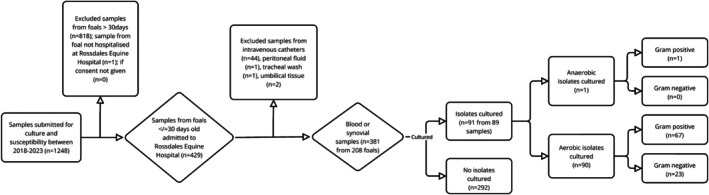
Blood and synovial fluid samples from 208 foals ≤ 30 days old admitted to Rossdales Equine Hospital from 2018 to 2023.
Retrospective cohort study. Antimicrobial susceptibility was assessed by disc diffusion method. Bacterial culture and susceptibility and foal survival were recorded. The effects of the presence of positive culture or multidrug resistance (MDR) isolates on survival were evaluated using univariable mixed effects logistic regression.
Ninety-one isolates were identified from 381 samples from 208 foals. Predominantly gram-positive (75%, 68/91; 95% confidence interval [CI]: 65%-83%) isolates were identified, and Enterococcus (26%, 24/91; 95% CI: 18%-37%) was the most commonly isolated bacteria. MDR was identified in 21% of isolates (19/91; 95% CI: 13%-31%). Enterococcus was the most frequent MDR isolate (7/19). The combination of ampicillin and amikacin showed in vitro susceptibility in 90% (81/90; 95% CI: 82%-95%) of aerobic isolates. In total, 87% of foals were discharged from the hospital (180/208; 95% CI: 81%-91%). No association was identified between survival and the presence of positive culture or MDR isolates.
Retrospective design; missing data for prior antimicrobial treatment, reason for admission and admission variables.
Ampicillin and amikacin are appropriate combination first-line antimicrobial treatments in this population. Many Gram-positive isolates were identified, most notably Enterococcus. Culture and susceptibility guided antimicrobial choices remain crucial, especially given the unpredictable susceptibility of Enterococcus and the frequency of MDR Enterococcus isolates identified.
需要特定地区的数据来指导马驹新生儿经验性抗菌药物的选择。
评估一家英国医院的马驹的抗菌谱和存活率,以指导抗菌药物的选择。
2018年至2023年入住罗斯代尔斯马医院的208匹30日龄及以下马驹的血液和滑液样本。
回顾性队列研究。采用纸片扩散法评估抗菌药物敏感性。记录细菌培养、药敏情况及马驹存活率。采用单变量混合效应逻辑回归评估阳性培养或多重耐药(MDR)菌株的存在对存活率的影响。
从208匹马驹的381份样本中鉴定出91株菌株。主要鉴定出革兰氏阳性菌(75%,68/91;95%置信区间[CI]:65%-83%),其中肠球菌(26%,24/91;95%CI:18%-37%)是最常分离出的细菌。21%的菌株(19/91;95%CI:13%-31%)鉴定为多重耐药。肠球菌是最常见的多重耐药菌株(7/19)。氨苄西林和阿米卡星联合用药对90%(81/90;95%CI:82%-95%)的需氧菌株显示出体外敏感性。共有87%的马驹出院(18./208;95%CI:81%-91%)。未发现存活率与阳性培养或多重耐药菌株的存在之间存在关联。
回顾性设计;缺乏先前抗菌治疗、入院原因和入院变量的数据。
氨苄西林和阿米卡星是该群体合适的联合一线抗菌治疗药物。鉴定出许多革兰氏阳性菌株,最显著的是肠球菌。培养和药敏指导抗菌药物选择仍然至关重要,特别是考虑到肠球菌药敏的不可预测性以及鉴定出的多重耐药肠球菌菌株的频率。