Dubey Pallavi, Dwivedi Alok Kumar, Sharma Kunal, Martin Sarah L, Thompson Peter M, Reddy Sireesha Y
Department of Obstetrics and Gynecology, Paul L. Foster School of Medicine, Texas Tech University Health Sciences Center El Paso, El Paso, TX, USA.
Division of Biostatistics & Epidemiology, Department of Molecular and Translational Medicine, Paul L. Foster School of Medicine, Texas Tech University Health Sciences Center El Paso, El Paso, TX, USA.
Commun Med (Lond). 2025 Aug 13;5(1):350. doi: 10.1038/s43856-025-01062-8.
Mental disorders are highly prevalent during pregnancy and are associated with unfavorable obstetrical outcomes, including maternal mortality. This study examined specific and combined associations of mental disorders with maternal morbidities.
A cross-sectional study of all delivery hospitalizations between the ages of 12-55 years was conducted using the National Inpatient Sample data from 2017. The International Classification of Diseases-10 codes were used to define exposures including depressive, anxiety, post-traumatic stress (PTSD), sleep, and bipolar disorders, and outcomes including premature rupture of membranes (PROM), hydramnios, placental disorder, cesarean delivery, fetal death, preterm birth, and postpartum hemorrhage (PPH). Survey-weighted logistic regression analysis was conducted to evaluate the associations between mental disorders and obstetric outcomes after adjusting for age, race/ethnicity, household income, primary payer, smoking, alcohol use, substance use, and obesity.
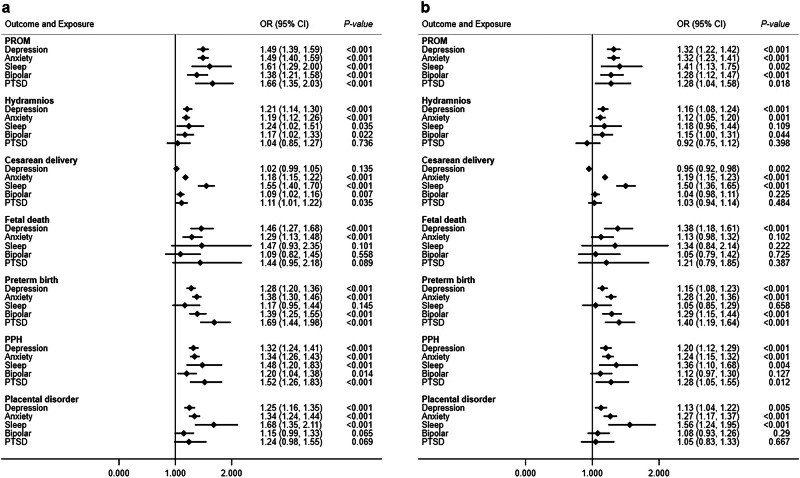
The analysis of 715,810 delivery hospitalizations, representing 3,579,046 deliveries in the US demonstrates that sleep disorder is associated with PROM (OR = 1.41; 95% CI: 1.13, 1.75), placental disorder (OR = 1.56; 95% CI: 1.24, 1.95), cesarean delivery (OR = 1.50; 95% CI: 1.36, 1.65), and PPH (OR = 1.36; 95% CI: 1.10, 1.68) to a greater extent than other mental disorders. However, depressive disorder is greatly associated with hydramnios (OR = 1.16; 95% CI: 1.08, 1.25) and fetal death (OR = 1.38; 95% CI: 1.18, 1.61), while PTSD (OR = 1.40; 95% CI: 1.19, 1.64) is associated with preterm birth than other mental disorders.
Most mental disorders are independently associated with critical obstetric outcomes, with the extent of associations depending on specific obstetric outcomes. The study findings indicate the need for mandatory screening and management of mental health conditions in routine obstetrical care to improve maternal and child health outcomes.
精神障碍在孕期极为普遍,且与不良产科结局相关,包括孕产妇死亡。本研究探讨了精神障碍与孕产妇发病情况的具体及综合关联。
利用2017年全国住院患者样本数据,对年龄在12至55岁之间的所有分娩住院病例进行了横断面研究。采用国际疾病分类第十版编码来定义暴露因素,包括抑郁、焦虑、创伤后应激障碍(PTSD)、睡眠障碍和双相情感障碍,以及结局指标,包括胎膜早破(PROM)、羊水过多、胎盘疾病、剖宫产、胎儿死亡、早产和产后出血(PPH)。在对年龄、种族/民族、家庭收入、主要支付方、吸烟、饮酒、物质使用和肥胖进行调整后,进行调查加权逻辑回归分析,以评估精神障碍与产科结局之间的关联。
对代表美国3579046例分娩的715810例分娩住院病例的分析表明,睡眠障碍与胎膜早破(OR = 1.41;95% CI:1.13,1.75)、胎盘疾病(OR = 1.56;95% CI:1.24,1.95)、剖宫产(OR = 1.50;95% CI:1.36,1.65)和产后出血(OR = 1.36;95% CI:1.10,1.68)的关联程度高于其他精神障碍。然而,抑郁症与羊水过多(OR = /1.16;95% CI:1.08,1.25)和胎儿死亡(OR = 1.38;95% CI:1.18,1.61)密切相关,而创伤后应激障碍(OR = 1.40;95% CI:1.19,1.64)与早产的关联高于其他精神障碍。
大多数精神障碍与关键产科结局独立相关,关联程度取决于具体的产科结局。研究结果表明,在常规产科护理中需要对心理健康状况进行强制性筛查和管理,以改善母婴健康结局。