Namlı Sevinç, Çar Bekir, Kurtoğlu Ahmet, Yılmaz Eda, Tekkurşun Demir Gönül, Güvendi Burcu, Batu Batuhan, Aldhahi Monira I
Department of Physical Education and Sports Teaching, Faculty of Sport Science, Erzurum Technical University, 25050 Erzurum, Türkiye.
Department of Physical Education and Sports Teaching, Faculty of Sport Science, Bandırma Onyedi Eylül University, 10200 Balıkesir, Türkiye.
Healthcare (Basel). 2025 Jul 25;13(15):1805. doi: 10.3390/healthcare13151805.
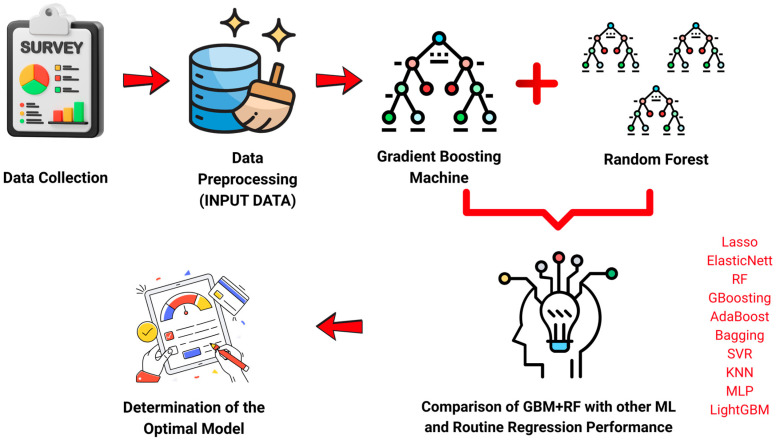
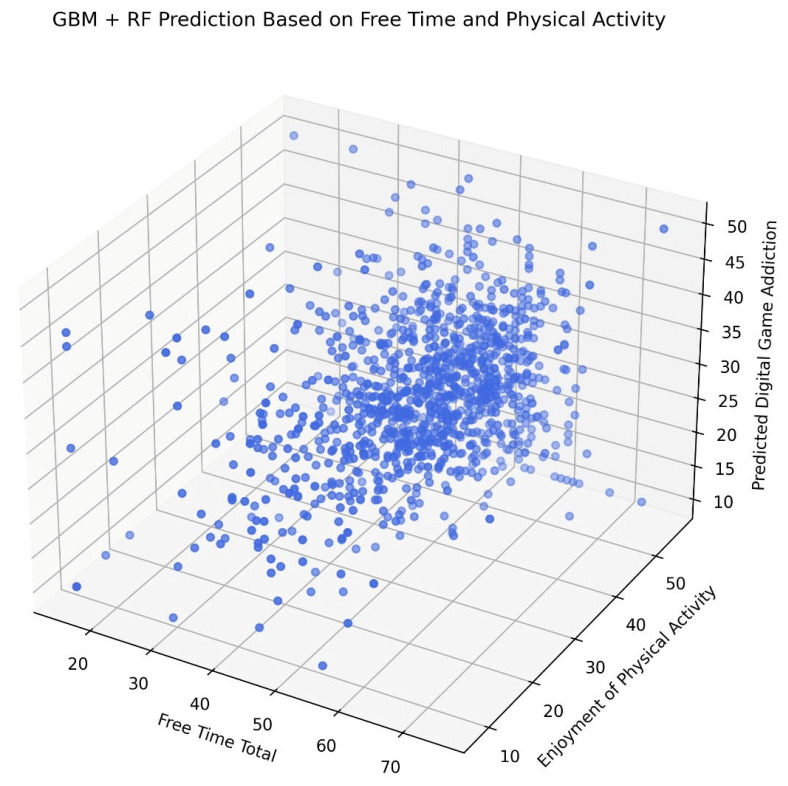
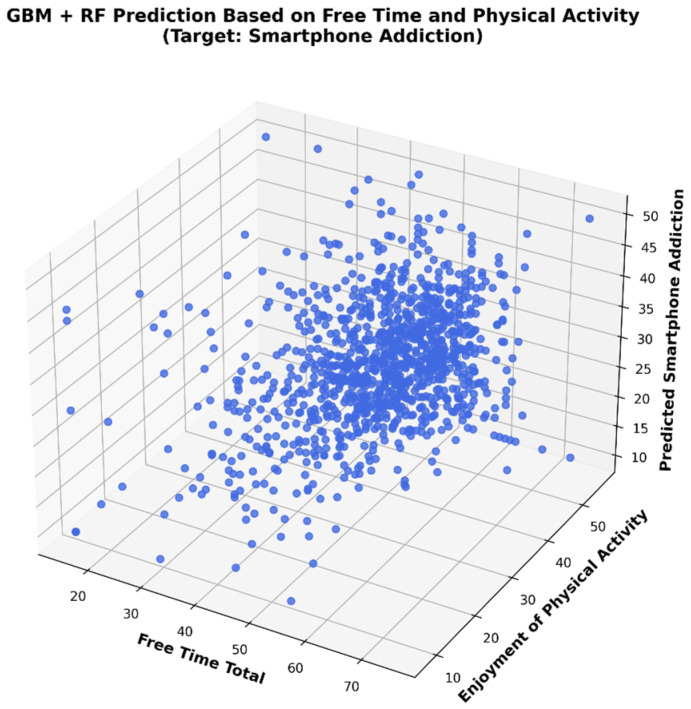
Smartphone addiction (SA) and gaming addiction (GA) have become risk factors for individuals of all ages in recent years. Especially during adolescence, it has become very difficult for parents to control this situation. Physical activity and the effective use of free time are the most important factors in eliminating such addictions. This study aimed to test a new machine learning method by combining routine regression analysis with the gradient-boosting machine (GBM) and random forest (RF) methods to analyze the relationship between SA and GA with leisure time management (LTM) and the enjoyment of physical activity (EPA) among adolescents. This study presents the results obtained using our developed GBM + RF hybrid model, which incorporates LTM and EPA scores as inputs for predicting SA and GA, following the preprocessing of data collected from 1107 high school students aged 15-19 years. The results were compared with those obtained using routine regression results and the lasso, ElasticNet, RF, GBM, AdaBoost, bagging, support vector regression (SVR), K-nearest neighbors (KNN), multi-layer perceptron (MLP), and light gradient-boosting machine (LightGBM) models. In the GBM + RF model, probability scores obtained from GBM were used as input to RF to produce final predictions. The performance of the models was evaluated using the R, mean absolute error (MAE), and mean squared error (MSE) metrics. Classical regression analyses revealed a significant negative relationship between SA scores and both LTM and EPA scores. Specifically, as LTM and EPA scores increased, SA scores decreased significantly. In contrast, GA scores showed a significant negative relationship only with LTM scores, whereas EPA was not a significant determinant of GA. In contrast to the relatively low explanatory power of classical regression models, ML algorithms have demonstrated significantly higher prediction accuracy. The best performance for SA prediction was achieved using the Hybrid GBM + RF model (MAE = 0.095, MSE = 0.010, R = 0.9299), whereas the SVR model showed the weakest performance (MAE = 0.310, MSE = 0.096, R = 0.8615). Similarly, the Hybrid GBM + RF model also showed the highest performance for GA prediction (MAE = 0.090, MSE = 0.014, R = 0.9699). These findings demonstrate that classical regression analyses have limited explanatory power in capturing complex relationships between variables, whereas ML algorithms, particularly our GBM + RF hybrid model, offer more robust and accurate modeling capabilities for multifactorial cognitive and performance-related predictions.
近年来,智能手机成瘾(SA)和游戏成瘾(GA)已成为各年龄段人群的风险因素。尤其是在青少年时期,父母很难控制这种情况。体育活动和有效利用空闲时间是消除此类成瘾的最重要因素。本研究旨在通过将常规回归分析与梯度提升机(GBM)和随机森林(RF)方法相结合,测试一种新的机器学习方法,以分析青少年中SA和GA与休闲时间管理(LTM)以及体育活动乐趣(EPA)之间的关系。本研究展示了使用我们开发的GBM + RF混合模型所获得的结果,该模型在对1107名15至19岁高中生收集的数据进行预处理后,将LTM和EPA分数作为预测SA和GA的输入。将结果与使用常规回归结果以及套索回归、弹性网络、RF、GBM、AdaBoost、装袋法、支持向量回归(SVR)、K近邻(KNN)、多层感知器(MLP)和轻梯度提升机(LightGBM)模型所获得的结果进行了比较。在GBM + RF模型中,将从GBM获得的概率分数用作RF的输入以产生最终预测。使用R、平均绝对误差(MAE)和均方误差(MSE)指标评估模型的性能。经典回归分析显示SA分数与LTM和EPA分数之间存在显著的负相关关系。具体而言,随着LTM和EPA分数的增加,SA分数显著降低。相比之下,GA分数仅与LTM分数呈显著负相关关系,而EPA不是GA的显著决定因素。与经典回归模型相对较低的解释力相比,机器学习算法已显示出显著更高的预测准确性。使用混合GBM + RF模型实现了SA预测的最佳性能(MAE = 0.095,MSE = 0.010,R = 0.9299),而SVR模型表现最弱(MAE = 0.310,MSE = 0.096,R = 0.8615)。同样,混合GBM + RF模型在GA预测方面也表现出最高性能(MAE = 0.090,MSE = 0.014,R = 0.9699)。这些发现表明,经典回归分析在捕捉变量之间的复杂关系方面解释力有限,而机器学习算法,特别是我们的GBM + RF混合模型,为多因素认知和与性能相关的预测提供了更强大、准确的建模能力。