Tao Ran, Xu Leijun, Bai Xue, Chen Jianfeng
School of Electrical and Information Engineering, Jiangsu University, Zhenjiang 212013, China.
Sensors (Basel). 2025 Aug 3;25(15):4783. doi: 10.3390/s25154783.
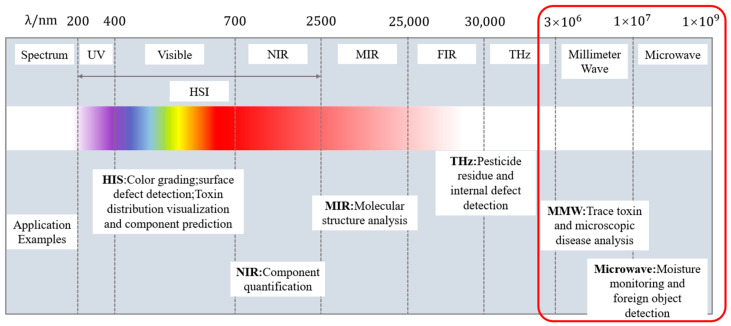
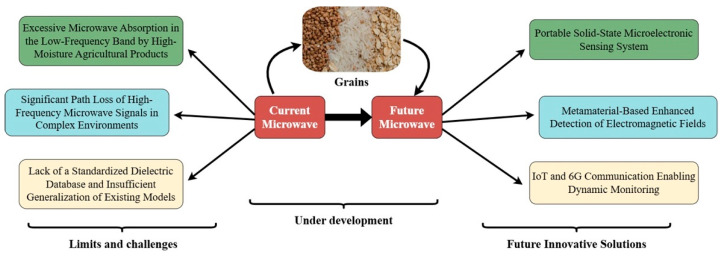
Agricultural nondestructive testing technology is pivotal in safeguarding food quality assurance, safety monitoring, and supply chain transparency. While conventional optical methods such as near-infrared spectroscopy and hyperspectral imaging demonstrate proficiency in surface composition analysis, their constrained penetration depth and environmental sensitivity limit effectiveness in dynamic agricultural inspections. This review highlights the transformative potential of microwave technologies, systematically examining their operational principles, current implementations, and developmental trajectories for agricultural quality control. Microwave technology leverages dielectric response mechanisms to overcome traditional limitations, such as low-frequency penetration for grain silo moisture testing and high-frequency multi-parameter analysis, enabling simultaneous detection of moisture gradients, density variations, and foreign contaminants. Established applications span moisture quantification in cereal grains, oilseed crops, and plant tissues, while emerging implementations address storage condition monitoring, mycotoxin detection, and adulteration screening. The high-frequency branch of the microwave-millimeter wave systems enhances analytical precision through molecular resonance effects and sub-millimeter spatial resolution, achieving trace-level contaminant identification. Current challenges focus on three areas: excessive absorption of low-frequency microwaves by high-moisture agricultural products, significant path loss of microwave high-frequency signals in complex environments, and the lack of a standardized dielectric database. In the future, it is essential to develop low-cost, highly sensitive, and portable systems based on solid-state microelectronics and metamaterials, and to utilize IoT and 6G communications to enable dynamic monitoring. This review not only consolidates the state-of-the-art but also identifies future innovation pathways, providing a roadmap for scalable deployment of next-generation agricultural NDT systems.
农业无损检测技术在保障食品质量保证、安全监测和供应链透明度方面至关重要。虽然近红外光谱和高光谱成像等传统光学方法在表面成分分析方面表现出色,但其有限的穿透深度和环境敏感性限制了在动态农业检测中的有效性。本综述强调了微波技术的变革潜力,系统地研究了其工作原理、当前应用和农业质量控制的发展轨迹。微波技术利用介电响应机制克服传统限制,如用于谷物筒仓水分检测的低频穿透和高频多参数分析,能够同时检测水分梯度、密度变化和外来污染物。既定应用涵盖谷物、油籽作物和植物组织中的水分定量,而新兴应用则涉及储存条件监测、霉菌毒素检测和掺假筛查。微波-毫米波系统的高频分支通过分子共振效应和亚毫米空间分辨率提高分析精度,实现痕量水平污染物识别。当前挑战集中在三个方面:高水分农产品对低频微波的过度吸收、复杂环境中微波高频信号的显著路径损耗以及缺乏标准化介电数据库。未来,必须基于固态微电子和超材料开发低成本、高灵敏度和便携式系统,并利用物联网和6G通信实现动态监测。本综述不仅巩固了当前的技术水平,还确定了未来的创新途径,为下一代农业无损检测系统的可扩展部署提供了路线图。