
趋化因子介导的迷走神经在调节组织内和组织间炎症中的作用的计算推断
Computational inference of chemokine-mediated roles for the vagus nerve in modulating intra- and inter-tissue inflammation.
作者信息
Shah Ashti M, Zamora Ruben, Barclay Derek, Yin Jinling, El-Dehaibi Fayten, Addorisio Meghan, Tsaava Tea, Tynan Aisling, Tracey Kevin, Chavan Sangeeta S, Vodovotz Yoram
机构信息
Department of Surgery, University of Pittsburgh, Pittsburgh, PA, United States.
Center for Inflammation and Regeneration Modeling, McGowan Institute for Regenerative Medicine, University of Pittsburgh, Pittsburgh, PA, United States.
出版信息
Front Syst Biol. 2024 Feb 15;4:1266279. doi: 10.3389/fsysb.2024.1266279. eCollection 2024.
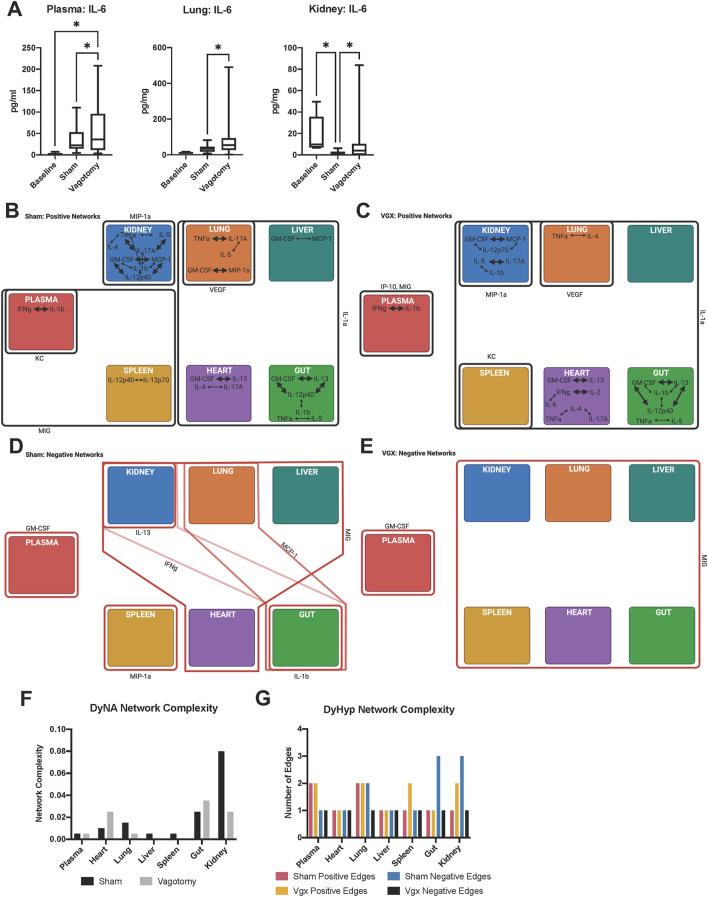
The vagus nerve innervates multiple organs, but its role in regulating cross-tissue spread of inflammation is as yet unclear. We hypothesized that the vagus nerve may regulate cross-tissue inflammation via modulation of the putatively neurally regulated chemokine IP-10/CXCL10. Rate-of-change analysis, dynamic network analysis, and dynamic hypergraphs were used to model intra- and inter-tissue trends, respectively, in inflammatory mediators from mice that underwent either vagotomy or sham surgery. This analysis suggested that vagotomy primarily disrupts the cross-tissue attenuation of inflammatory networks involving IP-10 as well as the chemokines MIG/CXCL9 and CCL2/MCP-1 along with the cytokines IFN-γ and IL-6. Computational analysis also suggested that the vagus-dependent rate of expression of IP-10 and MIG/CXCL9 in the spleen impacts the trajectory of chemokine expression in other tissues. Perturbation of this complex system with bacterial lipopolysaccharide (LPS) revealed a vagally regulated role for MIG in the heart. Further, LPS-stimulated expression of IP-10 was inferred to be vagus-independent across all tissues examined while reducing connectivity to IL-6 and MCP-1, a hypothesis supported by Boolean network modeling. Together, these studies define novel spatiotemporal dimensions of vagus-regulated acute inflammation.
迷走神经支配多个器官,但其在调节炎症跨组织扩散中的作用尚不清楚。我们推测,迷走神经可能通过调节假定受神经调节的趋化因子IP-10/CXCL10来调节跨组织炎症。分别使用变化率分析、动态网络分析和动态超图对接受迷走神经切断术或假手术的小鼠炎症介质的组织内和组织间趋势进行建模。该分析表明,迷走神经切断术主要破坏涉及IP-10以及趋化因子MIG/CXCL9和CCL2/MCP-1以及细胞因子IFN-γ和IL-6的炎症网络的跨组织衰减。计算分析还表明,脾脏中IP-10和MIG/CXCL9的迷走神经依赖性表达速率会影响其他组织中趋化因子表达的轨迹。用细菌脂多糖(LPS)对这个复杂系统进行扰动,揭示了MIG在心脏中的迷走神经调节作用。此外,推断LPS刺激的IP-10表达在所有检查的组织中与迷走神经无关,同时减少了与IL-6和MCP-1的连接,这一假设得到布尔网络建模的支持。总之,这些研究定义了迷走神经调节的急性炎症的新时空维度。



 Zotero 插件