Wong Jason H, Luo Shangbang, Hosseinaee Zohreh, Feroldi Fabio, Roorda Austin
Herbert Wertheim School of Optometry and Vision Science, University of California Berkeley, Berkeley, CA 94720-2020, USA.
Biomed Opt Express. 2025 Jul 17;16(8):3222-3236. doi: 10.1364/BOE.566376. eCollection 2025 Aug 1.
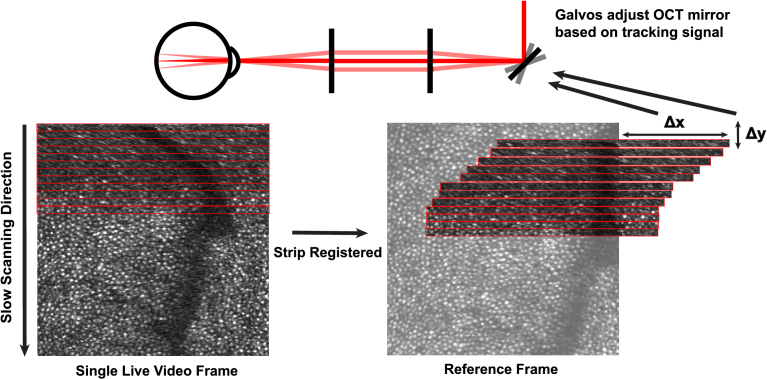
Optoretinography (ORG) is the optical measurement of changes in the retina in response to light stimulation. Adaptive optics optical coherence tomography (AOOCT) records photoreceptor ORGs by measuring the physical changes in their outer segment lengths in response to light stimulation. The main difficulty in recording these nanometer-scale changes is constant eye motion. Typically, fast volume acquisitions are used with offline spatial registration to compensate for the effect of eye motion. Here, we present an alternate solution whereby an adaptive optics scanning light ophthalmoscope (AOSLO) is used to measure the eye motion and actively guide the AOOCT beam to compensate for eye motion in real time. This system's cellular-scale tracking offers unparalleled control over scanning raster size and shape, allowing for high-speed (up to 100 kHz) ORG acquisition from targeted locations. We validate the method by comparing cone classifications against those made with an established ORG approach.
视网膜光响应成像(ORG)是对视网膜因光刺激而产生的变化进行光学测量。自适应光学光学相干断层扫描(AOOCT)通过测量光感受器外段长度因光刺激而产生的物理变化来记录光感受器ORG。记录这些纳米级变化的主要困难在于眼睛的持续运动。通常,使用快速体积采集结合离线空间配准来补偿眼睛运动的影响。在此,我们提出一种替代解决方案,即使用自适应光学扫描激光检眼镜(AOSLO)来测量眼睛运动,并实时主动引导AOOCT光束以补偿眼睛运动。该系统的细胞尺度跟踪对扫描光栅的大小和形状提供了无与伦比的控制,允许从目标位置进行高速(高达100 kHz)的ORG采集。我们通过将视锥细胞分类与使用既定ORG方法进行的分类相比较来验证该方法。