• 文献检索
  • 文档翻译
  • 深度研究
  • 学术资讯
  • Suppr Zotero 插件Zotero 插件
  • 邀请有礼
  • 套餐&价格
  • 历史记录
应用&插件
Suppr Zotero 插件Zotero 插件浏览器插件Mac 客户端Windows 客户端微信小程序
定价
高级版会员购买积分包购买API积分包
服务
文献检索文档翻译深度研究API 文档MCP 服务
关于我们
关于 Suppr公司介绍联系我们用户协议隐私条款
关注我们

Suppr 超能文献

核心技术专利:CN118964589B侵权必究
粤ICP备2023148730 号-1Suppr @ 2026

文献检索

告别复杂PubMed语法,用中文像聊天一样搜索,搜遍4000万医学文献。AI智能推荐,让科研检索更轻松。

立即免费搜索

文件翻译

保留排版,准确专业,支持PDF/Word/PPT等文件格式,支持 12+语言互译。

免费翻译文档

深度研究

AI帮你快速写综述,25分钟生成高质量综述,智能提取关键信息,辅助科研写作。

立即免费体验

菲律宾奎松市新冠疫情前后登革热热点地区的识别以及登革热的人口和环境决定因素探索。

Pre- and post-COVID-19 pandemic identification of dengue hotspots and exploration of population and environmental determinants of dengue in Quezon City, Philippines.

作者信息

Medina John Robert Carabeo, Kawamura Shin'ya, Takeuchi Rie, Cruz Rolando V, Mendoza Johnedel, Hernandez Paul Michael R, Garcia Fernando B, Gregorio Ernesto R, Kobayashi Jun

机构信息

Institute of Clinical Epidemiology, National Institutes of Health, University of the Philippines Manila, 623 Pedro Gil St, Ermita, Manila, 1000, Metro Manila, Philippines.

Department of Clinical Epidemiology, College of Medicine, University of the Philippines Manila, 547 Pedro Gil St, Ermita, Manila, 1000, Metro Manila, Philippines.

出版信息

Trop Med Health. 2025 Aug 14;53(1):109. doi: 10.1186/s41182-025-00789-3.

DOI:10.1186/s41182-025-00789-3
PMID:40814009
原文链接:
https://pmc.ncbi.nlm.nih.gov/articles/PMC12351799/
Abstract

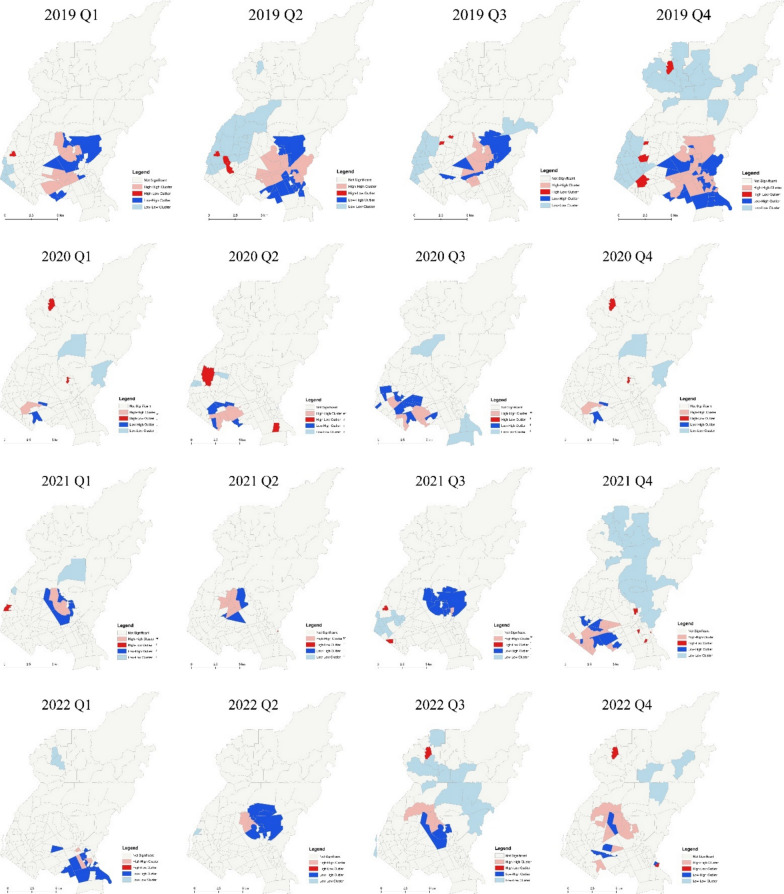
In 2020, there were decreasing trends in reported dengue cases in several countries in the Western Pacific Region, including the Philippines, amid the COVID-19 pandemic. In this study, the spatial distribution of dengue incidence and the hotspots were described quarterly in Quezon City from 2019 to 2022, with the unit of analysis being the 142 barangays (small territorial and administrative villages) in Quezon City. The influence of selected environmental and demographic factors on the persistence of dengue was also explored. Surveillance data from the Quezon City Epidemiology and Surveillance Division, Normalized Difference Vegetation Index (NDVI), and satellite images of built environments, such as buildings, facilities, and transportation network hubs were processed and analyzed. The local Moran's I statistics performed with 95% confidence level was employed in the identification of local dengue hotspots. Dengue hotspot maps and maps of greenness, surrounding greenness, small building ratios, and the number of transportation network hubs in each barangay (village) of Quezon City were developed. The association of dengue cases with greenness, surrounding greenness, transportation network hubs, small building ratios, and population density was determined through a generalized linear model (GLM). Results revealed that incidence rates of dengue across barangays were spatially heterogeneous, and the dengue hotspots were unstable as they varied quarterly each year. Proximity to surrounding greenness (NDVI 1 km), small building ratio, and presence of transportation network hubs were found to be significantly associated with dengue hotspots. Dengue prevention strategies, such as search-and-destroy activities for breeding sites, are suggested to be implemented regularly in such areas. The study also recommends considering the anticipated increase in dengue hotspots and the significant environmental factors in the development of health promotion and education campaigns.

摘要

2020年,在新冠疫情期间,西太平洋区域的几个国家(包括菲律宾)报告的登革热病例呈下降趋势。在本研究中,于2019年至2022年按季度描述了奎松市登革热发病率的空间分布和热点地区,分析单位为奎松市的142个行政区(小型地域和行政村庄)。还探讨了选定的环境和人口因素对登革热持续存在的影响。对奎松市流行病学和监测部门的监测数据、归一化植被指数(NDVI)以及建筑物、设施和交通网络枢纽等建成环境的卫星图像进行了处理和分析。采用置信水平为95%的局部莫兰指数统计来识别当地登革热热点地区。绘制了奎松市每个行政区(村庄)的登革热热点地图以及绿化程度、周边绿化程度、小型建筑比例和交通网络枢纽数量的地图。通过广义线性模型(GLM)确定登革热病例与绿化程度、周边绿化程度、交通网络枢纽、小型建筑比例和人口密度之间的关联。结果显示,各行政区的登革热发病率在空间上存在异质性,且登革热热点地区不稳定,因为它们每年每个季度都有所变化。发现靠近周边绿化区域(NDVI 1公里)、小型建筑比例以及存在交通网络枢纽与登革热热点地区显著相关。建议在此类地区定期开展登革热预防策略,如对滋生地进行搜索和清除活动。该研究还建议在开展健康促进和教育活动时考虑登革热热点地区的预期增加以及重要的环境因素。

https://cdn.ncbi.nlm.nih.gov/pmc/blobs/5371/12351799/f0b414ad5567/41182_2025_789_Fig10_HTML.jpg
https://cdn.ncbi.nlm.nih.gov/pmc/blobs/5371/12351799/fdd8ebc1c90b/41182_2025_789_Fig1_HTML.jpg
https://cdn.ncbi.nlm.nih.gov/pmc/blobs/5371/12351799/fc22b405b7d7/41182_2025_789_Fig2_HTML.jpg
https://cdn.ncbi.nlm.nih.gov/pmc/blobs/5371/12351799/554c748f7fe3/41182_2025_789_Fig3_HTML.jpg
https://cdn.ncbi.nlm.nih.gov/pmc/blobs/5371/12351799/32c20cf014b7/41182_2025_789_Fig4_HTML.jpg
https://cdn.ncbi.nlm.nih.gov/pmc/blobs/5371/12351799/cb04fe0a3505/41182_2025_789_Fig5_HTML.jpg
https://cdn.ncbi.nlm.nih.gov/pmc/blobs/5371/12351799/229d2e23c759/41182_2025_789_Fig6_HTML.jpg
https://cdn.ncbi.nlm.nih.gov/pmc/blobs/5371/12351799/cc08576c4244/41182_2025_789_Fig7_HTML.jpg
https://cdn.ncbi.nlm.nih.gov/pmc/blobs/5371/12351799/fc473f80fbfb/41182_2025_789_Fig8_HTML.jpg
https://cdn.ncbi.nlm.nih.gov/pmc/blobs/5371/12351799/7f679e9eec6f/41182_2025_789_Fig9_HTML.jpg
https://cdn.ncbi.nlm.nih.gov/pmc/blobs/5371/12351799/f0b414ad5567/41182_2025_789_Fig10_HTML.jpg
https://cdn.ncbi.nlm.nih.gov/pmc/blobs/5371/12351799/fdd8ebc1c90b/41182_2025_789_Fig1_HTML.jpg
https://cdn.ncbi.nlm.nih.gov/pmc/blobs/5371/12351799/fc22b405b7d7/41182_2025_789_Fig2_HTML.jpg
https://cdn.ncbi.nlm.nih.gov/pmc/blobs/5371/12351799/554c748f7fe3/41182_2025_789_Fig3_HTML.jpg
https://cdn.ncbi.nlm.nih.gov/pmc/blobs/5371/12351799/32c20cf014b7/41182_2025_789_Fig4_HTML.jpg
https://cdn.ncbi.nlm.nih.gov/pmc/blobs/5371/12351799/cb04fe0a3505/41182_2025_789_Fig5_HTML.jpg
https://cdn.ncbi.nlm.nih.gov/pmc/blobs/5371/12351799/229d2e23c759/41182_2025_789_Fig6_HTML.jpg
https://cdn.ncbi.nlm.nih.gov/pmc/blobs/5371/12351799/cc08576c4244/41182_2025_789_Fig7_HTML.jpg
https://cdn.ncbi.nlm.nih.gov/pmc/blobs/5371/12351799/fc473f80fbfb/41182_2025_789_Fig8_HTML.jpg
https://cdn.ncbi.nlm.nih.gov/pmc/blobs/5371/12351799/7f679e9eec6f/41182_2025_789_Fig9_HTML.jpg
https://cdn.ncbi.nlm.nih.gov/pmc/blobs/5371/12351799/f0b414ad5567/41182_2025_789_Fig10_HTML.jpg

相似文献

1
Pre- and post-COVID-19 pandemic identification of dengue hotspots and exploration of population and environmental determinants of dengue in Quezon City, Philippines.菲律宾奎松市新冠疫情前后登革热热点地区的识别以及登革热的人口和环境决定因素探索。
Trop Med Health. 2025 Aug 14;53(1):109. doi: 10.1186/s41182-025-00789-3.
2
Prescription of Controlled Substances: Benefits and Risks管制药品的处方:益处与风险
3
Measures implemented in the school setting to contain the COVID-19 pandemic.学校为控制 COVID-19 疫情而采取的措施。
Cochrane Database Syst Rev. 2022 Jan 17;1(1):CD015029. doi: 10.1002/14651858.CD015029.
4
Systemic treatments for metastatic cutaneous melanoma.转移性皮肤黑色素瘤的全身治疗
Cochrane Database Syst Rev. 2018 Feb 6;2(2):CD011123. doi: 10.1002/14651858.CD011123.pub2.
5
Signs and symptoms to determine if a patient presenting in primary care or hospital outpatient settings has COVID-19.在基层医疗机构或医院门诊环境中,如果患者出现以下症状和体征,可判断其是否患有 COVID-19。
Cochrane Database Syst Rev. 2022 May 20;5(5):CD013665. doi: 10.1002/14651858.CD013665.pub3.
6
Home treatment for mental health problems: a systematic review.心理健康问题的居家治疗:一项系统综述
Health Technol Assess. 2001;5(15):1-139. doi: 10.3310/hta5150.
7
A rapid and systematic review of the clinical effectiveness and cost-effectiveness of paclitaxel, docetaxel, gemcitabine and vinorelbine in non-small-cell lung cancer.对紫杉醇、多西他赛、吉西他滨和长春瑞滨在非小细胞肺癌中的临床疗效和成本效益进行的快速系统评价。
Health Technol Assess. 2001;5(32):1-195. doi: 10.3310/hta5320.
8
Community views on mass drug administration for soil-transmitted helminths: a qualitative evidence synthesis.社区对土壤传播蠕虫群体药物给药的看法:定性证据综合分析
Cochrane Database Syst Rev. 2025 Jun 20;6:CD015794. doi: 10.1002/14651858.CD015794.pub2.
9
Sexual Harassment and Prevention Training性骚扰与预防培训
10
Factors that influence participation in physical activity for people with bipolar disorder: a synthesis of qualitative evidence.影响双相障碍患者参与体育活动的因素:定性证据的综合分析。
Cochrane Database Syst Rev. 2024 Jun 4;6(6):CD013557. doi: 10.1002/14651858.CD013557.pub2.

本文引用的文献

1
Dengue virus: Etiology, epidemiology, pathobiology, and developments in diagnosis and control - A comprehensive review.登革病毒:病因学、流行病学、病理生物学以及诊断与控制的进展——全面综述
Infect Genet Evol. 2025 Jan;127:105710. doi: 10.1016/j.meegid.2024.105710. Epub 2024 Dec 26.
2
Risk of severe dengue during secondary infection: A population-based cohort study in Taiwan.二次感染登革热的风险:台湾基于人群的队列研究。
J Microbiol Immunol Infect. 2024 Oct;57(5):730-738. doi: 10.1016/j.jmii.2024.07.004. Epub 2024 Jul 11.
3
Spatial and temporal distribution of reported dengue cases and hot spot identification in Quezon City, Philippines, 2010-2017.
2010 - 2017年菲律宾奎松市报告登革热病例的时空分布及热点识别
Trop Med Health. 2023 May 25;51(1):31. doi: 10.1186/s41182-023-00523-x.
4
Epidemiology of dengue reported in the World Health Organization's Western Pacific Region, 2013-2019.2013-2019 年世界卫生组织西太平洋区域登革热报告流行病学。
Western Pac Surveill Response J. 2023 Mar 22;14(1):1-16. doi: 10.5365/wpsar.2023.14.1.973. eCollection 2023 Jan-Mar.
5
Efficacy Assessment of Autodissemination Using Pyriproxyfen-Treated Ovitraps in the Reduction of Dengue Incidence in Parañaque City, Philippines: A Spatial Analysis.菲律宾帕拉尼亚克市使用吡丙醚处理过的诱蚊产卵器进行自动传播以降低登革热发病率的效果评估:一项空间分析
Trop Med Infect Dis. 2023 Jan 16;8(1):66. doi: 10.3390/tropicalmed8010066.
6
Importance of Public Transport Networks for Reconciling the Spatial Distribution of Dengue and the Association of Socio-Economic Factors with Dengue Risk in Bangkok, Thailand.重要的是公共交通网络的协调空间分布登革热和社会经济因素与登革热风险在曼谷,泰国。
Int J Environ Res Public Health. 2022 Aug 16;19(16):10123. doi: 10.3390/ijerph191610123.
7
Dengue infection: Global importance, immunopathology and management.登革热感染:全球重要性、免疫病理学和管理。
Clin Med (Lond). 2022 Jan;22(1):9-13. doi: 10.7861/clinmed.2021-0791.
8
Disentangling associations between vegetation greenness and dengue in a Latin American city: Findings and challenges.解析拉丁美洲一座城市中植被绿化与登革热之间的关联:研究结果与挑战
Landsc Urban Plan. 2021 Dec;216:None. doi: 10.1016/j.landurbplan.2021.104255.
9
Land use and land cover change and its impacts on dengue dynamics in China: A systematic review.土地利用和土地覆盖变化及其对中国登革热动态的影响:系统评价。
PLoS Negl Trop Dis. 2021 Oct 20;15(10):e0009879. doi: 10.1371/journal.pntd.0009879. eCollection 2021 Oct.
10
Global dengue importation: a systematic review.全球登革热输入病例:系统综述。
BMC Infect Dis. 2021 Oct 19;21(1):1078. doi: 10.1186/s12879-021-06740-1.