• 文献检索
  • 文档翻译
  • 深度研究
  • 学术资讯
  • Suppr Zotero 插件Zotero 插件
  • 邀请有礼
  • 套餐&价格
  • 历史记录
应用&插件
Suppr Zotero 插件Zotero 插件浏览器插件Mac 客户端Windows 客户端微信小程序
定价
高级版会员购买积分包购买API积分包
服务
文献检索文档翻译深度研究API 文档MCP 服务
关于我们
关于 Suppr公司介绍联系我们用户协议隐私条款
关注我们

Suppr 超能文献

核心技术专利:CN118964589B侵权必究
粤ICP备2023148730 号-1Suppr @ 2026

文献检索

告别复杂PubMed语法,用中文像聊天一样搜索,搜遍4000万医学文献。AI智能推荐,让科研检索更轻松。

立即免费搜索

文件翻译

保留排版,准确专业,支持PDF/Word/PPT等文件格式,支持 12+语言互译。

免费翻译文档

深度研究

AI帮你快速写综述,25分钟生成高质量综述,智能提取关键信息,辅助科研写作。

立即免费体验

内耳类器官振动切片、免疫荧光和S期标记实验方案。

Protocol for vibratome sectioning, immunofluorescence, and S-phase labeling of inner ear organoids.

作者信息

Wu Jiayi, Heller Stefan, Matern Maggie S

机构信息

Department of Otolaryngology - Head and Neck Surgery, Stanford University School of Medicine, Stanford, CA 94304, USA; Institute for Stem Cell Biology & Regenerative Medicine, Stanford University School of Medicine, Stanford, CA 94304, USA.

Department of Otolaryngology - Head and Neck Surgery, Stanford University School of Medicine, Stanford, CA 94304, USA; Institute for Stem Cell Biology & Regenerative Medicine, Stanford University School of Medicine, Stanford, CA 94304, USA.

出版信息

STAR Protoc. 2025 Aug 14;6(3):104032. doi: 10.1016/j.xpro.2025.104032.

DOI:10.1016/j.xpro.2025.104032
PMID:40815565
原文链接:https://pmc.ncbi.nlm.nih.gov/articles/PMC12392772/
Abstract

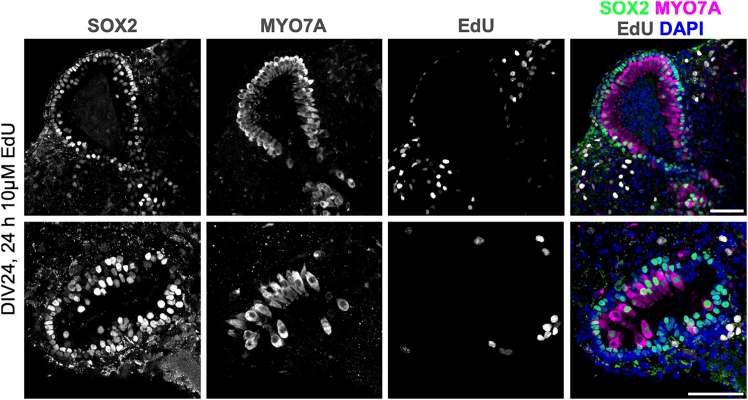
Inner ear organoids represent a potentially inexhaustible source of otic tissues, including sensory hair cells and supporting cells, for in vitro manipulation. Here, we present a protocol for labeling S-phase entry of cells in inner ear organoids using 5-ethynyl-2'-deoxyuridine (EdU), followed by fixation and vibratome sectioning. Nuclear EdU is then detected alongside protein markers of interest via immunofluorescence. This workflow enables the visualization of cell and tissue morphologies within developing organoids and assessment of how different manipulations affect cell proliferation. For complete details on the use and execution of this protocol, please refer to Matern et al..

摘要

内耳类器官是用于体外操作的耳组织(包括感觉毛细胞和支持细胞)潜在的无穷来源。在此,我们展示了一种使用5-乙炔基-2'-脱氧尿苷(EdU)标记内耳类器官中细胞进入S期的方案,随后进行固定和振动切片。然后通过免疫荧光检测细胞核中的EdU以及感兴趣的蛋白质标志物。该工作流程能够可视化发育中的类器官内的细胞和组织形态,并评估不同操作如何影响细胞增殖。有关此方案使用和执行的完整详细信息,请参考马特恩等人的文献。

https://cdn.ncbi.nlm.nih.gov/pmc/blobs/7b07/12392772/85ff06ae225f/gr5.jpg
https://cdn.ncbi.nlm.nih.gov/pmc/blobs/7b07/12392772/4338aecce7fe/fx1.jpg
https://cdn.ncbi.nlm.nih.gov/pmc/blobs/7b07/12392772/7b7518104a60/gr1.jpg
https://cdn.ncbi.nlm.nih.gov/pmc/blobs/7b07/12392772/a300a032bc88/gr2.jpg
https://cdn.ncbi.nlm.nih.gov/pmc/blobs/7b07/12392772/de54dfca3efa/gr3.jpg
https://cdn.ncbi.nlm.nih.gov/pmc/blobs/7b07/12392772/3d26fe276118/gr4.jpg
https://cdn.ncbi.nlm.nih.gov/pmc/blobs/7b07/12392772/85ff06ae225f/gr5.jpg
https://cdn.ncbi.nlm.nih.gov/pmc/blobs/7b07/12392772/4338aecce7fe/fx1.jpg
https://cdn.ncbi.nlm.nih.gov/pmc/blobs/7b07/12392772/7b7518104a60/gr1.jpg
https://cdn.ncbi.nlm.nih.gov/pmc/blobs/7b07/12392772/a300a032bc88/gr2.jpg
https://cdn.ncbi.nlm.nih.gov/pmc/blobs/7b07/12392772/de54dfca3efa/gr3.jpg
https://cdn.ncbi.nlm.nih.gov/pmc/blobs/7b07/12392772/3d26fe276118/gr4.jpg
https://cdn.ncbi.nlm.nih.gov/pmc/blobs/7b07/12392772/85ff06ae225f/gr5.jpg

相似文献

1
Protocol for vibratome sectioning, immunofluorescence, and S-phase labeling of inner ear organoids.内耳类器官振动切片、免疫荧光和S期标记实验方案。
STAR Protoc. 2025 Aug 14;6(3):104032. doi: 10.1016/j.xpro.2025.104032.
2
Generation and characterization of vestibular inner ear organoids from human pluripotent stem cells.人多能干细胞来源的前庭内耳类器官的生成与表征
Nat Protoc. 2025 Jun 2. doi: 10.1038/s41596-025-01191-3.
3
Development of histological sectioning techniques for the cochlear implanted inner ear in miniature swine.小型猪人工耳蜗植入内耳组织切片技术的发展
J Neurosci Methods. 2025 Jul 7;423:110527. doi: 10.1016/j.jneumeth.2025.110527.
4
A Hybrid 2D/3D Approach for Neural Differentiation Into Telencephalic Organoids and Efficient Modulation of FGF8 Signaling.一种用于神经分化为端脑类器官及有效调节FGF8信号传导的二维/三维混合方法
Bio Protoc. 2025 Jun 20;15(12):e5354. doi: 10.21769/BioProtoc.5354.
5
Protocol for the generation and analysis of organoids from Dental pulp stem cells (DPSCs).牙髓干细胞(DPSCs)来源类器官的生成与分析方案。
Tissue Cell. 2025 Oct;96:103010. doi: 10.1016/j.tice.2025.103010. Epub 2025 Jun 11.
6
Protocol for differentiating human pluripotent stem cells into midbrain organoids for targeted microinjection of viruses.将人类多能干细胞分化为中脑类器官以进行病毒靶向显微注射的方案。
STAR Protoc. 2025 Jul 25;6(3):103983. doi: 10.1016/j.xpro.2025.103983.
7
Protocol for the generation and differentiation of thymic epithelial organoids from adult mouse thymus tissue.从成年小鼠胸腺组织生成和分化胸腺上皮类器官的方案。
STAR Protoc. 2025 Jun 20;6(2):103883. doi: 10.1016/j.xpro.2025.103883. Epub 2025 Jun 10.
8
Protocol for establishing genetically engineered murine lung organoids mimicking cell plasticity and regeneration.建立模拟细胞可塑性和再生的基因工程小鼠肺类器官的方案。
STAR Protoc. 2025 Jun 20;6(3):103911. doi: 10.1016/j.xpro.2025.103911.
9
Fabricating mice and dementia: opening up relations in multi-species research制造小鼠与痴呆症:开启多物种研究中的关联
10
Mesenchymal stromal/stem cells promote intestinal epithelium regeneration after chemotherapy-induced damage.间充质基质/干细胞促进化疗诱导损伤后的肠道上皮细胞再生。
Stem Cell Res Ther. 2024 Apr 29;15(1):125. doi: 10.1186/s13287-024-03738-9.

本文引用的文献

1
A developmental atlas of mouse vestibular-like inner ear organoids.小鼠前庭样内耳类器官的发育图谱。
iScience. 2025 Jan 16;28(2):111817. doi: 10.1016/j.isci.2025.111817. eCollection 2025 Feb 21.
2
Fbxo2 mouse and embryonic stem cell reporter lines delineate in vitro-generated inner ear sensory epithelia cells and enable otic lineage selection and Cre-recombination.Fbxo2小鼠和胚胎干细胞报告系可描绘体外生成的内耳感觉上皮细胞,并实现耳系选择和Cre重组。
Dev Biol. 2018 Nov 1;443(1):64-77. doi: 10.1016/j.ydbio.2018.08.013. Epub 2018 Sep 1.
3
From Otic Induction to Hair Cell Production: Pax2 Cell Line Illuminates Key Stages of Development in Mouse Inner Ear Organoid Model.
从耳囊诱导到毛细胞生成:Pax2 细胞系揭示了小鼠内耳类器官模型发育的关键阶段。
Stem Cells Dev. 2018 Feb 15;27(4):237-251. doi: 10.1089/scd.2017.0142. Epub 2018 Jan 29.
4
Modulation of Wnt Signaling Enhances Inner Ear Organoid Development in 3D Culture.Wnt信号通路的调控增强了三维培养中内耳类器官的发育。
PLoS One. 2016 Sep 8;11(9):e0162508. doi: 10.1371/journal.pone.0162508. eCollection 2016.
5
Generating Inner Ear Organoids from Mouse Embryonic Stem Cells.从小鼠胚胎干细胞生成内耳类器官。
Methods Mol Biol. 2016;1341:391-406. doi: 10.1007/7651_2015_215.
6
Acquiring Ground State Pluripotency: Switching Mouse Embryonic Stem Cells from Serum/LIF Medium to 2i/LIF Medium.获得基态多能性:将小鼠胚胎干细胞从血清/LIF培养基转换至2i/LIF培养基
Methods Mol Biol. 2016;1341:41-8. doi: 10.1007/7651_2015_207.
7
3D mouse embryonic stem cell culture for generating inner ear organoids.用于生成内耳类器官的3D小鼠胚胎干细胞培养
Nat Protoc. 2014;9(6):1229-44. doi: 10.1038/nprot.2014.100. Epub 2014 May 1.
8
Generation of inner ear sensory epithelia from pluripotent stem cells in 3D culture.三维培养多能干细胞生成内耳感觉上皮。
Nature. 2013 Aug 8;500(7461):217-21. doi: 10.1038/nature12298. Epub 2013 Jul 10.