Godeau Amélie Luise, Seriola Anna, Tchaicheeyan Oren, Casals Marc, Denkova Denitza, Aroca Ester, Massafret Ot, Parra Albert, Demestre Maria, Ferrer-Vaquer Anna, Goren Shahar, Veiga Anna, Solé Miquel, Boada Montse, Comelles Jordi, Martínez Elena, Colombelli Julien, Lesman Ayelet, Ojosnegros Samuel
Institute for Bioengineering of Catalonia (IBEC), The Barcelona Institute of Science and Technology (BIST), 08028 Barcelona, Spain.
School of Mechanical Engineering, Faculty of Engineering, Tel Aviv University, Tel-Aviv, 55 Chaim Levanon St., Ramat Aviv 69978, Israel.
Sci Adv. 2025 Aug 15;11(33):eadr5199. doi: 10.1126/sciadv.adr5199.
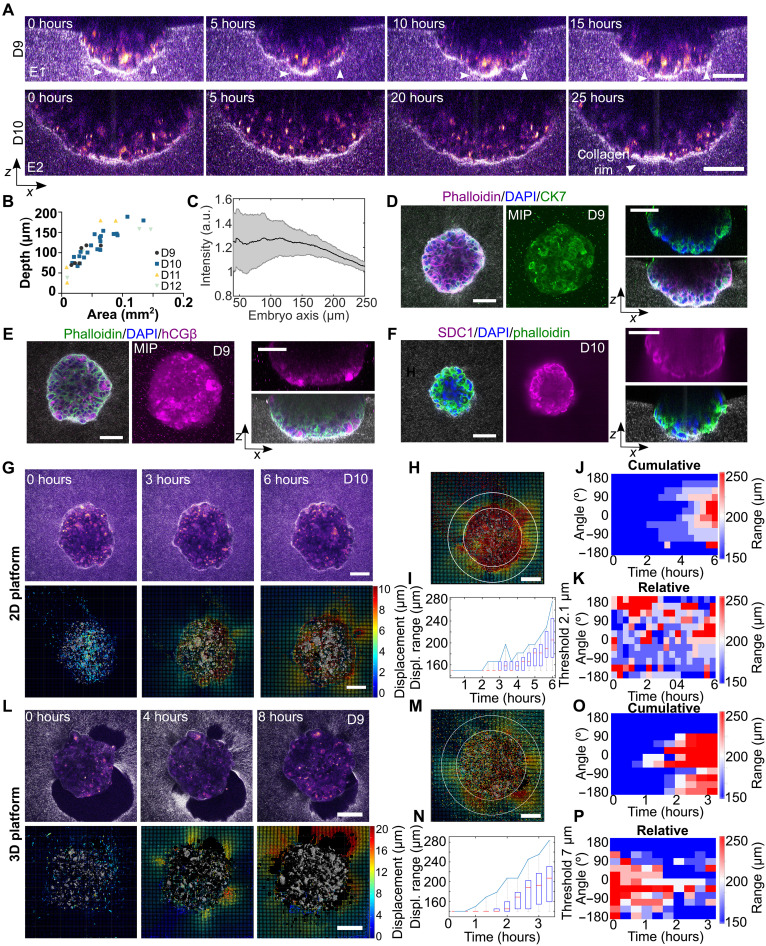
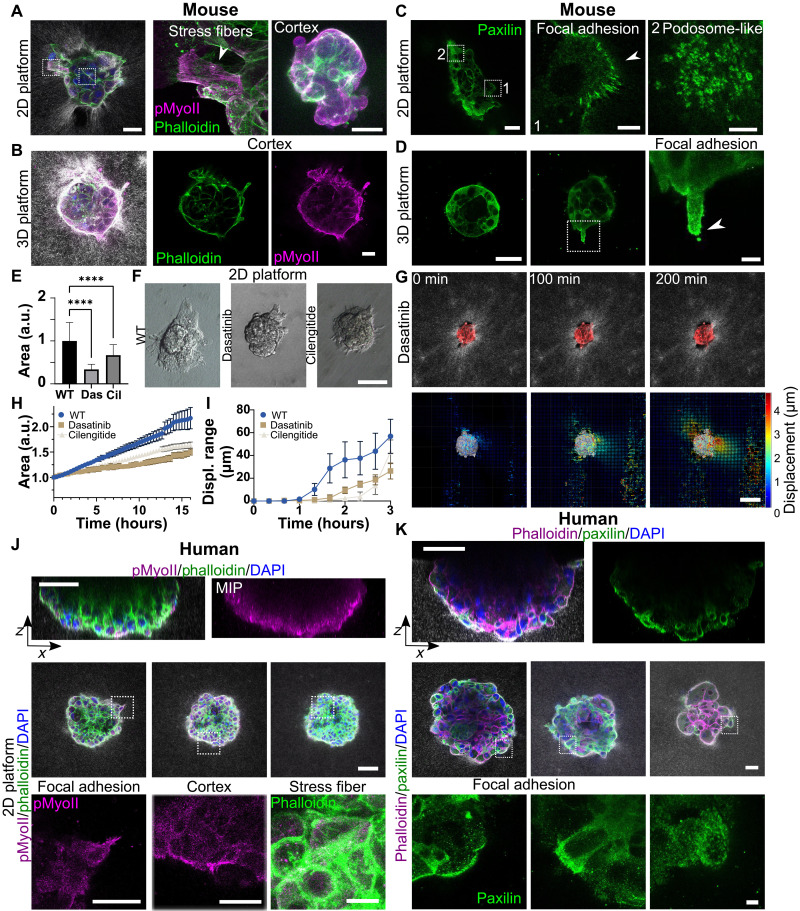
The invasion of human embryos in the uterus overcoming the maternal tissue barrier is a crucial step in embryo implantation and subsequent development. Although tissue invasion is fundamentally a mechanical process, most studies have focused on the biochemical and genetic aspects of implantation. Here, we fill the gap by using a deformable ex vivo platform to visualize traction during human embryo implantation. We demonstrate that embryos apply forces remodeling the matrix with species-specific displacement amplitudes and distinct radial patterns: principal displacement directions for mouse embryos, expanding on the surface while human embryos insert in the matrix generating multiple traction foci. Implantation-impaired human embryos showed reduced displacement, as well as mouse embryos with inhibited integrin-mediated force transmission. External mechanical cues induced a mechanosensitive response, human embryos recruited myosin, and directed cell protrusions, while mouse embryos oriented their implantation or body axis toward the external cue. These findings underscore the role of mechanical forces in driving species-specific invasion patterns during embryo implantation.
人类胚胎在子宫内侵入并克服母体组织屏障是胚胎着床及后续发育的关键步骤。尽管组织侵入从根本上来说是一个机械过程,但大多数研究都集中在着床的生化和遗传方面。在此,我们通过使用一个可变形的体外平台来可视化人类胚胎着床过程中的牵引力,填补了这一空白。我们证明,胚胎施加力重塑基质,具有物种特异性的位移幅度和独特的径向模式:小鼠胚胎的主要位移方向是在表面扩展,而人类胚胎则插入基质中产生多个牵引焦点。着床受损的人类胚胎显示位移减少,整合素介导的力传递受抑制的小鼠胚胎也是如此。外部机械信号诱导了机械敏感反应,人类胚胎募集肌球蛋白并引导细胞突起,而小鼠胚胎则将其着床或身体轴朝向外部信号定向。这些发现强调了机械力在驱动胚胎着床过程中物种特异性侵入模式方面的作用。