Ler Peggy, Jylhävä Juulia, Hägg Sara, Finkel Deborah, Dahl Aslan Anna K, Ploner Alexander, Karlsson Ida K
Department of Medical Epidemiology and Biostatistics, Karolinska Institutet, Stockholm, Sweden.
Department of Medical Epidemiology and Biostatistics, Karolinska Institutet, Stockholm, Sweden; Faculty of Medicine and Health Technology, and Gerontology Research Center, University of Tampere, Tampere, Finland; Tampere Institute for Advanced Study, Tampere University, Tampere, Finland.
EBioMedicine. 2025 Aug 16;119:105883. doi: 10.1016/j.ebiom.2025.105883.
The role of biological ageing in the association between body mass index (BMI) and survival remains unclear. We examined whether epigenetic age acceleration (EAA), a biomarker of biological ageing, mediates the BMI-survival association.
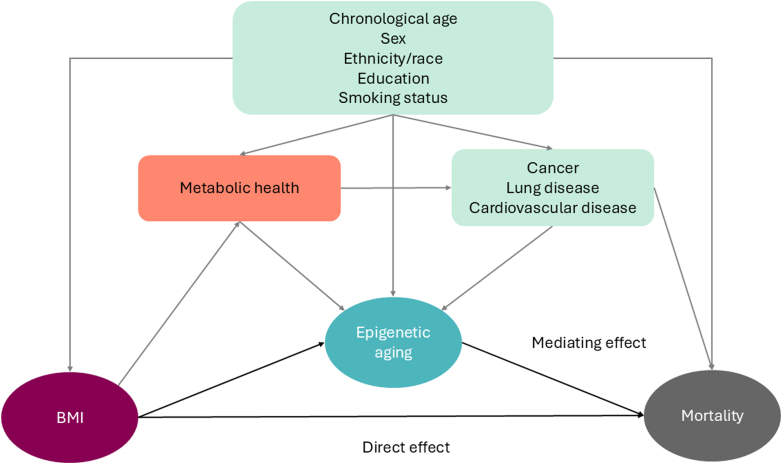
We analysed data from 3840 participants (aged 51-100) in the 2016 US Health and Retirement Study, with survival information through 2020. Mediation analyses were performed using linear regression and Gompertz proportional hazards models with restricted cubic splines, adjusting for age, sex, ethnicity/race, smoking, education, and metabolic health. Average direct effects (ADE) of BMI and average causal mediation effects of EAA (HannumAgeAcc, PhenoAgeAcc, GrimAgeAcc, and DunedinPace) on survival time were estimated with 95% confidence intervals (CI).
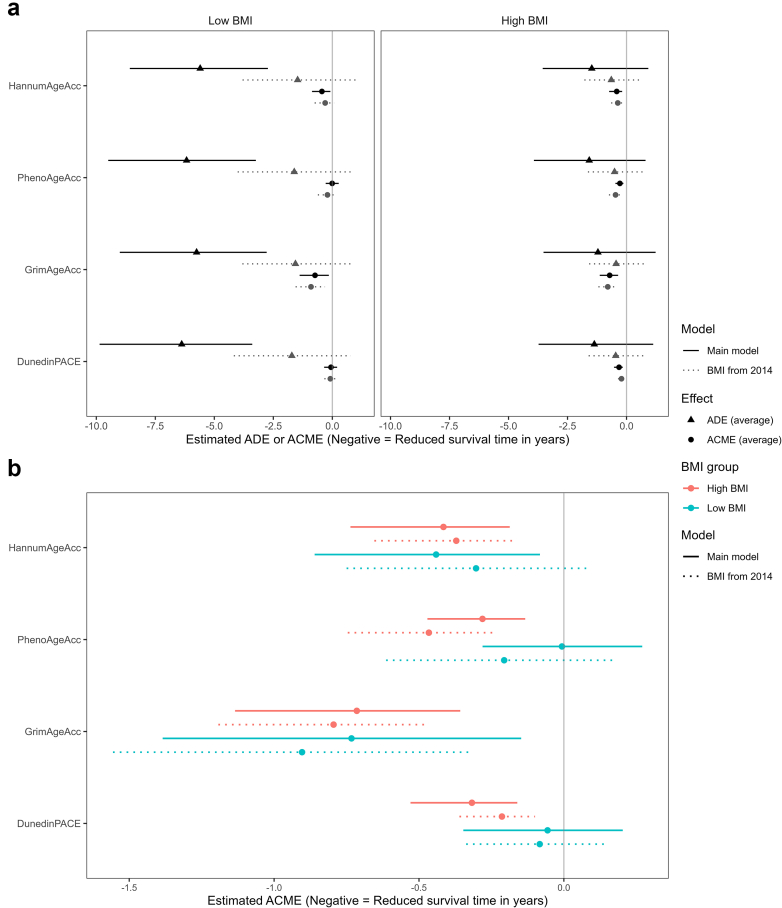
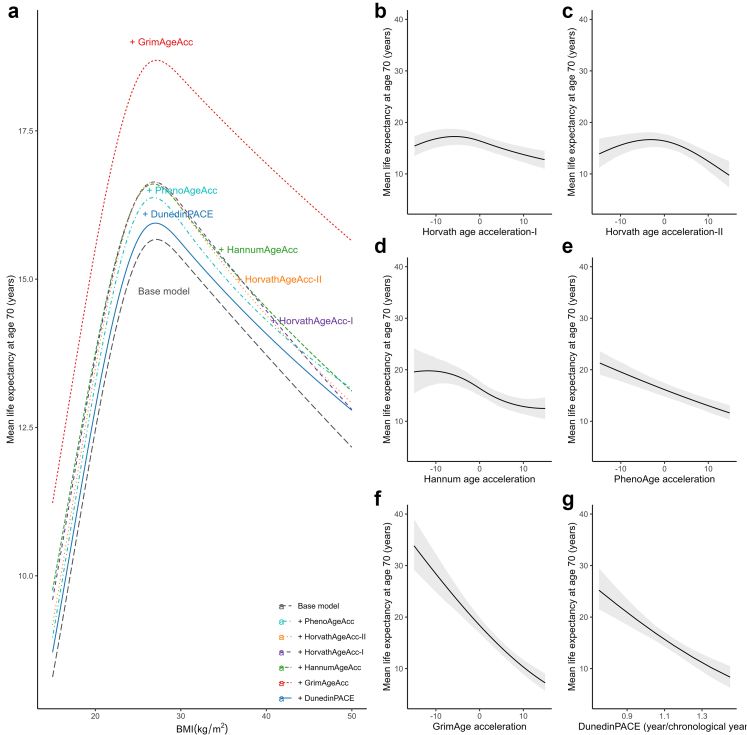
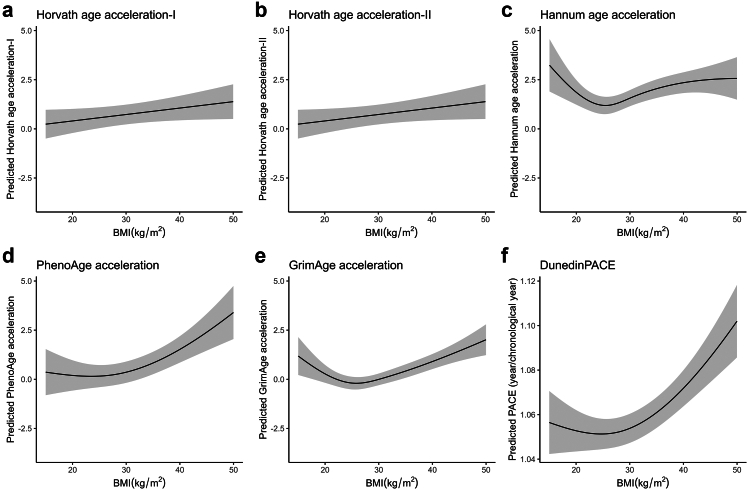
Associations between BMI, EAA, and survival were nonlinear: high and low BMIs were associated with higher EAA and reduced survival time. ADEs of high BMI (35 kg/m versus 27 kg/m) were not statistically significant (reduced survival time: 1.21-1.58 years) but significant for low BMI (19 kg/m versus 27 kg/m, reduced survival time: 5.60-6.38 years). For high BMI, mediation was significant through all EAAs, with reduced survival time ranging from 0.28 to 0.71 years, accounting for 15-37% of total effects. For low BMI, mediation was statistically significant through HannumAgeAcc (reduced survival time: 0.44, CI: 0.08-0.86) and GrimAgeAcc (reduced survival time: 0.73, CI: 0.15-1.38), accounting for 7-11% of total effects.
EAA partially mediated the high BMI-survival association, supporting the mediating role of accelerated ageing in the obesity-survival relationship. Mediation through EAA in the low BMI-survival association was weaker, indicating that alternative mechanisms, other than accelerated ageing, may dominate.
Forte, Vetenskaprådet, SFOepi, Karolinska Institutet's Research Foundation, Loo and Hans Osterman Foundation, the Foundation for Geriatric Diseases at Karolinska Institutet.
生物衰老在体重指数(BMI)与生存之间的关联中所起的作用仍不明确。我们研究了表观遗传年龄加速(EAA)这一生物衰老的生物标志物是否介导了BMI与生存之间的关联。
我们分析了2016年美国健康与退休研究中3840名参与者(年龄在51 - 100岁之间)的数据,并获取了截至2020年的生存信息。使用线性回归和带有受限立方样条的Gompertz比例风险模型进行中介分析,并对年龄、性别、种族/民族、吸烟、教育程度和代谢健康进行了调整。估计了BMI的平均直接效应(ADE)以及EAA(汉纳姆年龄加速、表型年龄加速、格里姆年龄加速和达尼丁步伐)对生存时间的平均因果中介效应,并给出95%置信区间(CI)。
BMI、EAA与生存之间的关联是非线性的:高BMI和低BMI均与较高的EAA及较短的生存时间相关。高BMI(35kg/m² 对比27kg/m²)的ADE无统计学意义(生存时间缩短:1.21 - 1.58年),但低BMI(19kg/m² 对比27kg/m²,生存时间缩短:5.60 - 6.38年)的ADE有统计学意义。对于高BMI,通过所有EAA的中介作用均显著,生存时间缩短范围为0.28至0.71年,占总效应的15% - 37%。对于低BMI,通过汉纳姆年龄加速(生存时间缩短:0.44,CI:0.08 - 0.86)和格里姆年龄加速(生存时间缩短:0.73,CI:0.15 - 1.38)的中介作用有统计学意义,占总效应的7% - 11%。
EAA部分介导了高BMI与生存之间的关联,支持了加速衰老在肥胖与生存关系中的中介作用。在低BMI与生存的关联中,通过EAA的中介作用较弱,表明除加速衰老外的其他机制可能起主导作用。
福特、瑞典科学理事会、SFOepi、卡罗林斯卡学院研究基金会、卢和汉斯·奥斯特曼基金会、卡罗林斯卡学院老年病基金会。