Appel Ruth E, Roozenbeek Jon, Rayburn-Reeves Rebecca, Basol Melisa, Corbin Jonathan, Compton Josh, van der Linden Sander
Department of Communication, Stanford University, Stanford, USA.
Department of War Studies, King's College London, London, UK.
Sci Rep. 2025 Aug 18;15(1):29830. doi: 10.1038/s41598-025-09462-5.
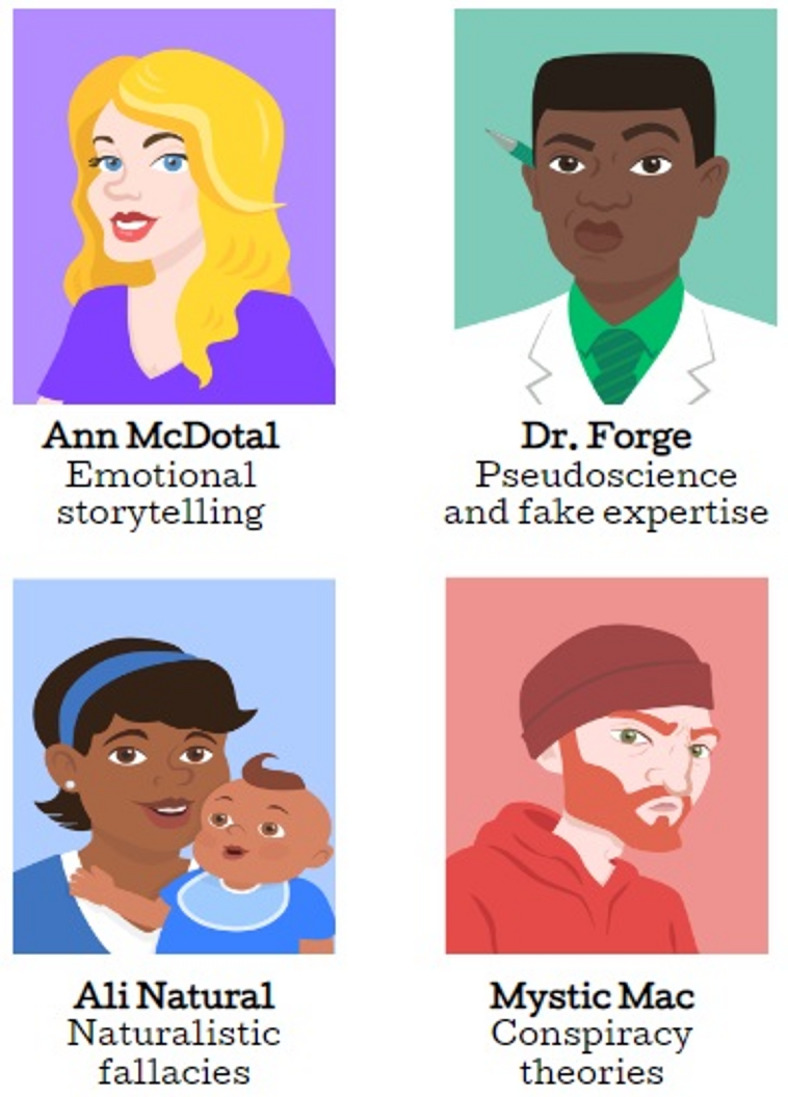
Vaccine misinformation endangers public health by contributing to reduced vaccine uptake. We developed a short online game to reduce people's susceptibility to vaccine misinformation. Building on inoculation theory, the Bad Vaxx game exposes people to weakened doses of manipulation techniques commonly used in vaccine misinformation and to strategies to identify these techniques. Across three preregistered randomized controlled trials (N = 2,326), we find that the game significantly improves participants' ability to discern vaccine misinformation from non-misinformation, their confidence in their ability to do so, and the quality of their sharing decisions. Further, taking the perspective of a character fighting as opposed to spreading misinformation is more effective on some outcome measures. In line with the learning goals of the intervention, we show that participants improve their ability to correctly identify the use of specific misinformation techniques. This insight is important because teaching manipulation technique recognition is not only effective to help evaluate information about vaccines, but also more viable than trying to debunk myriads of constantly-evolving myths. Our findings suggest that a short, low-cost, gamified intervention can increase resilience to vaccine misinformation.
疫苗错误信息会导致疫苗接种率降低,从而危及公众健康。我们开发了一款简短的在线游戏,以降低人们对疫苗错误信息的易感性。基于接种理论,“不良疫苗”游戏让人们接触到疫苗错误信息中常用的弱化版操纵技巧,以及识别这些技巧的策略。在三项预先注册的随机对照试验(N = 2326)中,我们发现该游戏显著提高了参与者从非错误信息中辨别疫苗错误信息的能力、他们对自己辨别能力的信心以及他们分享决策的质量。此外,从一个与传播错误信息作斗争的角色的角度出发在某些结果指标上更有效。符合干预的学习目标,我们表明参与者提高了正确识别特定错误信息技巧使用的能力。这一见解很重要,因为教授操纵技巧识别不仅有助于评估有关疫苗的信息,而且比试图揭穿无数不断演变的谣言更可行。我们的研究结果表明,一种简短、低成本、游戏化的干预措施可以增强对疫苗错误信息的抵御能力。