Alvarez-Galvez Javier, Lagares-Franco Carolina, Ortega-Martin Esther, De Sola Helena, Rojas-García Antonio, Sanz-Marcos Paloma, Almenara-Barrios José, Kassianos Angelos P, Montagni Ilaria, Camacho-García María, Serrano-Macías Maribel, Carretero-Bravo Jesús
Computational Social Science DataLab (CS2 DataLab), University Institute for Sustainable Social Development (INDESS), University of Cadiz, Jerez de la Frontera (Cadiz), Spain.
Department of General Economy (Sociology), University of Cadiz, Cadiz, Spain.
JMIR Infodemiology. 2025 Jun 16;5:e69945. doi: 10.2196/69945.
The COVID-19 pandemic has been accompanied by an unprecedented infodemic characterized by the widespread dissemination of misinformation. Globally, misinformation about COVID-19 has led to polarized beliefs and behaviors, including vaccine hesitancy, rejection of governmental authorities' recommendations, and distrust in health institutions. Thus, understanding the prevalence and drivers of misinformation is critical for designing effective and contextualized public health strategies.
On the basis of a tailored survey on health misinformation, this study aims to assess the prevalence and distribution of COVID-19-related misinformation in Spain; identify population groups based on their beliefs; and explore the social, economic, ideological, and media use factors associated with susceptibility to misinformation.
A cross-sectional telephone survey was conducted with a nationally representative sample of 2200 individuals in Spain. The study developed the COVID-19 Misinformation Scale to measure beliefs in misinformation. Exploratory factor analysis identified key misinformation topics, and k-means clustering classified participants into 3 groups: convinced, hesitant, and skeptical. Multinomial logistic regression was used to explore associations between misinformation beliefs and demographic, social, and health-related variables.
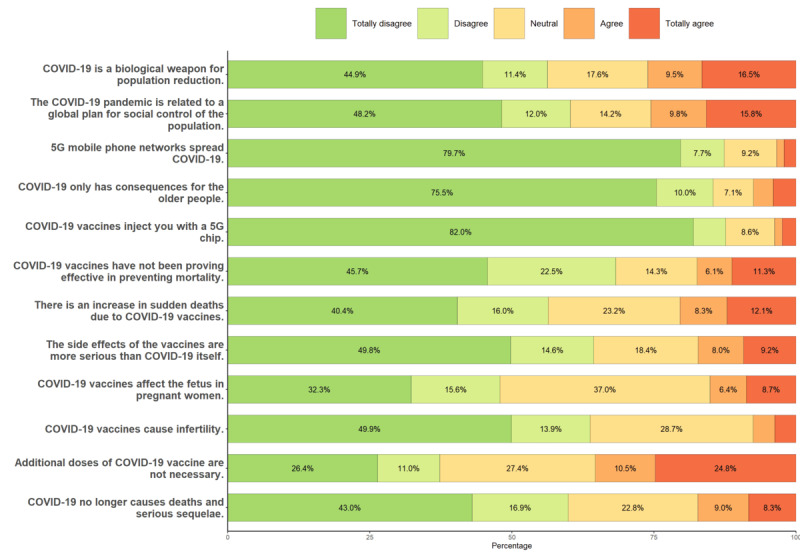
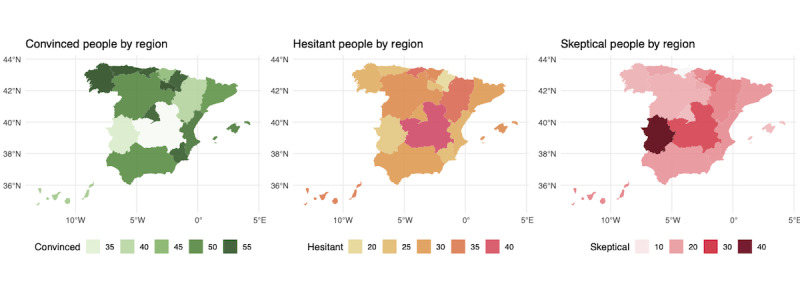
Three population groups were identified: convinced (1078/2200, 49%), hesitant (666/2200, 30.27%), and skeptical (456/2200, 20.73%). Conspiracy theories, doubts about vaccines, and stories about sudden death emerged as the most endorsed current misinformation topics. Higher susceptibility to misinformation was associated with the female sex, lower socioeconomic status, use of low-quality information sources, higher levels of media sharing, greater religiosity, distrust of institutions, and extreme and unstated political ideologies. Frequent sharing of health information on social networks was also associated with membership in the skeptical group, regardless of whether the information was verified. Interestingly, women were prone to COVID-19 skepticism, a finding that warranted further research to understand the gender-specific factors driving vulnerability to health misinformation. In addition, a geographic distribution of hesitant and skeptical groups was observed that coincides with the so-called empty Spain, areas where political disaffection with the main political parties is greater.
This study highlights the important role of determinants of susceptibility to COVID-19 misinformation that go beyond purely socioeconomic and ideological factors. Although these factors are relevant in explaining the social reproduction of this phenomenon, some determinants are linked to the use of social media (ie, searching and sharing of alternative health information) and probably the political disaffection of citizens who have stopped believing in both the ideologically centrist mainstream parties and the institutions that represent them. Furthermore, by establishing the profile and geographic distribution of the convinced, hesitant, and skeptical groups, our results provide useful insights for public health interventions. Specific strategies should focus on restoring institutional trust, promoting reliable sources of information, and addressing structural drivers of health misinformation linked to gender inequalities.
新冠疫情伴随着一场前所未有的信息疫情,其特点是错误信息广泛传播。在全球范围内,关于新冠疫情的错误信息导致了两极分化的观念和行为,包括对疫苗的犹豫、拒绝政府当局的建议以及对卫生机构的不信任。因此,了解错误信息的流行程度和驱动因素对于设计有效的、因地制宜的公共卫生策略至关重要。
基于一项针对健康错误信息的定制调查,本研究旨在评估西班牙与新冠疫情相关的错误信息的流行程度和分布情况;根据人们的信念确定人群类别;并探讨与易受错误信息影响相关的社会、经济、意识形态和媒体使用因素。
对西班牙2200名具有全国代表性的个体进行了横断面电话调查。该研究开发了新冠疫情错误信息量表来衡量对错误信息的信念。探索性因素分析确定了关键的错误信息主题,k均值聚类将参与者分为3组:确信组、犹豫组和怀疑组。多项逻辑回归用于探讨错误信息信念与人口统计学、社会和健康相关变量之间的关联。
确定了三类人群:确信组(1078/2200,49%)、犹豫组(666/2200,30.27%)和怀疑组(456/2200,20.73%)。阴谋论、对疫苗的怀疑以及关于猝死的故事成为目前最受认可的错误信息主题。更容易受到错误信息影响与女性、较低的社会经济地位、使用低质量信息来源、较高的媒体分享水平、更高的宗教虔诚度、对机构的不信任以及极端和未阐明的政治意识形态有关。在社交网络上频繁分享健康信息也与怀疑组的成员身份有关,无论信息是否经过核实。有趣的是,女性容易对新冠疫情持怀疑态度,这一发现值得进一步研究,以了解导致易受健康错误信息影响的性别特定因素。此外,观察到犹豫组和怀疑组的地理分布与所谓的“空心西班牙”相吻合,即对主要政党政治不满情绪较高的地区。
本研究强调了新冠疫情错误信息易感性决定因素的重要作用,这些因素超越了纯粹的社会经济和意识形态因素。虽然这些因素在解释这一现象的社会再现方面具有相关性,但一些决定因素与社交媒体的使用(即搜索和分享替代性健康信息)有关,可能还与那些不再相信意识形态上处于中间立场的主流政党及其代表机构的公民的政治不满情绪有关。此外,通过确定确信组、犹豫组和怀疑组的特征及地理分布,我们的研究结果为公共卫生干预提供了有用的见解。具体策略应侧重于恢复机构信任、推广可靠的信息来源以及解决与性别不平等相关的健康错误信息的结构性驱动因素。