Jessen Henrik H, Opdal Anders Frugård, Enberg Katja
Department of Biological Sciences, University of Bergen, 5006, Bergen, Norway.
Sci Rep. 2025 Aug 17;15(1):30039. doi: 10.1038/s41598-025-15394-x.
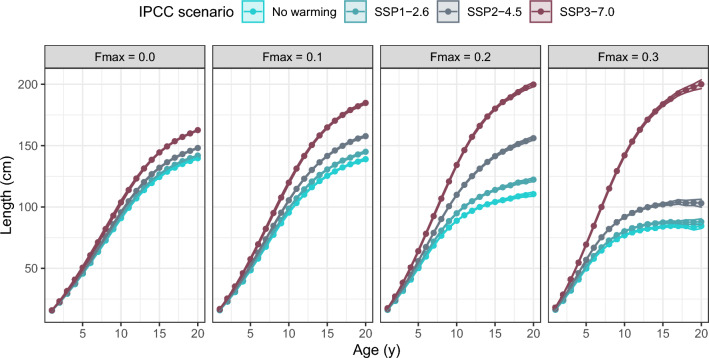
Fisheries and climate warming are two stressors known to induce evolutionary changes in fish life histories. While their independent effects have been well documented, their interactive effects are less charted, although likely important for sustainable fisheries management and conservation strategies. We investigated the evolutionary responses of the Northeast Arctic cod stock (Gadus morhua) to warming temperatures and fishing pressure using a mechanistic modeling approach. Our individual-based simulation model incorporates explicit energy and oxygen budgets, and a simplified genetics framework to capture the complex interactions among traits governing energy acquisition/allocation and maturation schedules. Our results provide a theoretical basis for positive consequences for this particular cod stock in a warming climate. Warmer temperatures increased the aerobic scope, which reduced natural mortality. We found that if food availability and temperature are not linked, a warming climate leads to larger population sizes. By selecting for maturation at larger sizes, adaptation to warming climate at least partially counteracts the evolutionary consequences of fishing, namely smaller body sizes and earlier maturation. Our findings emphasize the benefits of adaptive management approaches, considering fish as evolving organisms and integrating ocean warming into fisheries management strategies.
渔业和气候变暖是已知会引发鱼类生活史进化变化的两个压力源。虽然它们的独立影响已有充分记录,但它们的交互影响却鲜有人研究,尽管这可能对可持续渔业管理和保护策略至关重要。我们使用一种机理建模方法,研究了东北北极鳕鱼种群(大西洋鳕鱼)对水温升高和捕捞压力的进化反应。我们基于个体的模拟模型纳入了明确的能量和氧气预算,以及一个简化的遗传学框架,以捕捉控制能量获取/分配和成熟时间表的性状之间的复杂相互作用。我们的结果为在气候变暖情况下该特定鳕鱼种群产生积极后果提供了理论依据。水温升高增加了有氧代谢范围,从而降低了自然死亡率。我们发现,如果食物供应和温度不相关联,气候变暖会导致种群规模增大。通过选择更大体型时成熟,对气候变暖的适应至少部分抵消了捕捞的进化后果,即体型变小和成熟提前。我们的研究结果强调了适应性管理方法的益处,即将鱼类视为不断进化的生物体,并将海洋变暖纳入渔业管理策略。