Bucko Patricia, Novack Miriam A, Ho Emily H, Ece Berivan, Burleigh Evan, Mather Molly A, Karpouzian-Rogers Tatiana, Dworak Elizabeth M, Pila Sarah, Hosseinian Zahra, Han S Duke, Lichtenberg Peter A, Gershon Richard C, Weintraub Sandra
Department of Medical Social Sciences, Northwestern University Feinberg School of Medicine, Chicago, IL, United States.
Department of Psychology, Northwestern University, Evanston, IL, United States.
Front Med (Lausanne). 2025 Jul 31;12:1540486. doi: 10.3389/fmed.2025.1540486. eCollection 2025.
Cognitive impairment (CI) and related conditions are known to affect decision-making (DM), particularly in older adult populations. The intersection of CI and DM ability is crucial in end-of-life (EoL) care, where there is a confluence of heterogenous preferences and values often across different constituents (e.g., healthcare providers, family members, and proxies). Standardized questionnaires are necessary to characterize patients' EoL decisions, preferences, and readiness, but the extent of available measures is widely unknown.
This scoping review aims to summarize the current state of the literature regarding EoL decision-making measures. This effort supports the development of the Advancing Reliable Measurement in Cognitive Aging and Decision-making Ability (ARMCADA) research initiative, which seeks to develop a decision-making battery for use in older adults.
Following the Arksey and O'Malley framework, we conducted a scoping review for multiple domains of DM in studies published between January 2018 and November 2023. Any paper that assessed or characterized DM in participants 45 years and older was extracted for the DM domain, population characteristics, and DM measures.
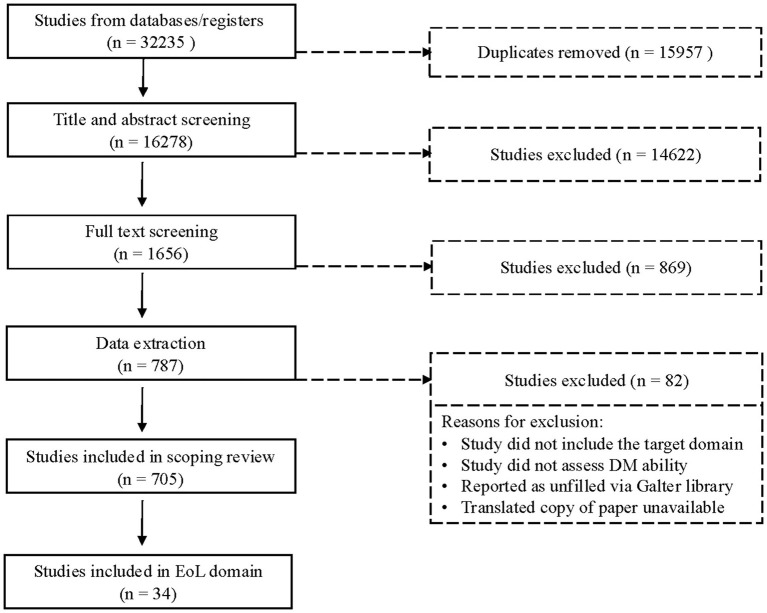
An initial search identified 16,286 articles, of which 705 were classified as assessing DM. Of those, 34 articles included measures of the EoL domain, and 28 unique measures were identified. The MacArthur Competence Assessment Tool for Treatment (MacCAT-T), the Decisional Conflict Scale (DCS), and the Decision Regret Scale (DRS) were the only assessments used more than once in the scoping review. Many studies assessed clinical populations, including those with CI/dementia (12%), cancer (24%), and chronic conditions (16%). Findings show that measures used at the end of life emphasize decisional preferences, efficacy, and conflict.
Overall, this review highlights the lack of DM ability measures that can assess older adults' capacity to make decisions regarding EoL-specific issues (e.g., life-sustaining treatment and pain management).
认知障碍(CI)及相关情况已知会影响决策(DM),尤其是在老年人群体中。CI与DM能力的交叉在临终(EoL)护理中至关重要,在这种情况下,不同的组成部分(如医疗保健提供者、家庭成员和代理人)往往存在多种不同的偏好和价值观。标准化问卷对于描述患者的EoL决策、偏好和准备情况是必要的,但现有测量方法的范围广为人知。
本范围综述旨在总结关于EoL决策测量的文献现状。这项工作支持了“推进认知衰老与决策能力可靠测量”(ARMCADA)研究计划的开展,该计划旨在开发一套用于老年人的决策测试组合。
遵循阿克西和奥马利框架,我们对2018年1月至2023年11月发表的研究中DM的多个领域进行了范围综述。提取了任何评估或描述45岁及以上参与者DM的论文,以获取DM领域、人群特征和DM测量方法。
初步检索确定了16286篇文章,其中705篇被归类为评估DM。其中,34篇文章包括EoL领域的测量方法,共识别出28种独特的测量方法。麦克阿瑟治疗能力评估工具(MacCAT-T)、决策冲突量表(DCS)和决策后悔量表(DRS)是范围综述中仅有的被多次使用的评估方法。许多研究评估了临床人群,包括患有CI/痴呆症的人群(12%)、癌症患者(24%)和慢性病患者(16%)。研究结果表明,临终时使用的测量方法强调决策偏好、效能和冲突。
总体而言,本综述强调了缺乏能够评估老年人就EoL特定问题(如维持生命治疗和疼痛管理)做出决策能力的DM能力测量方法。