Manchanda Yusman, Jones Ben, Carrat Gaelle, Ramchunder Zenouska, Marchetti Piero, Leclerc Isabelle, Thennati Rajamannar, Burade Vinod, Natarajan Muthukumaran, Shahi Pradeep, Tomas Alejandra, Rutter Guy A
Section of Cell Biology and Functional Genomics, Department of Metabolism, Digestion and Reproduction, Faculty of Medicine, Imperial College London, London, UK.
Section of Endocrinology and Investigative Medicine, Department of Metabolism, Digestion and Reproduction, Faculty of Medicine, Imperial College London, London, UK.
Diabetes Obes Metab. 2025 Oct;27(10):5938-5949. doi: 10.1111/dom.16652. Epub 2025 Aug 20.
The use of incretin analogues has emerged as an effective approach to achieve both enhanced insulin secretion and weight loss in Type 2 diabetes (T2D) patients. Agonists which bind and stimulate multiple receptors have shown particular promise. However, off-target effects remain a complication of using these agents, and modified versions with optimised pharmacological profiles and/or biased signalling are sought.
Ligand synthesis was achieved using standard solid-phase techniques. Assessments of GLP-1R-binding kinetics, G protein recruitment and receptor internalisation were performed using biochemical and imaging approaches. Insulin secretion was measured in purified mouse and human islets, and drug efficacy was assessed in hyperglycaemic db/db mice.
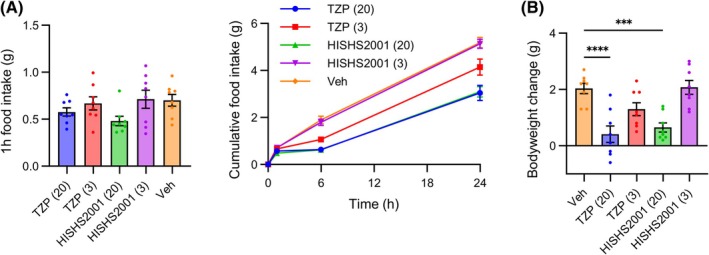
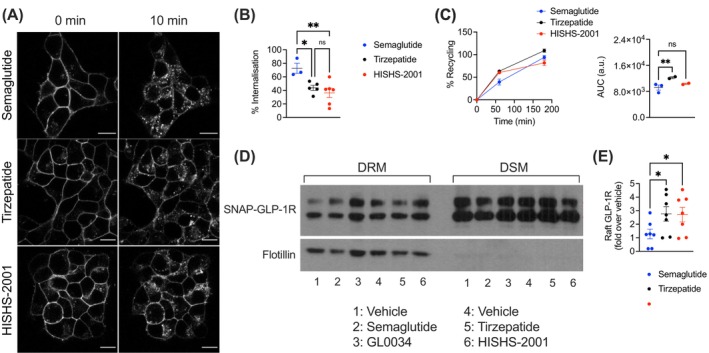
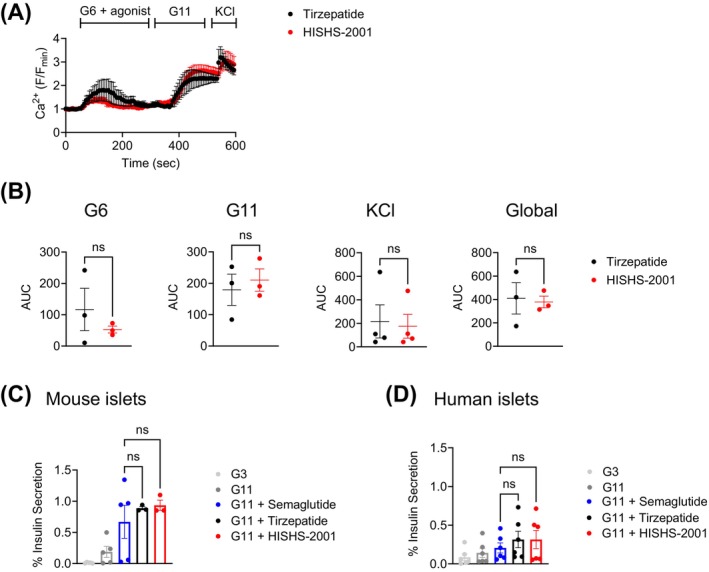
We describe the synthesis and properties of a molecule which binds to both glucagon-like peptide-1 (GLP-1) and glucose-dependent insulinotropic polypeptide (GIP) receptors (GLP-1R and GIPR) to enhance insulin secretion. HISHS-2001 shows increased affinity at the GLP-1R, as well as a tendency towards reduced internalisation and recycling at this receptor versus FDA-approved dual GLP-1R/GIPR agonist tirzepatide. HISHS-2001 also displayed significantly greater bias towards cAMP generation versus β-arrestin 2 recruitment compared to tirzepatide. In contrast, Gs recruitment was lower versus tirzepatide at the GLP-1R, but unchanged at the GIPR. Administered to obese hyperglycaemic db/db mice, HISHS-2001 increased circulating insulin whilst lowering body weight and HbA1c with similar efficacy to tirzepatide at substantially lower doses.
HISHS-2001 represents a novel dual receptor agonist with a promising pharmacological profile and actions. Future clinical studies will be needed to assess the safety and efficacy of this molecule in humans.
使用肠促胰岛素类似物已成为在2型糖尿病(T2D)患者中实现增强胰岛素分泌和体重减轻的有效方法。结合并刺激多种受体的激动剂已显示出特别的前景。然而,脱靶效应仍然是使用这些药物的一个并发症,因此人们正在寻找具有优化药理特性和/或偏向信号传导的改良版本。
使用标准固相技术进行配体合成。使用生化和成像方法评估胰高血糖素样肽-1受体(GLP-1R)结合动力学、G蛋白募集和受体内化。在纯化的小鼠和人类胰岛中测量胰岛素分泌,并在高血糖db/db小鼠中评估药物疗效。
我们描述了一种与胰高血糖素样肽-1(GLP-1)和葡萄糖依赖性促胰岛素多肽(GIP)受体(GLP-1R和GIPR)结合以增强胰岛素分泌的分子的合成和特性。与美国食品药品监督管理局批准的双重GLP-1R/GIPR激动剂替尔泊肽相比,HISHS-2001在GLP-1R上显示出更高的亲和力,并且在该受体上具有减少内化和再循环的趋势。与替尔泊肽相比,HISHS-2001在产生环磷酸腺苷(cAMP)方面对β-抑制蛋白2募集的偏向性也明显更大。相比之下,在GLP-1R上,Gs募集低于替尔泊肽,但在GIPR上则没有变化。给肥胖的高血糖db/db小鼠给药后,HISHS-2001可增加循环胰岛素水平,同时降低体重和糖化血红蛋白(HbA1c),在低得多的剂量下与替尔泊肽具有相似的疗效。
HISHS-2001代表一种具有前景的药理特性和作用的新型双受体激动剂。未来需要进行临床研究以评估该分子在人体中的安全性和疗效。