Harkey Matthew S, Grozier Corey D, Tolzman Jessica, Parmar Arjun, Jildeh Toufic R, Lissy Micah, Dima Robert, Hart Harvi F, Fajardo Ryan
Department of Kinesiology, Michigan State University, East Lansing, MI, USA.
Michigan State University Sports Medicine, East Lansing, MI, USA.
Osteoarthr Imaging. 2025 Jun;5(2). doi: 10.1016/j.ostima.2025.100267. Epub 2025 Mar 26.
The infrapatellar fat pad (IPFP) plays an important role in knee biomechanics and inflammation, particularly following anterior cruciate ligament reconstruction (ACLR). This study investigated whether IPFP stiffness, measured with shear wave elastography, is associated with early symptoms of osteoarthritis (OA) in individuals within one year after ACLR.
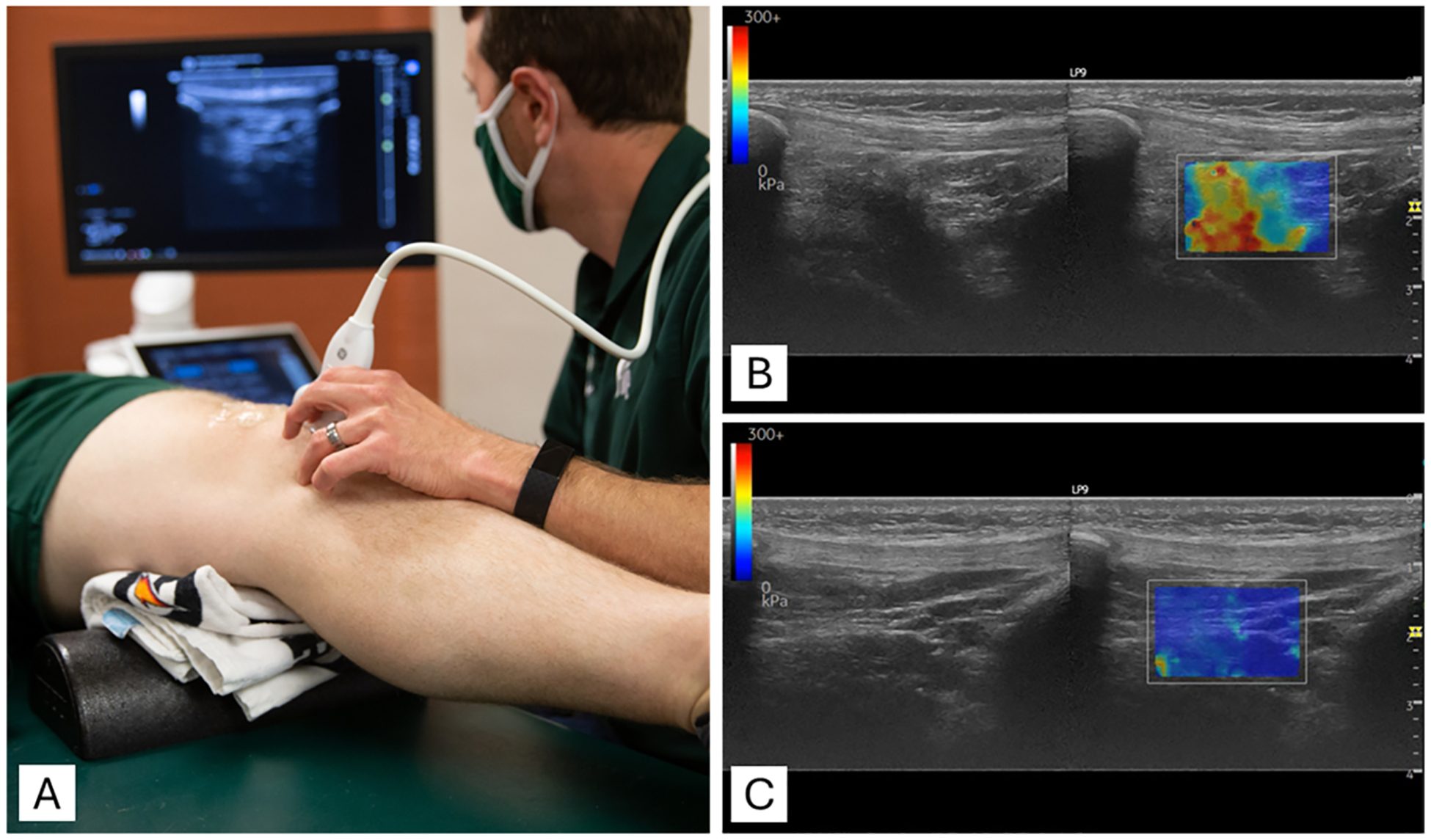
In this cross-sectional study, 24 participants underwent bilateral IPFP stiffness assessments using shear wave elastography. Participants were positioned supine with 20° knee flexion. The stiffness limb symmetry index (LSI) was calculated to normalize stiffness between the ACLR and contralateral limbs. Early OA symptoms were defined as scores ≤85 % on at least two of four subscales of the Knee Injury and Osteoarthritis Outcome Score (KOOS). Independent -tests were used to evaluate group differences in IPFP stiffness LSI, and receiver operating characteristic curve analysis determined the optimal LSI threshold for discriminating between groups.
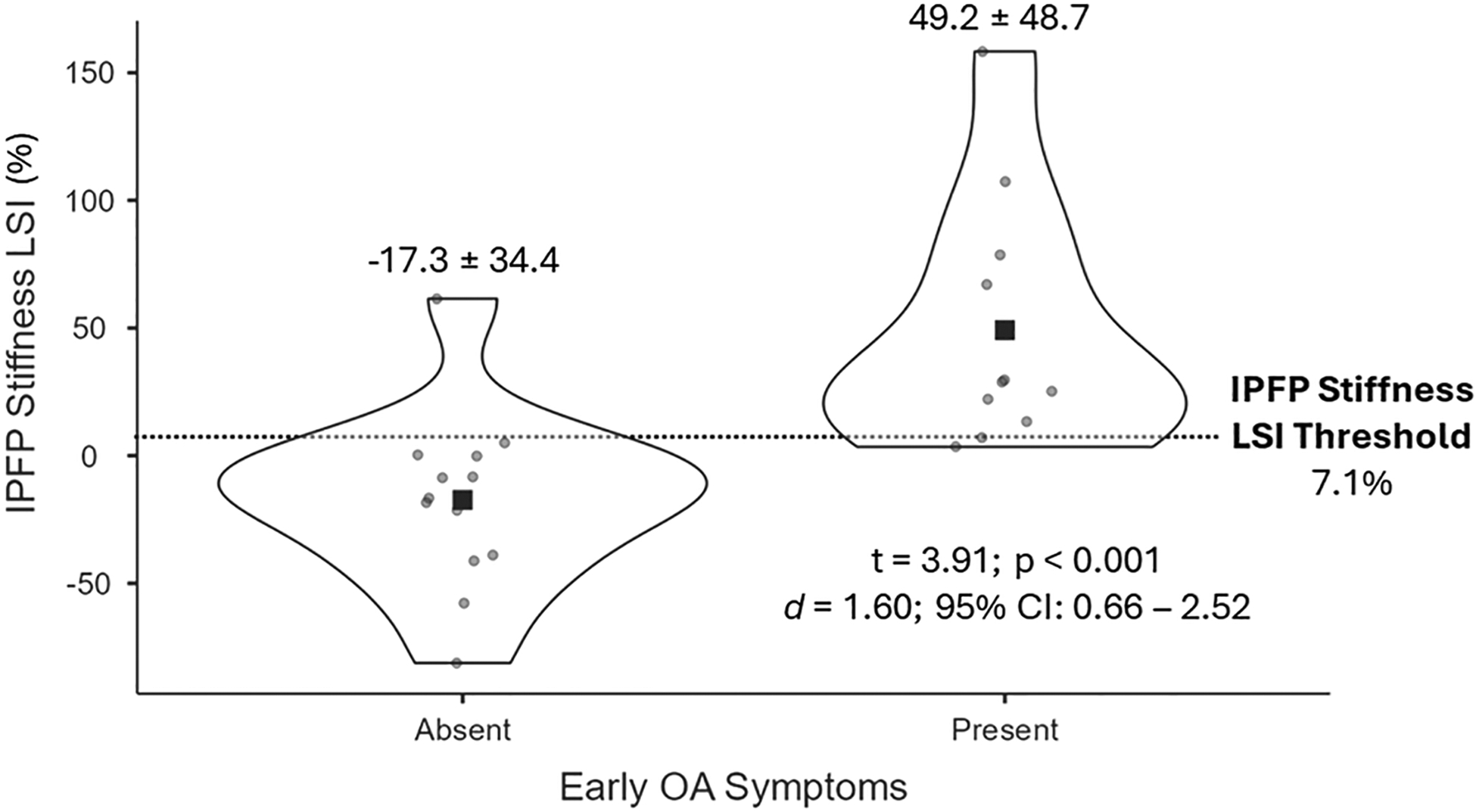
Eleven participants (46 %) showed early OA symptoms. Participants with early OA symptoms exhibited a significantly higher IPFP stiffness LSI compared to those without symptoms (49.2 ± 48.7 % vs. -17.3 ± 34.4 %, < 0.001). An optimal stiffness LSI threshold of 7.1 % was identified, achieving 90.9 % sensitivity, 92.3 % specificity, and an area under the curve of 0.94.
Shear wave elastography shows potential as a non-invasive tool for detecting early IPFP stiffness changes associated with OA symptoms post-ACLR. These findings suggest that IPFP stiffness may be an early marker for OA risk, warranting further longitudinal studies to evaluate its progression and to further examine the clinical utility of shear wave elastography.
髌下脂肪垫(IPFP)在膝关节生物力学和炎症中起重要作用,尤其是在前交叉韧带重建(ACLR)后。本研究调查了通过剪切波弹性成像测量的IPFP硬度是否与ACLR后一年内个体的骨关节炎(OA)早期症状相关。
在这项横断面研究中,24名参与者使用剪切波弹性成像进行了双侧IPFP硬度评估。参与者仰卧位,膝关节屈曲20°。计算硬度肢体对称指数(LSI)以标准化ACLR肢体和对侧肢体之间的硬度。早期OA症状定义为在膝关节损伤和骨关节炎结局评分(KOOS)的四个子量表中至少两个量表上得分≤85%。采用独立样本t检验评估IPFP硬度LSI的组间差异,并通过受试者操作特征曲线分析确定区分两组的最佳LSI阈值。
11名参与者(46%)出现早期OA症状。有早期OA症状的参与者与无症状参与者相比,IPFP硬度LSI显著更高(49.2±48.7%对-17.3±34.4%,P<0.001)。确定了最佳硬度LSI阈值为7.1%,灵敏度为90.9%,特异性为92.3%,曲线下面积为0.94。
剪切波弹性成像显示出作为一种无创工具检测ACLR后与OA症状相关的早期IPFP硬度变化的潜力。这些发现表明,IPFP硬度可能是OA风险的早期标志物,需要进一步进行纵向研究以评估其进展情况,并进一步检验剪切波弹性成像的临床应用价值。