
咖啡因和柚皮苷对高脂饮食诱导的成年雄性非酒精性脂肪性肝病大鼠线粒体生物合成和肝脂肪变性的潜在协同作用
Potential Synergistic Effects of Caffeine and Naringin on Mitochondrial Biogenesis and Hepatic Steatosis in Adult Male Rats With NAFLD Induced by a High-Fat Diet.
作者信息
Azizollahi Mehrasa, Nasehi Zahra, Derakhshan Maryam, Zadhoush Fouzieh
机构信息
Department of Clinical Biochemistry, School of Pharmacy and Pharmaceutical Sciences, Isfahan University of Medical Sciences, Isfahan, Iran.
Department of Pathology, School of Medicine, Isfahan University of Medical Sciences, Isfahan, Iran.
出版信息
Biomed Res Int. 2025 Aug 13;2025:1565994. doi: 10.1155/bmri/1565994. eCollection 2025.
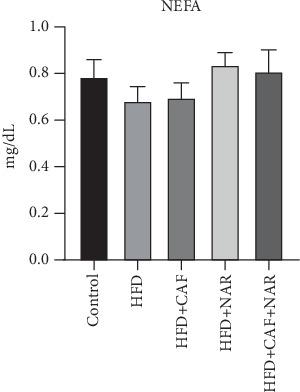
Nonalcoholic fatty liver disease (NAFLD) is one of the most common causes of chronic liver disease worldwide, and disturbances in lipid metabolism and mitochondrial function play a significant role in its progression. In this study, to improve the effects of caffeine (CAF) treatment, we evaluated the effects of CAF and naringin (NAR) alone and in combination on gene expression involved in mitochondrial biogenesis, plasma nonesterified fatty acid (NEFA) levels, hepatic TG levels, and pathological changes in the liver tissue in adult male rats with NAFLD induced by a high-fat diet (HFD). Then, 35 male Wistar rats were randomly assigned to five groups: control, HFD, HFD + CAF, HFD + NAR, and HFD + CAF + NAR (seven rats per group). They were fed a HFD containing 51% fat for 10 weeks, followed by a 6-week gavage treatment with CAF (50 mg/kg/day) and NAR (12.5 mg/kg/day), either individually or in combination. Gene expression related to mitochondrial biogenesis (SIRT1, PGC1, and TFAM), serum NEFA levels, hepatic triglyceride (TG) levels, and liver histological changes were assessed. The combination of CAF and NAR in the HFD + CAF + NAR group significantly increased the expression of SIRT1 ( < 0.01), PGC1- ( < 0.01), and TFAM ( < 0.05) compared to the HFD group, while single treatments did not show such effects. Serum NEFA levels did not change significantly in any of the groups (HFD and treatment groups), but liver TG levels were significantly reduced in both single and combination treatments ( < 0.001). Pathological changes, including improvements in steatosis, inflammation, and ballooning, were observed in the treatment groups, particularly in the HFD + CAF + NAR group. Based on current findings, the combined use of CAF and NAR as an adjunct therapy may exert its protective effects by enhancing the expression of genes involved in mitochondrial biogenesis, improving liver lipid levels, and ameliorating liver pathology. Therefore, it can be considered an innovative strategy for improving liver metabolic status in the context of NAFLD.
非酒精性脂肪性肝病(NAFLD)是全球慢性肝病最常见的病因之一,脂质代谢和线粒体功能紊乱在其进展中起重要作用。在本研究中,为提高咖啡因(CAF)治疗效果,我们评估了单独及联合使用CAF和柚皮苷(NAR)对高脂饮食(HFD)诱导的成年雄性NAFLD大鼠线粒体生物合成相关基因表达、血浆非酯化脂肪酸(NEFA)水平、肝脏甘油三酯(TG)水平及肝组织病理变化的影响。然后,将35只雄性Wistar大鼠随机分为五组:对照组、HFD组、HFD + CAF组、HFD + NAR组和HFD + CAF + NAR组(每组7只)。它们接受含51%脂肪的HFD喂养10周,随后单独或联合给予CAF(50 mg/kg/天)和NAR(12.5 mg/kg/天)进行为期6周的灌胃治疗。评估线粒体生物合成相关基因表达(SIRT1、PGC1和TFAM)、血清NEFA水平、肝脏甘油三酯(TG)水平及肝脏组织学变化。与HFD组相比,HFD + CAF + NAR组中CAF和NAR联合使用显著增加了SIRT1(<0.01)、PGC1-(<0.01)和TFAM(<0.05)的表达,而单一治疗未显示出这种效果。任何组(HFD组和治疗组)的血清NEFA水平均无显著变化,但单一和联合治疗组的肝脏TG水平均显著降低(<0.001)。在治疗组中观察到病理变化,包括脂肪变性、炎症和气球样变的改善,特别是在HFD + CAF + NAR组。基于目前的研究结果,联合使用CAF和NAR作为辅助治疗可能通过增强线粒体生物合成相关基因的表达、改善肝脏脂质水平和减轻肝脏病理来发挥其保护作用。因此,在NAFLD背景下,它可被视为改善肝脏代谢状态的一种创新策略。




 Zotero 插件