Mirocha Grzegorz, Makowska Joanna, Brzezińska Olga
Department of Rheumatology, Medical University of Lodz, Żeromskiego 113, Lodz, 90-549, Poland.
Rheumatol Int. 2025 Aug 22;45(9):205. doi: 10.1007/s00296-025-05948-7.
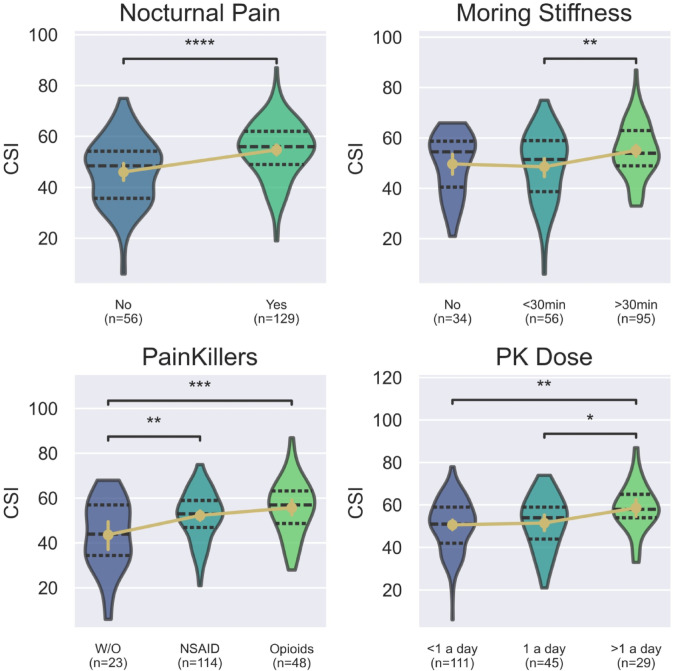
This study aimed to identify risk factors of nociplastic pain in patients with autoimmune arthritis. Patients suffering from chronic pain and autoimmune arthritis were invited to participate in a study via moderated support groups on social media. Each invitation included a brief description of nociplastic pain. The study cohort comprised 185 patients, primarily those with rheumatoid arthritis (64%) and spondyloarthropathies (27%). 82% of patients scored positively (≥ 40 points) on the Central Sensitization Inventory (CSI), while 57% showed a neuropathic component as indicated by the PainDetect Questionnaire (PDQ). Of the participants with a positive CSI score, 86% achieved at least a borderline grade on the PDQ. More frequent use of painkillers (> once a day) correlated with higher CSI scores (mean difference (MD) = 7.1, p = 0.039, and MD = 8, p = 0.005 compared to daily and less frequent use, respectively). In a multivariable linear regression model, factors such as depression (β = 8.7, p < 0.001), nocturnal pain (β = 4.5, p = 0.013), need for painkillers (β = 5.3, p = 0.032), disease duration > 2 years (β = 3.3, p = 0.036), Chronic Pain Grade Scale (β = 2.8, from I to IV grade, p < 0.001), and worse mood (β = -0.9, on a 0-10 scale, p = 0.031) were independently associated with higher CSI scores. Nocturnal pain and pain-related disability may serve as clinical risk factors of nociplastic pain. The PDQ may lose its reliability in detecting neuropathic pain in patients with a high nociplastic component.
本研究旨在确定自身免疫性关节炎患者中伤害感受性疼痛的危险因素。患有慢性疼痛和自身免疫性关节炎的患者通过社交媒体上的适度支持小组被邀请参与一项研究。每次邀请都包含对伤害感受性疼痛的简要描述。研究队列包括185名患者,主要是类风湿关节炎患者(64%)和脊柱关节炎患者(27%)。82%的患者在中枢敏化量表(CSI)上得分呈阳性(≥40分),而57%的患者根据疼痛检测问卷(PDQ)显示有神经病理性成分。在CSI得分呈阳性的参与者中,86%在PDQ上至少达到临界等级。更频繁使用止痛药(>每天一次)与更高的CSI得分相关(平均差异(MD)=7.1,p=0.039,与每天使用及使用频率更低相比,MD=8,p=0.005)。在多变量线性回归模型中,抑郁(β=8.7,p<0.001)、夜间疼痛(β=4.5,p=0.013)、对止痛药的需求(β=5.3,p=0.032)、疾病持续时间>2年(β=3.3,p=0.036)、慢性疼痛分级量表(β=2.8,从I级到IV级,p<0.001)以及更差的情绪(β=-0.9,在0-10分的量表上,p=0.031)等因素与更高的CSI得分独立相关。夜间疼痛和与疼痛相关的残疾可能是伤害感受性疼痛的临床危险因素。在具有高伤害感受性成分的患者中,PDQ在检测神经病理性疼痛方面可能会失去其可靠性。