Aubouy Agnès, Olatoundé Amoussa Abdou Madjid, Lagnika Latifou, Fabre Nicolas, Vitrai Adrien, Claparols Catherine, Houzé Sandrine, Sarrasin Véronique, Chapeland-Leclerc Florence, Ruprich-Robert Gwenaël, Bourgeade-Delmas Sandra, Yedomonhan Hounnankpon, Dumondin Charlotte, Jullian Valérie
UMR 152 PharmaDev, Université Paul Sabatier-Toulouse 3, IRD, Université de Toulouse, Toulouse France.
Laboratoire de Biochimie et Substances Naturelles Bioactives (LBSNB), Faculté des Sciences et Techniques (FAST), Université d'Abomey Calavi, Bénin.
PLoS One. 2025 Aug 22;20(8):e0330682. doi: 10.1371/journal.pone.0330682. eCollection 2025.
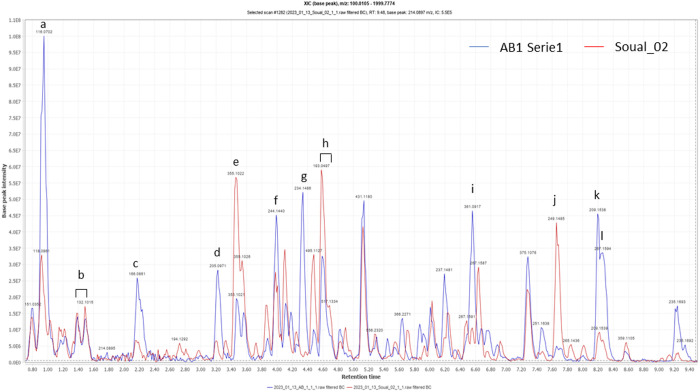
The use of teas made from locally cultivated Artemisia annua to fight malaria in remote areas where access to care is difficult is a matter of debate. This study aimed at document differences in the composition of A. annua teas cultivated in Benin to be sold as antimalarial teas, and in France, and their impact on antiplasmodial activity. A. annua teas were prepared with plants from one location in south France and from ten different plantations in Benin. Artemisinin was quantified in herbal teas with a liquid chromatography system coupled to mass spectrometry and multiple reaction monitoring detection methods. The herbal teas were tested against chloroquine-sensitive 3D7 strain of Plasmodium falciparum using isotopic microtest to determine IC50 values and calculate the concentration of artemisinin corresponding to the IC50 of the teas [ART(tea)_IC50]. Chemical profiles were determined by liquid chromatography coupled to high resolution mass spectrometry and a metabolomic analysis was performed to annotate compounds statistically linked to the antiplasmodial properties of the teas. Artemisinin content varied between 0.3 mg/L for tea with plants from France to 15.7 mg/L for teas made with plants from Benin with differences between locations. Artemisinin content was decreasing after a one-year storage of the plant for 3 localities in Benin with loss of 33%, 48% and 24% (P < 0.05). Artemisinin concentrations and antiplasmodial activity of teas were positively correlated although the comparison of ART(tea)_IC50s to IC50 of pure artemisinin suggested that other compounds present in the tea were involved in the activity, either enhancing or limiting it. Unknown alkaloids in A. annua teas correlated to antiplasmodial activity were also detected. These findings suggest that A. annua teas deserve further studies to identify other metabolites of interest and determine their role in antiplasmodial activity in relation to other molecules, particularly artemisinin.
在难以获得医疗服务的偏远地区,使用当地种植的青蒿制成的茶来抗击疟疾存在争议。本研究旨在记录在贝宁种植用于作为抗疟茶出售的青蒿茶与在法国种植的青蒿茶在成分上的差异,以及它们对抗疟原虫活性的影响。青蒿茶分别用法国南部一个地点的植物以及贝宁十个不同种植园的植物制成。采用液相色谱系统结合质谱和多反应监测检测方法对凉茶中的青蒿素进行定量。使用同位素微量试验针对氯喹敏感的恶性疟原虫3D7株对凉茶进行测试,以确定IC50值并计算与茶的IC50相对应的青蒿素浓度[ART(茶)_IC50]。通过液相色谱结合高分辨率质谱确定化学图谱,并进行代谢组学分析以注释与茶的抗疟原虫特性有统计学关联的化合物。青蒿素含量在法国植物制成的茶中为0.3毫克/升,在贝宁植物制成的茶中为15.7毫克/升,不同地点之间存在差异。贝宁三个地点的植物储存一年后,青蒿素含量下降,损失分别为33%、48%和24%(P < 0.05)。茶的青蒿素浓度与抗疟原虫活性呈正相关,尽管将ART(茶)_IC50与纯青蒿素的IC50进行比较表明,茶中存在的其他化合物也参与了活性,要么增强要么限制活性。还检测到青蒿茶中与抗疟原虫活性相关的未知生物碱。这些发现表明,青蒿茶值得进一步研究,以鉴定其他有意义的代谢物,并确定它们与其他分子(特别是青蒿素)在抗疟原虫活性中的作用。