Yıldız Tuğçenur, Zan Recai
Department of Endodontics, Faculty of Dentistry, Sakarya University, Sakarya, 54100, Turkey.
Department of Endodontics, Faculty of Dentistry, Sivas Cumhuriyet University, Sivas, 58140, Turkey.
BMC Oral Health. 2025 Aug 23;25(1):1366. doi: 10.1186/s12903-025-06710-y.
This study aimed to evaluate and compare the cyclic fatigue resistance of new generation nickel-titanium file systems in simulated single and double curvature ceramic root canals.
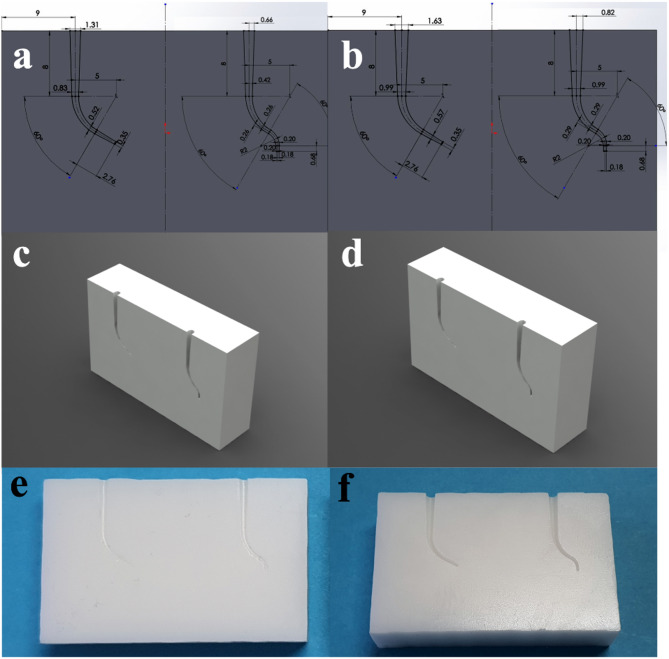
A total of 80 Nickel-Titanium (Ni-Ti) instruments-TruNatomy (TN) (26/0.04), WaveOne Gold (WOG) (25/0.07), Reciproc Blue (RecB) (25/0.08), and One Curve (OC) (25/0.04)-were tested under simulated intracanal thermal conditions (35 ± 0.1 °C). The instruments were evaluated within custom-designed artificial canals fabricated from ceramic blocks, incorporating either a single curvature (SC; 60° angle, 5 mm radius) or a double curvature configuration (DC; coronal bend: 60°, 5 mm radius; apical bend: 60°, 2 mm radius). For each instrument, the time until fracture occurred was recorded, and the number of cycles to failure (NCF) was calculated accordingly. Fragment lengths (FLs) were measured using a digital microcaliper, and the topography of the fracture surfaces was analyzed through scanning electron microscopy (SEM). Data were statistically assessed using non-parametric Kruskal-Wallis and Mann-Whitney U tests, with significance defined at the p-value threshold of < 0.05.
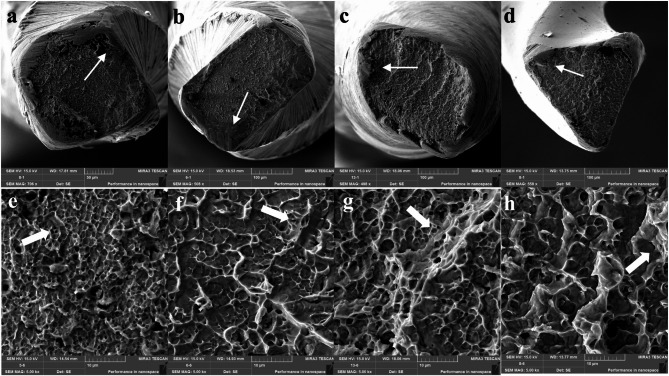
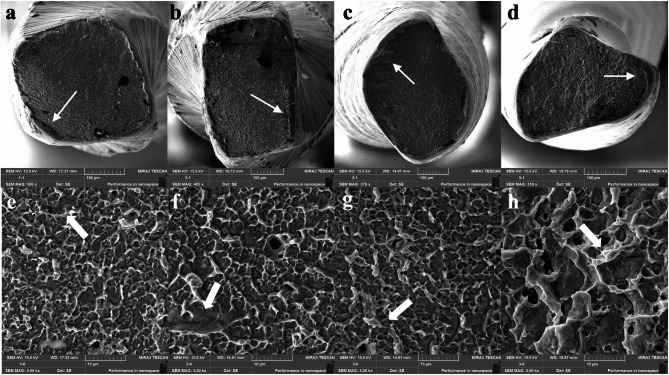
RecB files demonstrated the highest NCF in the SC group (p < 0.05). TN and OC had significantly lower NCF than RecB (p < 0.05) but were statistically similar (p > 0.05). WOG recorded the lowest NCF in SC (p < 0.05). In the DC group, WOG also showed the lowest NCF (p < 0.05), with no significant differences among the other three files (p > 0.05). SEM analysis revealed that nearly all fractured instruments exhibited a ductile fracture pattern, characterized by the presence of microcavities and pits, which are typically associated with cyclic fatigue failure.
Selecting Ni-Ti file systems based on canal anatomy is essential for minimizing fatigue-related failures. RecB exhibited superior resistance in SC canals, while WOG showed consistently lower performance in both configurations, warranting cautious use in curved canals. These findings underscore the importance of matching instrument selection to canal morphology and mechanical demands to ensure safe and predictable clinical outcomes.
本研究旨在评估和比较新一代镍钛锉系统在模拟单曲率和双曲率陶瓷根管中的抗循环疲劳性能。
共80支镍钛(Ni-Ti)器械——TruNatomy(TN)(26/0.04)、WaveOne Gold(WOG)(25/0.07)、Reciproc Blue(RecB)(25/0.08)和One Curve(OC)(25/0.04)——在模拟根管内热条件(35±0.1°C)下进行测试。这些器械在由陶瓷块制成的定制人工根管内进行评估,人工根管包含单曲率(SC;60°角,5mm半径)或双曲率结构(DC;冠部弯曲:60°,5mm半径;根尖弯曲:60°,2mm半径)。对于每支器械,记录直至断裂发生的时间,并据此计算失效循环次数(NCF)。使用数字游标卡尺测量碎片长度(FL),并通过扫描电子显微镜(SEM)分析断裂表面的形貌。数据采用非参数Kruskal-Wallis和Mann-Whitney U检验进行统计学评估,显著性定义为p值阈值<0.05。
RecB锉在SC组中表现出最高的NCF(p<0.05)。TN和OC的NCF显著低于RecB(p<0.05),但在统计学上相似(p>0.05)。WOG在SC组中记录到最低的NCF(p<0.05)。在DC组中,WOG也表现出最低的NCF(p<0.05),其他三支锉之间无显著差异(p>0.05)。SEM分析显示,几乎所有断裂的器械都呈现出韧性断裂模式,其特征是存在微腔和凹坑,这通常与循环疲劳失效相关。
根据根管解剖结构选择镍钛锉系统对于将疲劳相关的失败降至最低至关重要。RecB在SC根管中表现出卓越的抗疲劳性能,而WOG在两种结构中均表现出持续较低的性能,因此在弯曲根管中使用时需谨慎。这些发现强调了使器械选择与根管形态和机械需求相匹配以确保安全和可预测的临床结果的重要性。