Pozzi Carlo M, Gaiti Angelo, Spada Alberto
Dipartimento Di Scienze Agrarie Ed Ambientali, Università Di Milano, Via Celoria 2, 20133, Milan, Italy.
Dipartimento Di Scienze Per Gli Alimenti, La Nutrizione E L'Ambiente, Università Di Milano, Via Celoria 2, 20133, Milan, Italy.
Theor Appl Genet. 2025 Aug 27;138(9):231. doi: 10.1007/s00122-025-05010-x.
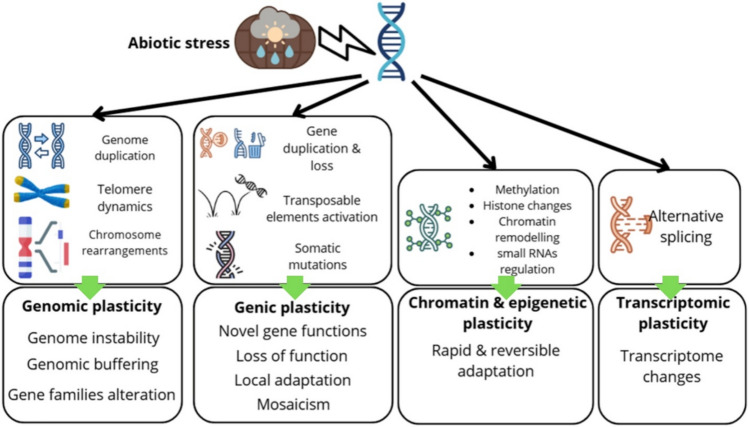
Genome adaptation, driven by mutations, transposable elements, and structural variations, relies on plasticity and instability. This allows populations to evolve, enhance fitness, and adapt to challenges like climate change. Genomes adapt via mutations, transposable elements, DNA structural changes, and epigenetics. Genome plasticity enhances fitness by providing the genetic variation necessary for organisms to adapt their traits and survive, which is especially critical during rapid climate shifts. This plasticity often stems from genome instability, which facilitates significant genomic alterations like duplications or deletions. While potentially harmful initially, these changes increase genetic diversity, aiding adaptation. Major genome reorganizations arise from polyploidization and horizontal gene transfer, both linked to instability. Plasticity and restructuring can modify Quantitative Trait Loci (QTLs), contributing to adaptation. Tools like landscape genomics identify climate-selected regions, resurrection ecology reveals past adaptive responses, and pangenome analysis examines a species' complete gene set. Signatures of past selection include reduced diversity and allele frequency shifts. Gene expression plasticity allows environmental adaptation without genetic change through mechanisms like alternative splicing, tailoring protein function. Co-opted transposable elements also generate genetic and regulatory diversity, contributing to genome evolution. This review consolidates these findings, repositioning genome instability not as a mere source of random error but as a fundamental evolutionary engine that provides the rapid adaptive potential required for plant survival in the face of accelerating climate change.
由突变、转座元件和结构变异驱动的基因组适应依赖于可塑性和不稳定性。这使得种群得以进化、增强适应性并适应气候变化等挑战。基因组通过突变、转座元件、DNA结构变化和表观遗传学进行适应。基因组可塑性通过提供生物体适应其性状并生存所需的遗传变异来增强适应性,这在快速的气候变化期间尤为关键。这种可塑性通常源于基因组不稳定性,它促进了诸如重复或缺失等重大基因组改变。虽然这些变化最初可能是有害的,但它们增加了遗传多样性,有助于适应。主要的基因组重组源于多倍体化和水平基因转移,二者均与不稳定性有关。可塑性和重组可以改变数量性状位点(QTL),从而促进适应。景观基因组学等工具可识别受气候选择的区域,复活生态学揭示过去的适应性反应,而泛基因组分析则研究一个物种的完整基因集。过去选择的特征包括多样性降低和等位基因频率变化。基因表达可塑性通过可变剪接等机制允许在不发生遗传变化的情况下实现环境适应,从而调整蛋白质功能。被征用的转座元件也会产生遗传和调控多样性,促进基因组进化。本综述整合了这些发现,将基因组不稳定性重新定位,不再仅仅将其视为随机错误的来源,而是作为一种基本的进化引擎,它为植物在加速的气候变化面前生存提供了所需的快速适应潜力。