Trinh Ly, Parks Jaclyn, McDonald Treena, Roth Andrew, Shen-Tu Grace, Vena Jennifer, Murphy Rachel A, Bhatti Parveen
School of Population and Public Health, University of British Columbia, Vancouver, BC, V6T 1Z3, Canada.
Population Health Sciences, BC Cancer Research Institute, Vancouver, BC, V5Z 1L3, Canada.
Breast Cancer Res. 2025 Aug 27;27(1):156. doi: 10.1186/s13058-025-02102-w.
Metabolomics offers a promising approach to identify biomarkers for timely intervention and enhanced screening of individuals at increased risk of developing breast cancer.
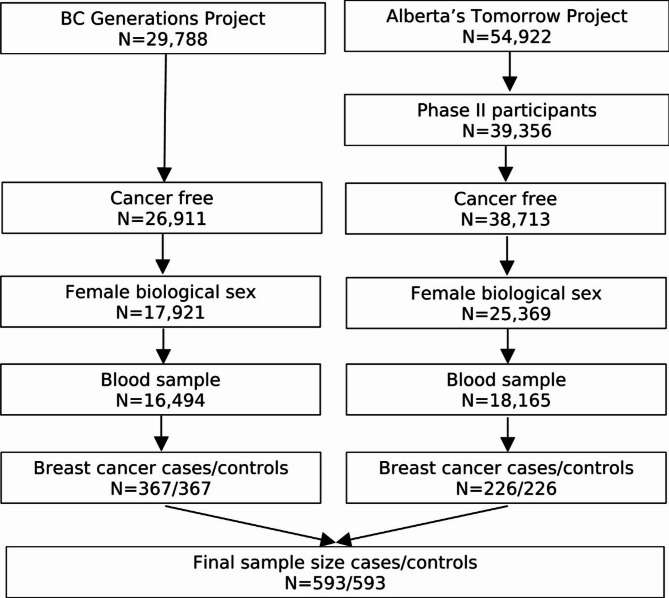
We conducted a study of 593 female breast cancer cases and 593 matched controls nested in two prospective cohort studies. Mass spectrometry, without liquid chromatography, was used to conduct untargeted metabolomics profiling of serum samples collected, on average, 5.3 years before cancer diagnosis. Logistic regression was used to estimate odds ratios (OR) for a one standard deviation increase of metabolite intensities. Partial least squares discriminant analyses were applied to those metabolites significantly associated with breast cancer to develop risk prediction models.
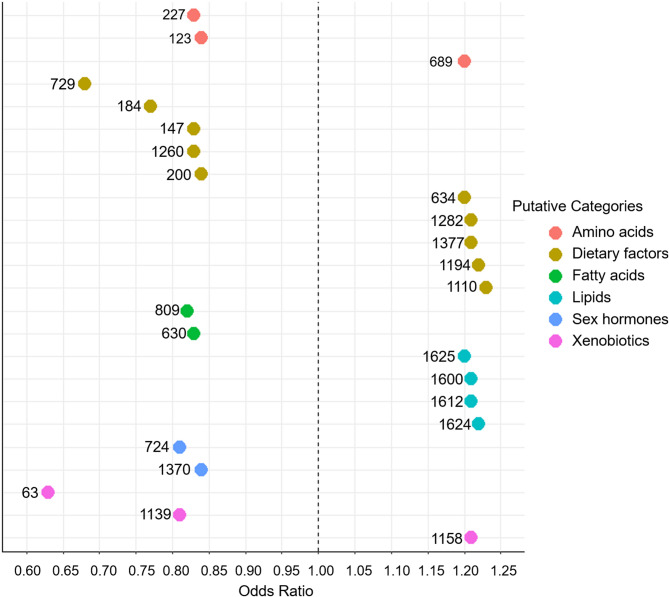
Associations were evaluated with a total of 837 metabolites. Twenty-four metabolites were significantly associated with overall breast cancer risk, including 13 associated with decreased risk and 11 associated with increased risk. Putative identities of the metabolites included various amino acids (n = 3), dietary factors (n = 10), fatty acids (n = 2), phosplipids (n = 4), sex hormone derivatives (n = 2), and xenobiotics (n = 3). For example, a metabolite identified as acetyl tributyl citrate, a plasticizer in food wrappings, was associated with an increased risk of breast cancer (OR = 1.21; 95% CI: 1.07-1.37). Risk prediction models for overall breast cancer and the various subtypes were found to have modest levels of prediction accuracy (area under the curve ranged from 0.60 to 0.63).
Additional studies are needed to confirm the identities of the metabolites and validate their associations with breast cancer risk. Metabolomics should be evaluated in conjunction with other 'omics' technologies for creation of clinically useful risk prediction models.
代谢组学为识别生物标志物提供了一种有前景的方法,以便及时进行干预,并加强对乳腺癌发病风险增加个体的筛查。
我们在两项前瞻性队列研究中纳入了593例女性乳腺癌病例和593例匹配对照进行研究。采用不联用液相色谱的质谱法,对平均在癌症诊断前5.3年采集的血清样本进行非靶向代谢组学分析。使用逻辑回归估计代谢物强度增加一个标准差时的比值比(OR)。对与乳腺癌显著相关的代谢物应用偏最小二乘判别分析来建立风险预测模型。
共评估了837种代谢物的相关性。24种代谢物与总体乳腺癌风险显著相关,其中13种与风险降低相关,11种与风险增加相关。这些代谢物的推定身份包括各种氨基酸(n = 3)、饮食因素(n = 10)、脂肪酸(n = 2)、磷脂(n = 4)、性激素衍生物(n = 2)和外源性物质(n = 3)。例如,一种被鉴定为乙酰柠檬酸三丁酯(食品包装中的一种增塑剂)的代谢物与乳腺癌风险增加相关(OR = 1.21;95%CI:1.07 - 1.37)。发现总体乳腺癌和各种亚型乳腺癌的风险预测模型的预测准确性处于中等水平(曲线下面积范围为0.60至0.63)。
需要进一步研究来确认这些代谢物的身份,并验证它们与乳腺癌风险的关联。代谢组学应与其他“组学”技术联合评估,以创建临床有用的风险预测模型。