Moyer Haley L, Vergara Leoncio, Stephan Clifford, Sakolish Courtney, Lin Hsing-Chieh, Chiu Weihsueh A, Villenave Remi, Hewitt Philip, Ferguson Stephen S, Rusyn Ivan
Department of Veterinary Physiology and Pharmacology, Texas A&M University, College Station, TX 77843, USA.
Institute of Biosciences and Technology, Texas A&M University, Houston, TX 77030, USA.
Bioengineering (Basel). 2025 Jul 28;12(8):809. doi: 10.3390/bioengineering12080809.
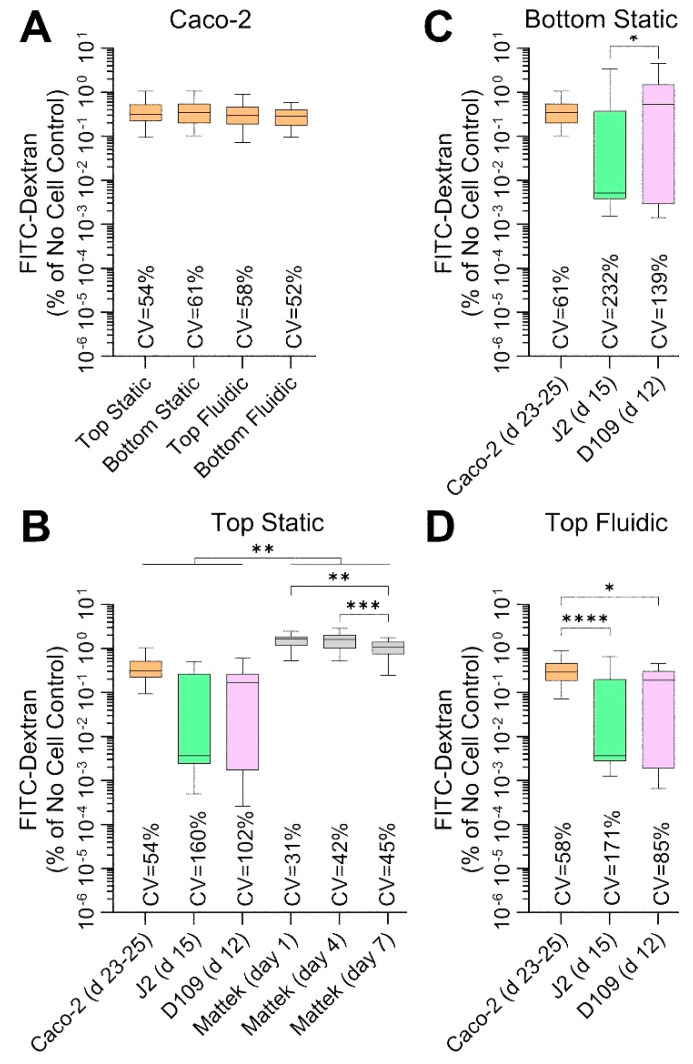
Accurate in vitro models of intestinal permeability are essential for predicting oral drug absorption. Standard models like Caco-2 cells have well-known limitations, including lack of segment-specific physiology, but are widely used. Emerging models such as organoid-derived monolayers and microphysiological systems (MPS) offer enhanced physiological relevance but require comparative validation. We performed a head-to-head evaluation of Caco-2 cells, human jejunal (J2) and duodenal (D109) enteroid-derived cells, and EpiIntestinal tissues cultured on either static Transwell and flow-based MPS platforms. We assessed tissue morphology, barrier function (TEER, dextran leakage), and permeability of three model small molecules (caffeine, propranolol, and indomethacin), integrating the data into a physiologically based gut absorption model (PECAT) to predict human oral bioavailability. J2 and D109 cells demonstrated more physiologically relevant morphology and higher TEER than Caco-2 cells, while the EpiIntestinal model exhibited thicker and more uneven tissue structures with lower TEER and higher passive permeability. MPS cultures offered modest improvements in epithelial architecture but introduced greater variability, especially with enteroid-derived cells. Predictions of human fraction absorbed (F) were most accurate when using static Caco-2 data with segment-specific corrections based on enteroid-derived values, highlighting the utility of combining traditional and advanced in vitro gut models to optimize predictive performance for F. While MPS and enteroid-based systems provide physiological advantages, standard static models remain robust and predictive when used with in silico modeling. Our findings support the need for further refinement of enteroid-MPS integration and advocate for standardized benchmarking across gut model systems to improve translational relevance in drug development and regulatory reviews.
准确的肠道通透性体外模型对于预测口服药物吸收至关重要。像Caco-2细胞这样的标准模型存在众所周知的局限性,包括缺乏特定节段的生理学特征,但仍被广泛使用。新兴模型,如意原代单层细胞和微生理系统(MPS),具有更高的生理学相关性,但需要进行比较验证。我们对Caco-2细胞、人空肠(J2)和十二指肠(D109)类器官来源的细胞以及在静态Transwell和基于流动的MPS平台上培养的EpiIntestinal组织进行了直接比较评估。我们评估了组织形态、屏障功能(跨上皮电阻、右旋糖酐渗漏)以及三种模型小分子(咖啡因、普萘洛尔和吲哚美辛)的通透性,并将数据整合到基于生理学的肠道吸收模型(PECAT)中以预测人体口服生物利用度。J2和D109细胞表现出比Caco-2细胞更具生理学相关性的形态和更高的跨上皮电阻,而EpiIntestinal模型表现出更厚且更不均匀的组织结构,跨上皮电阻较低且被动通透性较高。MPS培养在上皮结构方面有适度改善,但引入了更大的变异性,尤其是对于类器官来源的细胞。当使用基于类器官来源值进行节段特异性校正的静态Caco-2数据时,对人体吸收分数(F)的预测最为准确,这突出了结合传统和先进的体外肠道模型以优化F预测性能的实用性。虽然MPS和基于类器官的系统具有生理学优势,但标准的静态模型在与计算机模拟结合使用时仍然稳健且具有预测性。我们的研究结果支持进一步完善类器官 - MPS整合的必要性,并提倡在肠道模型系统中进行标准化基准测试,以提高药物开发和监管审查中的转化相关性。