Grigore Ionica, Ciobotaru Oana Roxana, Hînganu Delia, Gurau Gabriela, Tutunaru Dana, Hînganu Marius Valeriu
Department of Morphological and Functional Sciences, Faculty of Medicine and Pharmacy, "Dunarea de Jos" University of Galați, 35, Al. I. Cuza Street, 800216 Galați, Romania.
Department of Clinical Medical, Faculty of Medicine and Pharmacy, "Dunarea de Jos" University of Galați, 35, Al. I. Cuza Street, 800216 Galați, Romania.
Life (Basel). 2025 Aug 7;15(8):1251. doi: 10.3390/life15081251.
Cardiovascular diseases (CVDs) are the leading global cause of death, with long-term hospitalization becoming increasingly frequent in advanced or chronic cases. In this context, the interplay between systemic factors such as lipid metabolism, circulating metabolites, gut microbiota, and oral health is gaining attention for its potential role in influencing inflammation, cardiometabolic risk, and long-term outcomes. Despite their apparent independence, these domains are increasingly recognized as interconnected and influential in cardiovascular pathophysiology.
This narrative review was conducted by analyzing studies published between 2015 and 2024 from databases including PubMed, Scopus, and Web of Science. Keywords such as "lipid profile," "metabolomics," "gut microbiota," "oral health," and "cardiovascular disease" were used. Original research, meta-analyses, and reviews relevant to hospitalized cardiac patients were included. A critical integrative approach was applied to highlight cross-domain connections.
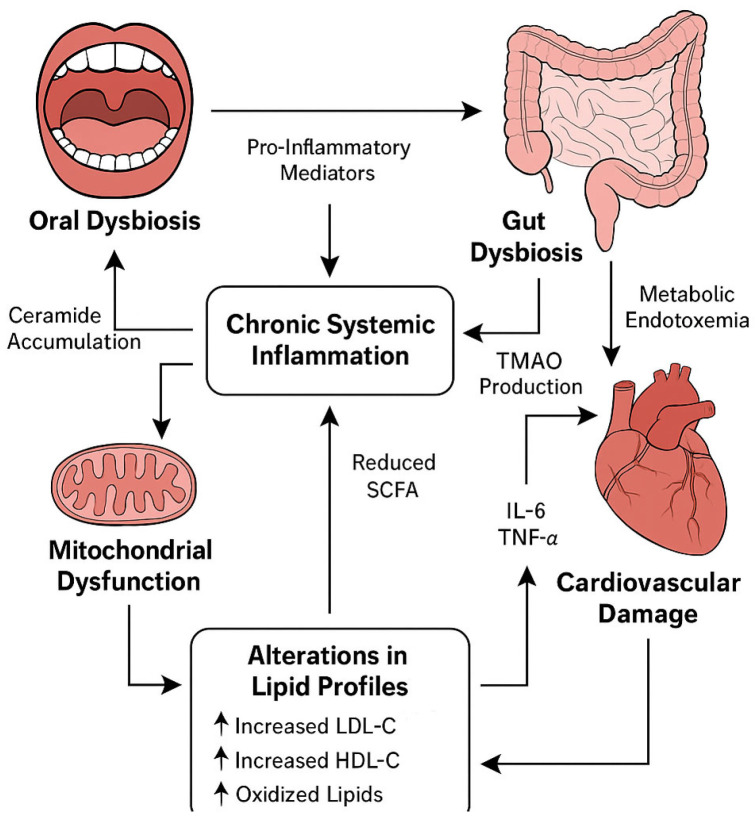
Evidence reveals significant interrelations between altered lipid profiles, gut dysbiosis (including increased TMAO levels), metabolic imbalances, and oral inflammation. Each component contributes to a systemic pro-inflammatory state that worsens cardiovascular prognosis, particularly in long-term hospitalized patients. Despite isolated research in each domain, there is a paucity of studies integrating all four. The need for interdisciplinary diagnostic models and preventive strategies is emphasized, especially in populations with frailty or immobilization.
Monitoring lipid metabolism, metabolomic shifts, gut microbial balance, and oral status should be considered part of comprehensive cardiovascular care. Gut microbiota exerts a dual role in cardiac health: when balanced, it supports anti-inflammatory and metabolic homeostasis; when dysbiotic, it contributes to systemic inflammation and worsened cardiac outcomes. Future research should aim to develop integrative screening tools and personalized interventions that address the multifactorial burden of disease. A systemic approach may improve both short- and long-term outcomes in this complex and vulnerable patient population.
心血管疾病(CVDs)是全球首要的死亡原因,在晚期或慢性病例中,长期住院的情况越来越频繁。在这种背景下,诸如脂质代谢、循环代谢物、肠道微生物群和口腔健康等全身因素之间的相互作用,因其在影响炎症、心脏代谢风险和长期预后方面的潜在作用而受到关注。尽管这些领域看似相互独立,但它们在心血管病理生理学中越来越被认为是相互关联且有影响的。
通过分析2015年至2024年期间在包括PubMed、Scopus和科学网在内的数据库中发表的研究进行了这项叙述性综述。使用了诸如“血脂谱”“代谢组学”“肠道微生物群”“口腔健康”和“心血管疾病”等关键词。纳入了与住院心脏病患者相关的原始研究、荟萃分析和综述。采用了批判性综合方法来突出跨领域联系。
证据表明,血脂谱改变、肠道菌群失调(包括三甲胺氧化物水平升高)、代谢失衡和口腔炎症之间存在显著的相互关系。每个组成部分都促成了一种全身促炎状态,这会恶化心血管预后,尤其是在长期住院患者中。尽管在每个领域都有单独的研究,但整合所有这四个方面的研究却很少。强调了跨学科诊断模型和预防策略的必要性,特别是在体弱或行动不便的人群中。
监测脂质代谢、代谢组学变化、肠道微生物平衡和口腔状况应被视为综合心血管护理的一部分。肠道微生物群在心脏健康中发挥双重作用:平衡时,它支持抗炎和代谢稳态;失调时,它会导致全身炎症并使心脏预后恶化。未来的研究应旨在开发综合筛查工具和个性化干预措施,以应对疾病的多因素负担。一种系统性方法可能会改善这一复杂且脆弱患者群体的短期和长期预后。