Constantin Carolina, Dobre Elena-Georgiana, Istvan Paula, Munteanu Adriana Narcisa, Surcel Mihaela, Isvoranu Gheorghita, Neagu Monica
Immunology Department, "Victor Babes" National Institute of Pathology, 050096 Bucharest, Romania.
Colentina Clinical Hospital, 020125 Bucharest, Romania.
Int J Mol Sci. 2025 Aug 8;26(16):7697. doi: 10.3390/ijms26167697.
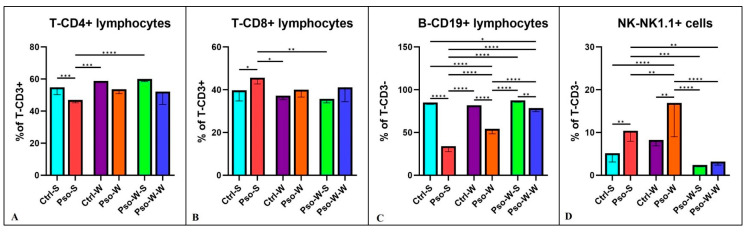
As obesity and Western diet consumption are key factors contributing to gut dysbiosis, we investigated the relationship between intestinal microbiota, obesity, and psoriasis in an imiquimod-based model. C57BL/6 mice were used as follows: psoriasis-induced groups fed continuously with a standard or Western diet, psoriasis-induced group fed with a Western diet and then returned to a standard diet, and controls. For each group, clinicopathological, immune, and metabolic parameters were integrated with microbiome data. The imiquimod-based models displayed human psoriasis features and significant changes in immune parameters. Hence, psoriatic mice on prolonged high-fat intake presented decreased microbial richness and evenness and a gut microbiome composition resembling that of obese mice. , , , and were the most abundant genera in the obesity-enhanced psoriasis group. abundance was linked with psoriasis. Yet, the same pathobionts over-represented in the obese psoriatic mice displayed positive correlations with metabolic stress indicators and proinflammatory factors, indicating potential biomarkers of disease severity. Conversely, , , and might be potential taxa for attenuating the metabolic burden in obesity-enhanced psoriasis. Here, we depict the microbial signatures associated with inflammation and metabolic stress in an obesity-aggravated psoriasis mouse model.
由于肥胖和西方饮食的摄入是导致肠道菌群失调的关键因素,我们在咪喹莫特诱导的模型中研究了肠道微生物群、肥胖和银屑病之间的关系。C57BL/6小鼠分组如下:持续喂食标准饮食或西方饮食的银屑病诱导组、先喂食西方饮食然后恢复标准饮食的银屑病诱导组以及对照组。对于每组,将临床病理、免疫和代谢参数与微生物组数据相结合。基于咪喹莫特的模型呈现出人类银屑病特征以及免疫参数的显著变化。因此,长期高脂饮食的银屑病小鼠微生物丰富度和均匀度降低,肠道微生物群组成与肥胖小鼠相似。在肥胖加重的银屑病组中,[具体菌属名称1]、[具体菌属名称2]、[具体菌属名称3]和[具体菌属名称4]是最丰富的菌属。[具体菌属名称5]的丰度与银屑病有关。然而,在肥胖银屑病小鼠中过度富集的相同致病共生菌与代谢应激指标和促炎因子呈正相关,表明其可能是疾病严重程度的生物标志物。相反,[具体菌属名称6]、[具体菌属名称7]和[具体菌属名称8]可能是减轻肥胖加重的银屑病中代谢负担的潜在分类群。在此,我们描绘了肥胖加重的银屑病小鼠模型中与炎症和代谢应激相关的微生物特征。