
运用集成方法模拟胡椒象鼻虫的历史及未来潜在全球分布
Modeling the Historical and Future Potential Global Distribution of the Pepper Weevil Using the Ensemble Approach.
作者信息
Xiao Kaitong, Ling Lei, Deng Ruixiong, Huang Beibei, Wu Qiang, Cao Yu, Ning Hang, Chen Hui
机构信息
Hubei Key Laboratory of Biological Resources Protection and Utilization, Hubei Minzu University, Enshi 445000, China.
College of Forestry and Horticulture, Hubei Minzu University, Enshi 445000, China.
出版信息
Insects. 2025 Aug 3;16(8):803. doi: 10.3390/insects16080803.
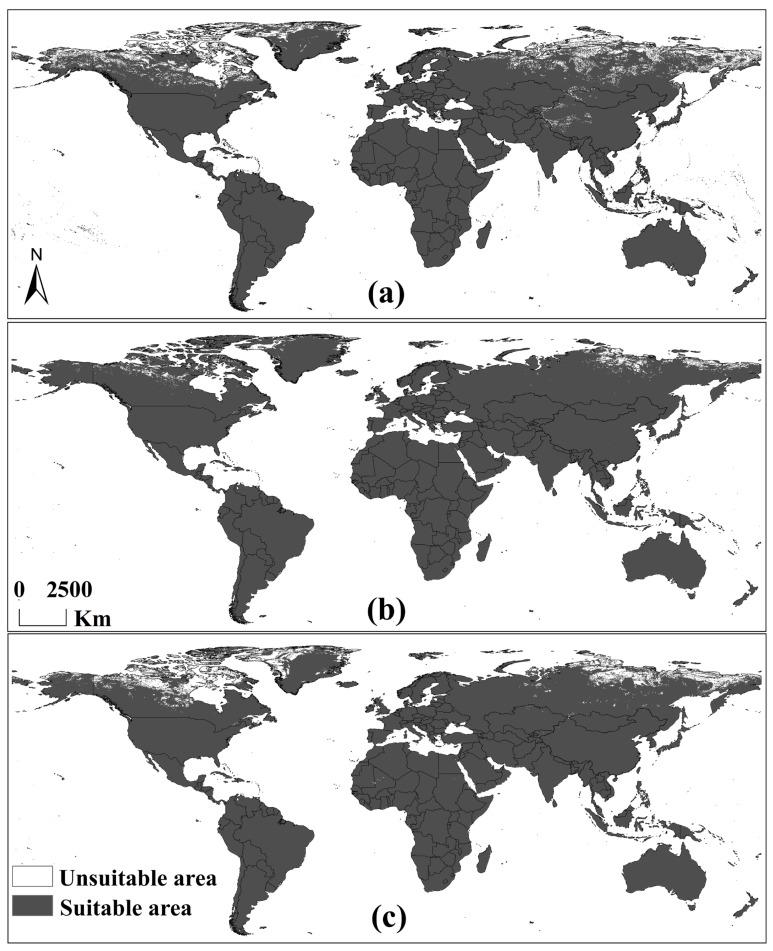
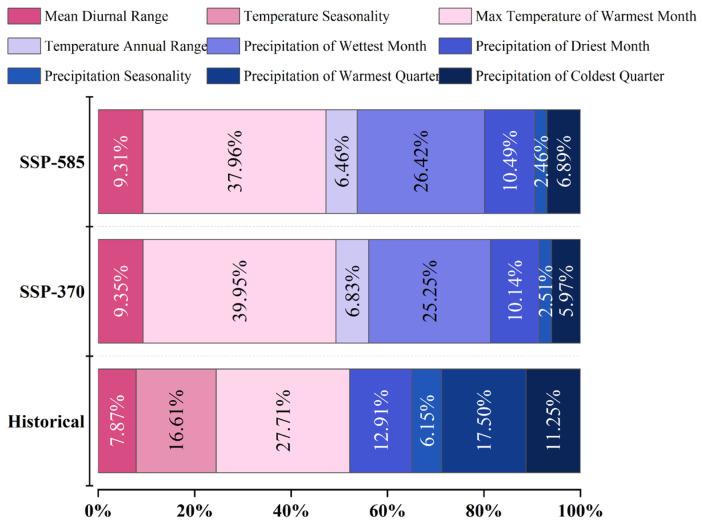
The pepper weevil is a devastating pest native to Central America that can cause severe damage to over 35 pepper varieties. Global trade in peppers has significantly increased the risk of its spread and expansion. Moreover, future climate change may add more uncertainty to its distribution, resulting in considerable ecological and economic damage globally. Therefore, we employed an ensemble model combining Random Forests and CLIMEX to predict the potential global distribution of in historical and future climate scenarios. The results indicated that the maximum temperature of the warmest month is an important variable affecting global distribution. Under the historical climate scenario, the potential global distribution of is concentrated in the Midwestern and Southern United States, Central America, the La Plata Plain, parts of the Brazilian Plateau, the Mediterranean and Black Sea coasts, sub-Saharan Africa, Northern and Southern China, Southern India, Indochina Peninsula, and coastal area in Eastern Australia. Under future climate scenarios, suitable areas in the Northern Hemisphere, including North America, Europe, and China, are projected to expand toward higher latitudes. In China, the number of highly suitable areas is expected to increase significantly, mainly in the south and north. Contrastingly, suitable areas in Central America, northern South America, the Brazilian Plateau, India, and the Indochina Peninsula will become less suitable. The total land area suitable for under historical and future low- and high-emission climate scenarios accounted for 73.12, 66.82, and 75.97% of the global land area (except for Antarctica), respectively. The high-suitability areas identified by both models decreased by 19.05 and 35.02% under low- and high-emission scenarios, respectively. Building on these findings, we inferred the future expansion trends of globally. Furthermore, we provide early warning of invasion and a scientific basis for its spread and outbreak, facilitating the development of effective quarantine and control measures.
胡椒象鼻虫是一种原产于中美洲的毁灭性害虫,可对35多种辣椒品种造成严重损害。全球辣椒贸易显著增加了其传播和扩散的风险。此外,未来的气候变化可能会给其分布增加更多不确定性,从而在全球范围内造成相当大的生态和经济破坏。因此,我们采用了一种结合随机森林和CLIMEX的集成模型,来预测胡椒象鼻虫在历史和未来气候情景下的潜在全球分布。结果表明,最暖月的最高温度是影响全球胡椒象鼻虫分布的一个重要变量。在历史气候情景下,胡椒象鼻虫的潜在全球分布集中在美国中西部和南部、中美洲、拉普拉塔平原、巴西高原部分地区、地中海和黑海沿岸、撒哈拉以南非洲、中国北部和南部、印度南部、印度支那半岛以及澳大利亚东部沿海地区。在未来气候情景下,预计北半球包括北美、欧洲和中国的适宜区域将向更高纬度扩展。在中国,高度适宜区域的数量预计将显著增加,主要集中在南部和北部。相比之下,中美洲、南美洲北部、巴西高原、印度和印度支那半岛的适宜区域将变得不太适宜。在历史以及未来低排放和高排放气候情景下,适合胡椒象鼻虫生存的陆地总面积分别占全球陆地面积(不包括南极洲)的73.12%、66.82%和75.97%。在低排放和高排放情景下,两种模型确定的高适宜区域分别减少了19.05%和35.02%。基于这些发现,我们推断了胡椒象鼻虫在全球的未来扩张趋势。此外,我们为胡椒象鼻虫的入侵提供了早期预警,并为其传播和爆发提供了科学依据,有助于制定有效的检疫和控制措施。





 Zotero 插件