
毒素基因可抵御胃肠道应激。
The Toxin Gene Protects from Gastrointestinal Stress.
作者信息
Guo Qin, Liu Jia-Er, Liu Lin-Xue, Gao Jian, Xu Bin
机构信息
School of Food and Biological Engineering, Jiangsu University, Zhenjiang 212013, China.
出版信息
Microorganisms. 2025 Jul 31;13(8):1788. doi: 10.3390/microorganisms13081788.
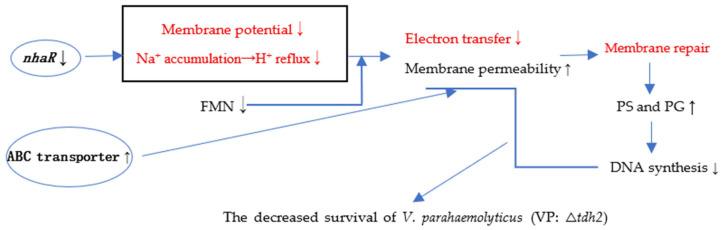
is a major foodborne pathogen worldwide, responsible for seafood-associated poisoning. Among its toxin genes, is the most critical. To investigate the role of in under gastrointestinal conditions, we constructed deletion and complementation strains and compared their survival under acid (pH 3 and 4) and bile stress (2%). The results showed that expression was significantly upregulated under cold (4 °C) and bile stress (0.9%). Survival assays and PI staining revealed that the mutant strain (VP: △) was more sensitive to acid and bile stress than the wild-type (WT), and this sensitivity was rescued by complementation. These findings suggest that plays a protective role in enhancing tolerance to acid and bile stress. In the VP: △ strain, seven genes were significantly upregulated and six were downregulated as a result of deletion. These genes included (), (), (), and (ABC transporters), (), and (), among others. Additionally, LC-MS/MS analysis identified 12 differential metabolites between the WT and VP: △ strains, including phosphatidylserine (PS) (17:2 (9Z,12Z) /0:0 and 20:1 (11Z) /0:0), phosphatidylglycerol (PG) (17:0/0:0), flavin mononucleotide (FMN), and various nucleotides. The protective mechanism of may involve preserving cell membrane permeability through regulation of and ABC transporters and enhancing electron transfer efficiency via regulation of . The resulting reduction in ATP, DNA, and RNA synthesis-along with changes in membrane permeability and electron transfer due to decreased FMN-likely contributed to the reduced survival of the VP: △ strain. Meanwhile, the cells actively synthesized phospholipids to repair membrane damage, leading to increased levels of PS and PG. This study provides important insights into strategies for preventing and controlling food poisoning caused by .
是全球主要的食源性病原体,可导致与海鲜相关的中毒。在其毒素基因中,最为关键。为研究在胃肠道条件下在中的作用,我们构建了缺失和互补菌株,并比较了它们在酸性(pH 3和4)和胆汁应激(2%)下的存活率。结果表明,在低温(4℃)和胆汁应激(0.9%)下表达显著上调。存活试验和PI染色显示,突变株(VP:△)比野生型(WT)对酸性和胆汁应激更敏感,并且这种敏感性通过互补得以挽救。这些发现表明,在增强对酸性和胆汁应激的耐受性方面起保护作用。在VP:△菌株中,由于缺失,七个基因显著上调,六个基因下调。这些基因包括()、()、()、和(ABC转运蛋白)、()和()等。此外,LC-MS/MS分析确定了WT和VP:△菌株之间的12种差异代谢物,包括磷脂酰丝氨酸(PS)(17:2(9Z,12Z)/0:0和20:1(11Z)/0:0)、磷脂酰甘油(PG)(17:0/0:0)、黄素单核苷酸(FMN)和各种核苷酸。的保护机制可能涉及通过调节和ABC转运蛋白来维持细胞膜通透性,并通过调节增强电子传递效率。由于FMN减少导致ATP、DNA和RNA合成减少以及膜通透性和电子传递变化,可能导致VP:△菌株存活率降低。同时,细胞积极合成磷脂以修复膜损伤,导致PS和PG水平升高。本研究为预防和控制由引起的食物中毒策略提供了重要见解。


 Zotero 插件