Johnson Gabrielle A, Jackson Carissa L, Timoteo Antonio, Sardaru Papaiah, Foland Michael H, Natarajan Purushothaman, Dhekney Sadanand A
Department of Agriculture, Food and Resource Sciences, University of Maryland Eastern Shore, 1 College Backbone Road, Princess Anne, MD 21853, USA.
Plants (Basel). 2025 Aug 20;14(16):2586. doi: 10.3390/plants14162586.
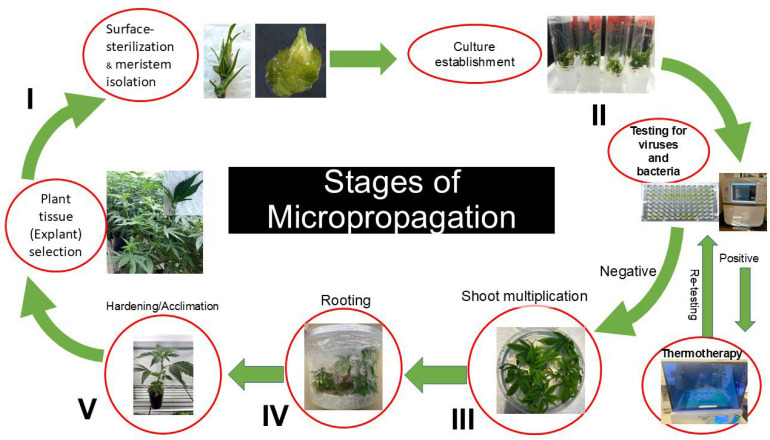
In this study, the effect of growth regulators on shoot proliferation and rooting were evaluated to develop an efficient micropropagation protocol for the L. cultivars 'Cherry Soda' and 'Purple'. Apical meristems were isolated from actively growing shoots of stock plants and transferred to Driver and Kuniyuki Walnut (DKW) culture medium containing either 0.0, 0.5, 1.0, 2.0, or 5.0 μM meta-Topolin to study their shoot proliferation response. Resulting shoot cultures were transferred to medium containing varying levels of Indole Acetic Acid (IAA), Indole Butyric Acid (IBA), or Naphthalene Acetic Acid (NAA), solely or in combination, and were subjected to a 10-day dark incubation followed by a 16 h/8 h light/dark period to identify the best treatment for root production. Among the different shoot proliferation treatments studied, the maximum number of shoots was produced on the control medium that was devoid of any meta-Topolin. Cultures grown on medium containing 5.0 μM meta-Topolin exhibited hyperhydricity, where shoots appeared translucent and pale green in color; were characterized by water-soaked lesions; and leaves appeared curled and brittle in contrast to healthy looking cultures. Among the various rooting treatments studied, shoots grown in the dark for 10 days exhibited the highest frequency of rooting on medium containing 4.0 μM NAA or 6.0 μM IBA + 1.0 μM NAA. Full developed plants with a robust shoot and root system were transferred to soil, acclimatized under conditions for high humidity, and then transferred to ambient conditions in 4 weeks. The micropropagation protocol developed here allows for rapid multiplication of disease-free plants in cultivars.
在本研究中,评估了生长调节剂对芽增殖和生根的影响,以开发一种针对百合品种“樱桃苏打”和“紫色”的高效微繁殖方案。从母株活跃生长的芽中分离出顶端分生组织,并转移到含有0.0、0.5、1.0、2.0或5.0 μM间-拓扑替康的Driver和Kuniyuki核桃(DKW)培养基中,以研究它们的芽增殖反应。将所得的芽培养物转移到含有不同水平的吲哚乙酸(IAA)、吲哚丁酸(IBA)或萘乙酸(NAA)单独或组合的培养基中,并进行10天的黑暗培养,随后进行16小时/8小时的光照/黑暗周期,以确定促进生根的最佳处理方法。在所研究的不同芽增殖处理中,不含任何间-拓扑替康的对照培养基上产生的芽数量最多。在含有5.0 μM间-拓扑替康的培养基上生长的培养物表现出玻璃化现象,芽呈现半透明和淡绿色;其特征是有水渍状病斑;与外观健康的培养物相比,叶片卷曲且易碎。在所研究的各种生根处理中,在黑暗中生长10天的芽在含有4.0 μM NAA或6.0 μM IBA + 1.0 μM NAA的培养基上生根频率最高。具有健壮茎和根系的完全发育植株被转移到土壤中,在高湿度条件下驯化,然后在4周后转移到环境条件下。这里开发的微繁殖方案能够快速繁殖该品种的无病植株。