Ribeiro Caroline Oliveira, Lopes Agnaldo José, de Melo Pedro Lopes
Biomedical Instrumentation Laboratory - Institute of Biology and Faculty of Engineering, State University of Rio de Janeiro, Rio de Janeiro, Brazil.
Pulmonary Function Laboratory, State University of Rio de Janeiro, Rio de Janeiro, Brazil.
Int J Chron Obstruct Pulmon Dis. 2025 Aug 22;20:2945-2965. doi: 10.2147/COPD.S524591. eCollection 2025.
The contribution of respiratory models to understanding and predicting functional capacity abnormalities in chronic obstructive pulmonary disease (COPD) has not yet been investigated.
The aims of this study were: (1) To investigate the associations between the extended Resistance-Inertance-Compliance (eRIC) and the fractional-order (FrOr) models with changes in Glittre-ADL and handgrip tests and; (2) To evaluate the accuracy of these models in predicting abnormal functional capacity in COPD.
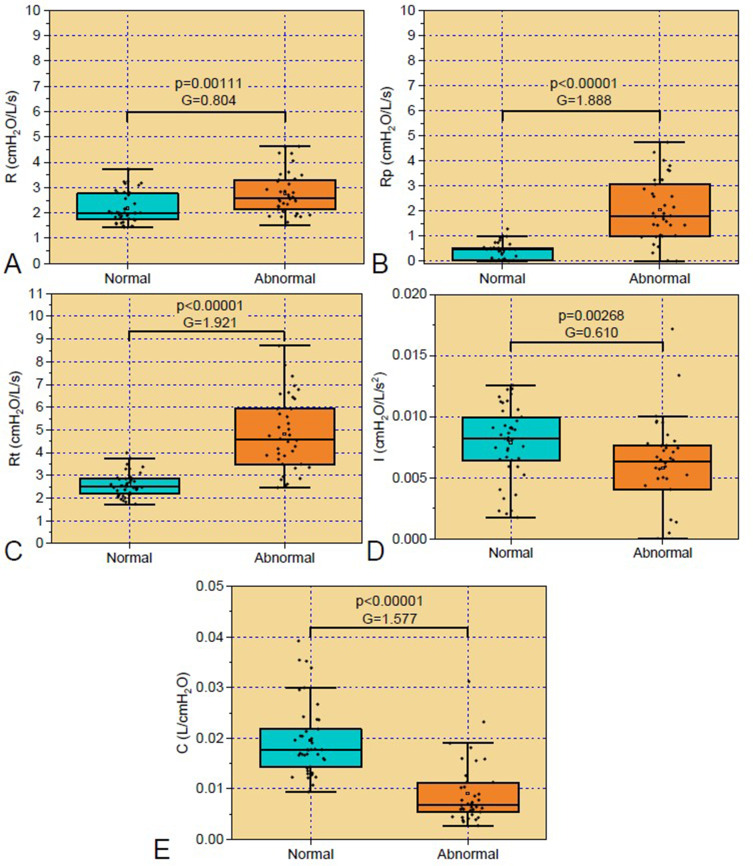
The study was carried out in a group of 40 adults with COPD and a control group of 40 healthy individuals, both evaluated by respiratory oscillometry, spirometry, Glittre-ADL test and handgrip test. eRIC and fractional order models were also used to quantify biomechanical changes and obtain physiological information. The ability of model parameters to predict abnormal functional performance was evaluated by investigating the area under the receiver operating characteristic curve (AUC).
Inverse relationships were observed between central airway resistance from the eRIC model and the handgrip test (p<0.005), while respiratory compliance (C) was directly related with handgrip strength test and inversely associated with the Glittre-ADL test time (p<0.05). The FrOr model showed direct associations among respiratory damping (G) and elastance with the Glittre-ADL test (p<0.02), while significant inverse relationships were observed with the handgrip test (p<0.05). Modeling parameters (peripheral resistance, total resistance and hysteresivity) achieved high prediction accuracy (AUC>0.90) in predicting non-normal functional capacity in COPD assessed by the Glittre-ADL test. Considering abnormal changes evaluated by the handgrip test as a reference, C (AUC=0.810) and G (AUC=0.786) obtained the highest predictive accuracies.
Parameters obtained from the eRIC and the fractional order models are associated with non-normal exercise performance in COPD and may help predict poor functional performance in these patients.
呼吸模型对理解和预测慢性阻塞性肺疾病(COPD)功能能力异常的贡献尚未得到研究。
本研究的目的是:(1)研究扩展的阻力-惯性-顺应性(eRIC)模型和分数阶(FrOr)模型与Glittre-ADL和握力测试变化之间的关联;(2)评估这些模型预测COPD患者功能能力异常的准确性。
本研究纳入了40名成年COPD患者和40名健康个体作为对照组,两组均通过呼吸振荡法、肺量计、Glittre-ADL测试和握力测试进行评估。还使用eRIC和分数阶模型来量化生物力学变化并获取生理信息。通过研究受试者工作特征曲线(AUC)下的面积来评估模型参数预测异常功能表现的能力。
观察到eRIC模型的中心气道阻力与握力测试之间呈负相关(p<0.005),而呼吸顺应性(C)与握力强度测试呈正相关,与Glittre-ADL测试时间呈负相关(p<0.05)。FrOr模型显示呼吸阻尼(G)和弹性与Glittre-ADL测试之间呈正相关(p<0.02),而与握力测试呈显著负相关(p<0.05)。在通过Glittre-ADL测试评估的COPD患者非正常功能能力预测中,建模参数(外周阻力、总阻力和滞后性)达到了较高的预测准确性(AUC>0.90)。以握力测试评估的异常变化为参考,C(AUC=0.810)和G(AUC=0.786)获得了最高的预测准确性。
从eRIC和分数阶模型获得的参数与COPD患者的非正常运动表现相关,可能有助于预测这些患者的功能表现不佳。