Kudlay Dmitry, Kozlov Vladimir, Savchenko Andrey A, Simbirtsev Andrey, Anisimova Evgenia, Kudryavtsev Igor, Kulpina Anastasia, Rubinstein Artem, Ryabkova Varvara A, Churilov Leonid P, Sirotkina Olga, Vavilova Tatyana, Starshinova Anna An, Borisov Alexandr
I.M. Sechenov First Moscow State Medical University, Institute of Pharmacy, Department of Pharmacology, Moscow, Russia.
Institute of Immunology FMBA of Russia, Laboratory of Personalized Medicine and Molecular Immunology, Moscow, Russia.
Front Med (Lausanne). 2025 Aug 13;12:1633624. doi: 10.3389/fmed.2025.1633624. eCollection 2025.
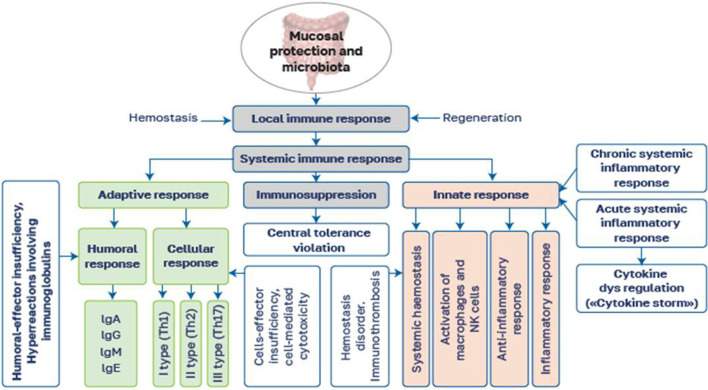
The review of the current state of knowledge on local and systemic immunopathological reactions of cellular and humoral origin, as well as the ways of their interaction, is considered in this article. This study aimed to organize, standardize, and conceptualize existing knowledge about immunopathological syndromes associated with innate immunity. It highlights syndromes linked to type I, II, and III hypersensitivity reactions, while also separately examining manifestations related to immunosuppression disorders. The review outlines how to differentiate humoral immunity syndromes based on the classes of immunoglobulins A, M, E, and the four subclasses of immunoglobulin G. Additionally, it provides a detailed analysis of complement system disorders and the mechanisms of systemic inflammatory response syndrome, as well as their role in various pathological processes. The authors advocate for a unified set of definitions for immunopathological syndromes related to adaptive immunity, aiming to develop a new concept of their pathogenesis. Currently, many definitions of these syndromes lack consensus, stemming from varying interpretations of their manifestations. The authors also propose standardized tools for assessing immunopathological syndromes, along with guidelines for staging and treatment optimization.
本文对细胞和体液来源的局部和全身免疫病理反应的当前知识状态以及它们的相互作用方式进行了综述。本研究旨在整理、规范和概念化与先天免疫相关的免疫病理综合征的现有知识。它重点介绍了与I型、II型和III型超敏反应相关的综合征,同时还单独研究了与免疫抑制障碍相关的表现。该综述概述了如何根据免疫球蛋白A、M、E类以及免疫球蛋白G的四个亚类来区分体液免疫综合征。此外,它还对补体系统障碍和全身炎症反应综合征的机制及其在各种病理过程中的作用进行了详细分析。作者主张为与适应性免疫相关的免疫病理综合征制定一套统一的定义,旨在形成其发病机制的新概念。目前,这些综合征的许多定义缺乏共识,这源于对其表现的不同解释。作者还提出了评估免疫病理综合征的标准化工具以及分期和治疗优化指南。