
多学科干预对慢性疲劳淋巴瘤幸存者疲劳的影响:一项随机对照试验(REFUEL)方案
Effects of a Multidisciplinary Intervention on Fatigue in Lymphoma Survivors With Chronic Fatigue: Protocol for a Randomized Controlled Trial (REFUEL).
作者信息
Bøhn Synne-Kristin Hoffart, Reinertsen Kristin V, Kiserud Cecilie E, Loge Jon Håvard, Fosså Alexander, Skaali Tone, Blomhoff Rune, Oldervoll Line Merethe, Courneya Kerry S, Raastad Truls, Nilsen Tormod S, Wisløff Torbjørn, Lie Hanne Cathrine, Berge Torkil, Edvardsen Elisabeth, Fagerli Unn-Merete, Fjerstad Elin, Gjerset Gunhild Maria, Haavik Ingvild, Henriksen Hege Berg, Rutkovskiy Arkady, Sandberg Gro, Seland Mette, Slott Malene, Tjessem Kristin Holm, Viktil Linn, Thorsen Lene
机构信息
Department of Oncology, Division of Cancer Medicine, Oslo University Hospital, Oslo, Norway.
Department of Behavioural Medicine, University of Oslo, Oslo, Norway.
出版信息
JMIR Res Protoc. 2025 Aug 29;14:e69336. doi: 10.2196/69336.
BACKGROUND
Chronic fatigue (CF) is a highly disabling late effect after cancer, affecting 25% to 40% of lymphoma survivors years after cancer treatment. There is a lack of randomized controlled trials testing interventions to reduce fatigue levels among survivors with CF.
OBJECTIVE
The primary aim of the Randomized Controlled Trial in Chronically Fatigued Lymphoma Survivors (REFUEL) is to examine the effects of a multidisciplinary intervention on the level of fatigue among lymphoma survivors with CF before and immediately after the intervention (3 months after randomization). Secondary aims are to (1) investigate the effects of the intervention on the level of fatigue 6 and 9 months after randomization and the effects on health-related quality of life (HRQoL); other patient-reported outcome measures; and physical fitness 3, 6, and 9 months after randomization; (2) evaluate the cost-utility of the intervention; (3) examine the effect of the intervention on HRQoL among the survivors' partners; and (4) investigate the long-term perceived benefits and daily use of acquired self-management strategies, as well as measure changes in fatigue, daily functioning, HRQoL, mental health, and work-life balance management within each group at 1- and 2-year follow-ups.
METHODS
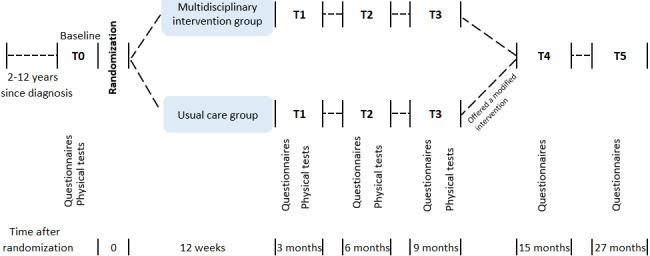
The REFUEL trial is a 2-armed randomized controlled trial. Lymphoma survivors (2-12 years after diagnosis) with CF are randomly allocated to a 12-week multidisciplinary intervention including patient education, physical exercise, a cognitive behavioral therapy-based group program, and individual nutrition counseling or to usual care. Fatigue is measured by the Chalder Fatigue Questionnaire. Other patient-reported outcome measures are measured by validated questionnaires (eg, the European Organization for Research and Treatment of Cancer Core Quality of Life Questionnaire, the Patient Health Questionnaire-9, and the Generalized Anxiety Disorder-7). Cardiorespiratory fitness is measured as peak oxygen consumption during a cardiopulmonary exercise test or indirectly using a modified Balke treadmill protocol. Muscle strength is assessed by push-ups and leg press. The primary analyses will be performed using a generalized linear mixed model for repeated measures, with an intention-to-treat approach.
RESULTS
A total of 150 survivors were included from December 2021 to March 2023. Three-month postrandomization assessments were completed in June 2023 and 2-year follow-up assessments were completed in June 2025.
CONCLUSIONS
The REFUEL trial will provide new and highly needed scientific evidence about the effects of a multidisciplinary intervention on the level of fatigue and secondary outcomes regarding HRQoL aspects among lymphoma survivors with CF.
TRIAL REGISTRATION
ClinicalTrials.gov NCT05130099; https://www.clinicaltrials.gov/study/NCT05130099.
INTERNATIONAL REGISTERED REPORT IDENTIFIER (IRRID): DERR1-10.2196/69336.
背景
慢性疲劳(CF)是癌症后一种严重致残的晚期效应,在癌症治疗数年之后,影响25%至40%的淋巴瘤幸存者。缺乏针对降低CF幸存者疲劳水平的干预措施的随机对照试验。
目的
慢性疲劳淋巴瘤幸存者随机对照试验(REFUEL)的主要目的是研究多学科干预对CF淋巴瘤幸存者干预前及干预后即刻(随机分组后3个月)疲劳水平的影响。次要目的是:(1)调查随机分组后6个月和9个月时干预对疲劳水平的影响以及对健康相关生活质量(HRQoL)的影响;其他患者报告的结局指标;以及随机分组后3个月、6个月和9个月时的体能;(2)评估干预措施的成本效益;(3)研究干预对幸存者伴侣HRQoL的影响;(4)调查获得的自我管理策略的长期感知益处和日常使用情况,以及在1年和2年随访时测量每组内疲劳、日常功能、HRQoL、心理健康和工作生活平衡管理方面的变化。
方法
REFUEL试验是一项双臂随机对照试验。患有CF的淋巴瘤幸存者(诊断后2至12年)被随机分配至为期12周的多学科干预组,包括患者教育、体育锻炼、基于认知行为疗法的团体项目和个体营养咨询,或常规护理组。疲劳程度通过查尔德疲劳问卷进行测量。其他患者报告的结局指标通过经过验证的问卷进行测量(例如,欧洲癌症研究与治疗组织核心生活质量问卷、患者健康问卷-9和广泛性焦虑障碍量表-7)。心肺适能通过心肺运动试验期间的峰值耗氧量进行测量,或使用改良的巴尔克跑步机方案进行间接测量。肌肉力量通过俯卧撑和腿部推举进行评估。主要分析将采用广义线性混合模型进行重复测量,并采用意向性分析方法。
结果
2021年12月至2023年3月共纳入150名幸存者。随机分组后3个月的评估于2023年6月完成,2年随访评估于2025年6月完成。
结论
REFUEL试验将提供关于多学科干预对CF淋巴瘤幸存者疲劳水平及HRQoL方面次要结局影响的新的且急需的科学证据。
试验注册
ClinicalTrials.gov NCT05130099;https://www.clinicaltrials.gov/study/NCT05130099。
国际注册报告识别码(IRRID):DERR1-10.2196/69336。
 Zotero 插件