
DNA甲基化抑制剂对光诱导的昼夜节律钟可塑性的影响。
Effects of DNA methylation inhibitors on light-induced circadian clock plasticity.
作者信息
Kim Suil, McMahon Douglas G
机构信息
Vanderbilt Brain Institute, Vanderbilt University, Nashville, TN, USA.
Department of Biological Sciences, Vanderbilt University, Nashville, TN, USA.
出版信息
Neurobiol Sleep Circadian Rhythms. 2025 Aug 13;19:100134. doi: 10.1016/j.nbscr.2025.100134. eCollection 2025 Nov.
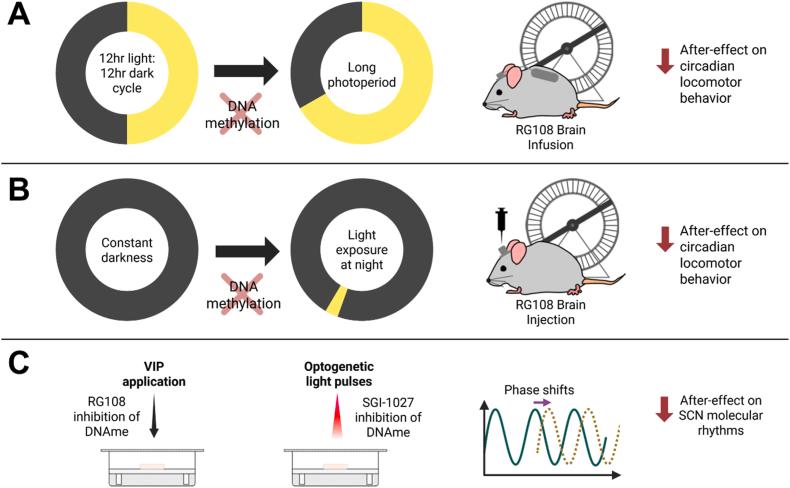
The suprachiasmatic nucleus (SCN) of the hypothalamus is a principal light-responsive circadian clock that adjusts circadian rhythms in mammalian physiology and behavior to changes in external light signals. Although mechanisms underlying how light acutely resets the timing of circadian rhythms have been characterized, it remains elusive how light signals induce lasting changes in circadian period, known as period after-effects. Here we have found that the period after-effects on circadian behavior of changing photoperiods are blocked by application of the DNA methyltransferase inhibitor RG108 near the SCN. At the level of single light pulses acting as clock-resetting stimulations, RG108 significantly attenuates period after-effects following acute phase shifts in behavioral rhythms , and blocks period after-effects on clock gene rhythms following phase resetting by the vasoactive intestinal peptide in the isolated SCN. In addition, the DNA methyltransferase inhibitor SGI-1027 blocked period after-effects of optogenetic neuronal stimulation on SCN rhythms. Acute clock resetting shifts themselves, however, do not appear to require DNA methylation at the SCN and behavioral levels, in contrast to subsequent period plasticity. Our results demonstrate that DNA methylation inhibitors block light-induced period after-effects in response to photoperiods and single light pulses. Together with previous studies showing that DNA methylation in the SCN is essential for period after-effects of non-24hr light cycles (T-cycles), this suggests that DNA methylation in the SCN may be a widespread mechanism of light-induced circadian period plasticity.
下丘脑的视交叉上核(SCN)是主要的光响应昼夜节律时钟,可根据外部光信号的变化调整哺乳动物生理和行为中的昼夜节律。尽管已经阐明了光如何急性重置昼夜节律时间的机制,但光信号如何诱导昼夜周期的持久变化(即周期后效应)仍不清楚。在这里,我们发现,在SCN附近应用DNA甲基转移酶抑制剂RG108可阻断光周期变化对昼夜行为的周期后效应。在作为时钟重置刺激的单个光脉冲水平上,RG108可显著减弱行为节律急性相位偏移后的周期后效应,并阻断孤离SCN中血管活性肠肽进行相位重置后对时钟基因节律的周期后效应。此外,DNA甲基转移酶抑制剂SGI-1027可阻断光遗传学神经元刺激对SCN节律的周期后效应。然而,与随后的周期可塑性相反,急性时钟重置自身的相位偏移在SCN和行为水平上似乎不需要DNA甲基化。我们的结果表明,DNA甲基化抑制剂可阻断光诱导的光周期和单个光脉冲响应中的周期后效应。与之前表明SCN中的DNA甲基化对于非24小时光周期(T周期)的周期后效应至关重要的研究一起,这表明SCN中的DNA甲基化可能是光诱导昼夜周期可塑性的广泛机制。


 Zotero 插件